

On this page
Phenol (also called carbolic acid) is a vital industrial chemical and a cornerstone of the Class 12 chemistry syllabus. Whether you are aiming for board exams, JEE Main, or NEET-UG, knowing how to prepare phenol from different starting materials is essential.
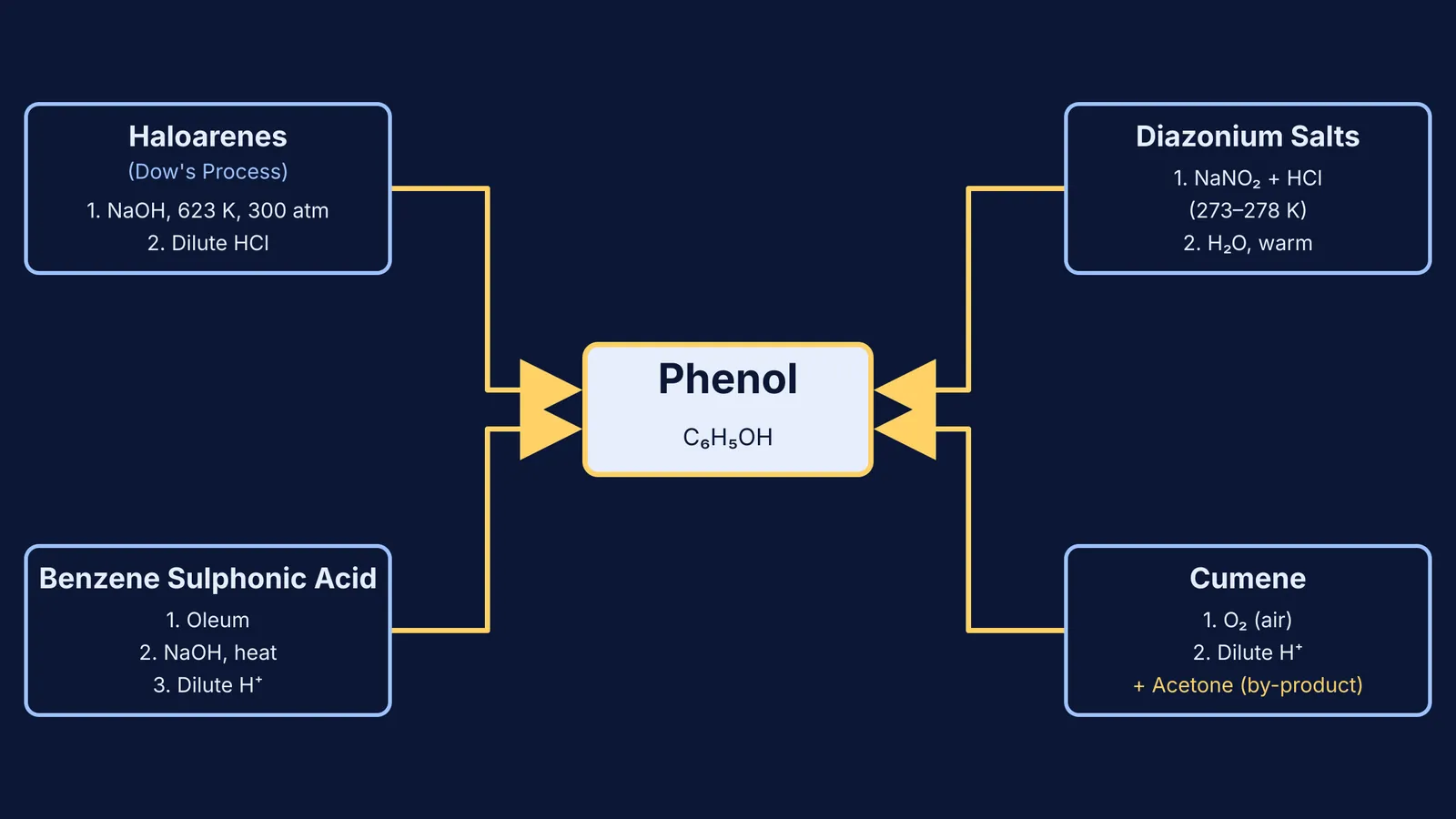
There are four standard methods of preparation of phenol. While laboratory syntheses often rely on chlorobenzene, benzene sulphonic acid, or diazonium salts, the chemical industry overwhelmingly uses the cumene process.
Here is a step-by-step breakdown of each method, the reagents you need, and why industry favours one over the rest.
How do you prepare phenol from chlorobenzene?
This method, often known as Dow's process, converts chlorobenzene into phenol using high temperatures and pressures.
Step 1: Chlorobenzene is fused with sodium hydroxide (NaOH) at 623 K and 300 atmospheric pressure to form sodium phenoxide (Wikipedia).
Step 2: The sodium phenoxide is acidified using dilute hydrochloric acid (HCl) to yield phenol.
Because the chlorine atom in chlorobenzene is tightly bound to the benzene ring (thanks to partial double-bond character from resonance), ordinary nucleophilic substitution will not work. That is why the extreme conditions of 623 K and 300 atm are necessary.
How is phenol prepared from benzene sulphonic acid?
This route begins with benzene and works well as a multi-step laboratory synthesis.
Step 1: Benzene is sulphonated by treating it with oleum (H₂S₂O₇) to produce benzene sulphonic acid.
Step 2: The benzene sulphonic acid is heated with molten sodium hydroxide (NaOH) to form sodium phenoxide.
Step 3: Acidification of the sodium salt with a dilute acid yields phenol.
How do you prepare phenol from diazonium salts?
Diazonium salts are highly reactive intermediates, making them excellent starting materials for various aromatic compounds, including phenol.
Step 1 (Diazotisation): Aniline (a primary aromatic amine) is treated with a cold mixture of sodium nitrite (NaNO₂) and hydrochloric acid (HCl) at 273–278 K (0–5 °C) to produce benzene diazonium chloride (Wikipedia).
Step 2 (Hydrolysis): The diazonium salt is simply warmed with water (or treated with dilute acid). It hydrolyses immediately to give phenol, releasing nitrogen gas and HCl as by-products.
Once you have prepared phenol, its reactions are equally important for exams. You can read our guide on the Reimer-Tiemann and Kolbe reactions of phenol to complete your revision.
Which method of preparation of phenol is used in industry?
The chemical industry uses the cumene process to manufacture phenol. In 2022, approximately 10.8 million tonnes of phenol were produced globally via the cumene process (Wikipedia), accounting for the vast majority of worldwide production.
The process starts with cumene (isopropylbenzene), which is prepared by alkylating benzene with propylene.
Step 1: Cumene is oxidised in the presence of air to form cumene hydroperoxide.
Step 2: The cumene hydroperoxide is treated with dilute acid. It undergoes a rearrangement and cleavage (the Hock rearrangement) to yield phenol and acetone.
The cumene process dominates because it converts relatively cheap feedstocks (benzene and propylene) into two highly valuable chemicals simultaneously. The process generates acetone as a co-product alongside phenol, making it highly economical.
A revision framework for phenol preparation
When revising organic chemistry for board exams or competitive tests like JEE Main and NEET-UG, avoid memorising reactions in isolation. Use this framework to master the preparation of phenol:
Identify the starting material: Is it chlorobenzene, benzene, aniline, or cumene?
Note the intermediate: Three of the four methods pass through a specific intermediate before the final step. Haloarenes and benzene sulphonic acid pass through sodium phenoxide, while cumene passes through cumene hydroperoxide.
Track the by-products: Knowing the by-products is often the key to exam questions. For example, the diazonium salt route releases nitrogen gas, while the cumene route produces acetone.
Connect to other chapters: Remember that aniline (used in the diazonium method) is prepared from the reduction of nitrobenzene, giving you a longer synthetic chain to practice.
How to learn organic reaction pathways
Organic chemistry can feel like an endless list of reactions to memorise, but focusing on the intermediates and functional groups makes it predictable. Just as understanding the carbocation intermediate helps you predict the major alkene in the dehydration of alcohols, knowing why chlorobenzene resists substitution explains the extreme conditions of Dow's process.
If you have concept gaps or are struggling to map out these reaction sequences, the Fermi Concept Library can help you trace the logic of aromatic substitutions step by step. When you understand the underlying mechanism, you no longer need to rely purely on memory.


