

On this page
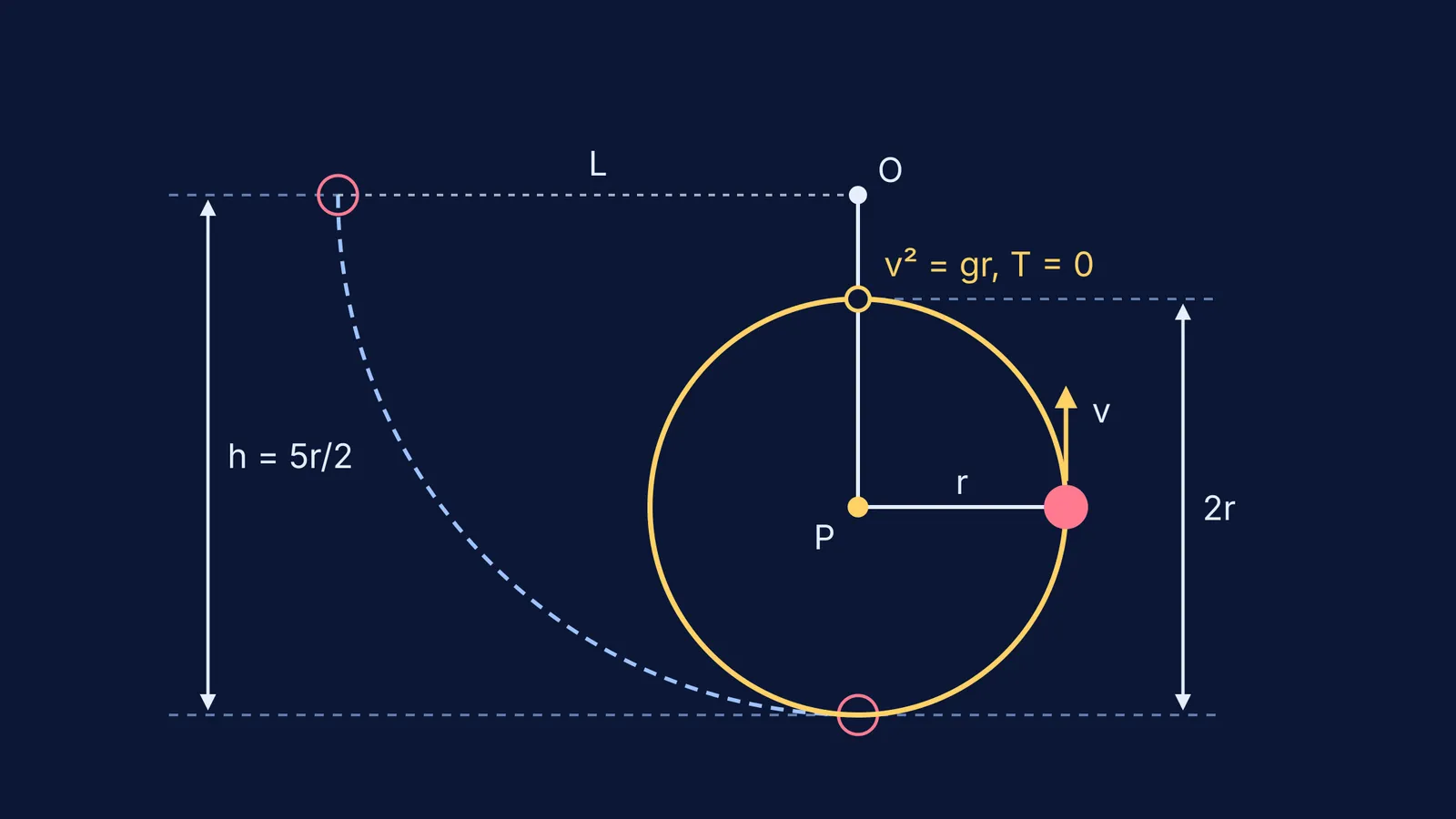
A pendulum string snags on a nail below the pivot, and the bob whips round a tighter circle. This set-up tests energy conservation, centripetal force and the condition for a taut string at once. A Caltech Ph1a practice problem is the classic version: a ball on a string of length L, released with the string horizontal, wraps around a nail a distance d below the pivot. Find the tension before and after contact, and the minimum d for a complete circle.
What changes when the string catches the nail?
The new radius is the length of string below the nail: r = L − d.
The speed does not change at contact: tension is perpendicular to the motion and does no work, and mechanical energy is conserved when non-conservative forces do no work (OpenStax University Physics, 8.3). If you measure the release height h from the lowest point, the speed at the bottom is given by v₀² = 2gh, both just before and just after the string catches.
The tension does change. The net force towards the centre must equal mv²/r (OpenStax University Physics, 6.3), so at the bottom the tension jumps from mg + mv₀²/L to mg + mv₀²/r. A smaller radius means a bigger tension, hence the "will the string break?" versions. For tension at any angle, see simple pendulum string tension at any angle.
What is the minimum release height to loop round the peg?
At the top of the small circle, tension and gravity both point down, towards the nail: T + mg = mv²/r. A string can pull but never push, so T ≥ 0 and v² ≥ gr at the top. HyperPhysics gives the same critical speed, √(gr), as the minimum speed at the top of a vertical circle when the string stays taut.
The top of the small circle is 2r above the lowest point, so energy conservation gives v² = 2g(h − 2r) there. Put the two together: 2g(h − 2r) ≥ gr, so h ≥ 5r/2.
For the Caltech set-up, the string starts horizontal, so h = L. Then L ≥ 5(L − d)/2, which gives d ≥ 3L/5.
Where does the string go slack if the bob does not make it?
Let α be the angle of the string above the horizontal line through the nail. Gravity has a component mg sin α towards the nail, so T + mg sin α = mv²/r, and energy gives v² = 2g(h − r − r sin α). Set T = 0 and solve: sin α = 2(h − r)/(3r). The slack point sits at a height (2h + r)/3 above the lowest point. After that the bob is a projectile and falls inside the circle.
That gives three outcomes:
h ≤ r: the bob swings back with the string taut.
r < h < 5r/2: the string goes slack at height (2h + r)/3.
h ≥ 5r/2: the bob goes all the way round the nail.
Check the formula at the edges: h = r gives a slack height of r, and h = 5r/2 gives 2r, the very top. Our circular motion guide to vertical circles uses the same top-of-the-loop condition.
Worked example: a 1 m pendulum and a nail
Take m = 0.1 kg, L = 1.0 m and g = 9.8 m/s².
Nail 0.7 m below the pivot, string released horizontal. Then r = 0.3 m, so you need h ≥ 0.75 m. You have h = 1.0 m, so it loops. At the top v² = 2 × 9.8 × (1.0 − 0.6) = 7.84 m²/s², so v = 2.8 m/s, above √(gr) ≈ 1.71 m/s. Tension at the top is 0.1 × (7.84/0.3 − 9.8) ≈ 1.63 N. At the bottom the tension jumps from 3mg ≈ 2.94 N to 0.98 + 0.1 × 19.6/0.3 ≈ 7.51 N the instant the string catches.
Same nail, released at 60° from vertical. Now h = 1.0 × (1 − cos 60°) = 0.5 m. Since 0.3 < 0.5 < 0.75, the string goes slack at (2 × 0.5 + 0.3)/3 ≈ 0.433 m above the bottom, where sin α ≈ 0.444 (α ≈ 26°) and the speed is √(gr sin α) ≈ 1.14 m/s.
Same nail, released at 30°. Now h ≈ 0.134 m, less than r, so the bob swings back with the string taut.
Splitting gravity into radial and tangential parts is covered in non-uniform circular motion.
How do you avoid the usual mistakes?
Measure h from the lowest point, not the pivot or the nail.
Use r = L − d, not d, as the new radius.
Do not set the top speed to zero. That works for a rigid rod, which can push, but not a string.
Speed carries over when the string catches; tension does not.
If you get stuck halfway through, the Fermi Problem Library has worked problems with a step-by-step solver that explains the reasoning rather than printing an answer. For ideas easier to see than read, try the interactive simulations in the Fermi Simulation Lab.


