On this page
Your arms and legs are both attached to your trunk by a set of bones called a girdle. The two girdles look like they do the same job, but they are built for opposite goals. Once you see that, most exam questions on them answer themselves.
What bones make up the pectoral girdle?
The pectoral girdle (shoulder girdle) is the set of bones that attaches each upper limb to the axial skeleton, and it consists of two bones: the scapula and the clavicle, according to OpenStax Anatomy and Physiology 2e, section 8.1.
Clavicle (collarbone): its medial end meets the sternum at the sternoclavicular joint. This is the only bony joint between the pectoral girdle and the axial skeleton.
Scapula (shoulder blade): a flat, triangular bone surrounded by muscles on both its front and back surfaces, so it does not form a joint with the ribs.
Acromioclavicular joint: the lateral end of the clavicle meets the acromion, the part of the scapula that forms the bony tip of the shoulder.
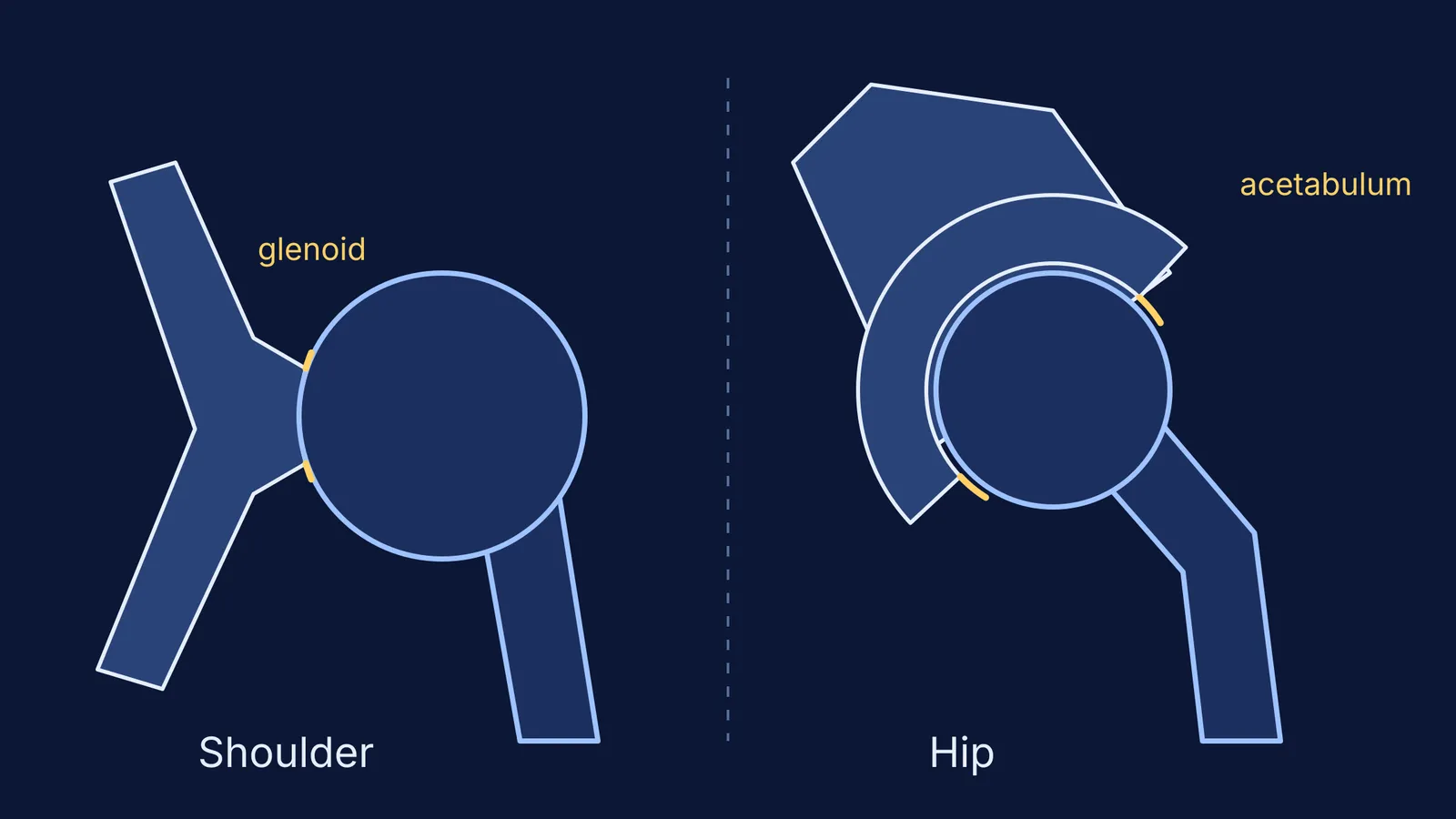
Glenoid cavity: the shallow socket on the scapula that takes the head of the humerus to form the shoulder joint.
The same OpenStax section notes that the clavicle is the most commonly fractured bone in the body.
What bones make up the pelvic girdle?
The pelvic girdle (hip girdle) is formed by a single bone on each side, the hip bone or coxal bone, according to OpenStax section 8.3.
Ilium, ischium and pubis: three separate bones that fuse into one hip bone during the late teenage years.
Acetabulum: the deep, cup-shaped socket where those three parts meet. It takes the head of the femur.
Sacroiliac joint: where the hip bone joins the sacrum firmly. The joint is largely immobile.
Pubic symphysis: where the two pubic bones meet at the front.
A common trap: the pelvic girdle and the pelvis are not the same thing. The bony pelvis is the two hip bones plus the sacrum and the coccyx, as the same OpenStax section explains. The sacrum and coccyx belong to the axial skeleton, so they are not part of the girdle.
How do the girdles join the limbs to the axial skeleton?
This is where the two girdles differ most. Each shoulder girdle is anchored to the axial skeleton by a single, highly mobile joint at the sternum, and the left and right girdles are not joined to each other (OpenStax section 8.1). The hip girdle is locked onto the sacrum at the back and onto the other hip bone at the front.
OpenStax puts it plainly: the pectoral girdle bones are highly mobile to widen the range of arm movement, while the pelvic bones are strongly united into a largely immobile, weight-bearing structure (section 8.3).
Why is the shoulder socket shallow and the hip socket deep?
The glenoid cavity is only about one third the size of the humeral head, and it is deepened slightly by a small lip of fibrocartilage called the glenoid labrum, according to OpenStax section 9.6. That gives the shoulder the largest range of motion of any joint in the body. The cost is stability: the rotator cuff muscles provide its main structural support.
The acetabulum is deep, with a large contact area for the head of the femur, and the acetabular labrum deepens it further. Its ligaments stabilise the joint and let you stand upright with only minimal muscle contraction. Because the hip is built for that stability and for bearing weight, its range of motion is more limited than the shoulder's, as the same section explains.
How can you revise the two girdles in ten minutes?
Use this side-by-side drill. Cover the right half of each line and say the answer aloud.
Bones per side: pectoral, clavicle and scapula; pelvic, one hip bone (ilium, ischium, pubis fused).
Link to the axial skeleton: pectoral, sternoclavicular joint only; pelvic, sacroiliac joint (the two hip bones also meet each other at the pubic symphysis).
Socket: pectoral, glenoid cavity, shallow; pelvic, acetabulum, deep.
Limb bone in the socket: humerus versus femur.
What it is built for: reach and mobility versus weight-bearing and stability.
Then try a worked question. "A student says the sacrum is part of the pelvic girdle. Are they right?" Walk it through: the girdle is the hip bones; the sacrum belongs to the axial skeleton; together they make the pelvis. So the answer is no, and the reason is the girdle-versus-pelvis difference.
Finally, trace each chain outwards on your own body: sternum, clavicle, scapula, humerus; then sacrum, hip bone, femur.
If a term in this chain is still fuzzy, the Fermi Concept Library has every concept in biology, each with its own lesson and its place in the map. If you are not sure where to start with the skeleton chapter, Fermi's AI tutor works out what you already know and builds a plan for the session.