

On this page
The pBR322 plasmid is one of the foundational tools of genetic engineering. Created in 1977 by Francisco Bolivar and Raymond Rodriguez, it was the first widely used *E. coli* cloning vector (Wikipedia).
pBR322 is exactly 4,361 base pairs long (SnapGene). Its map is a standard requirement for biology students, particularly those preparing for exams like NEET-UG. Knowing the map is not just about memorising genes; it is about understanding how to select bacteria that have successfully taken up a foreign piece of DNA.
What do ori and rop do?
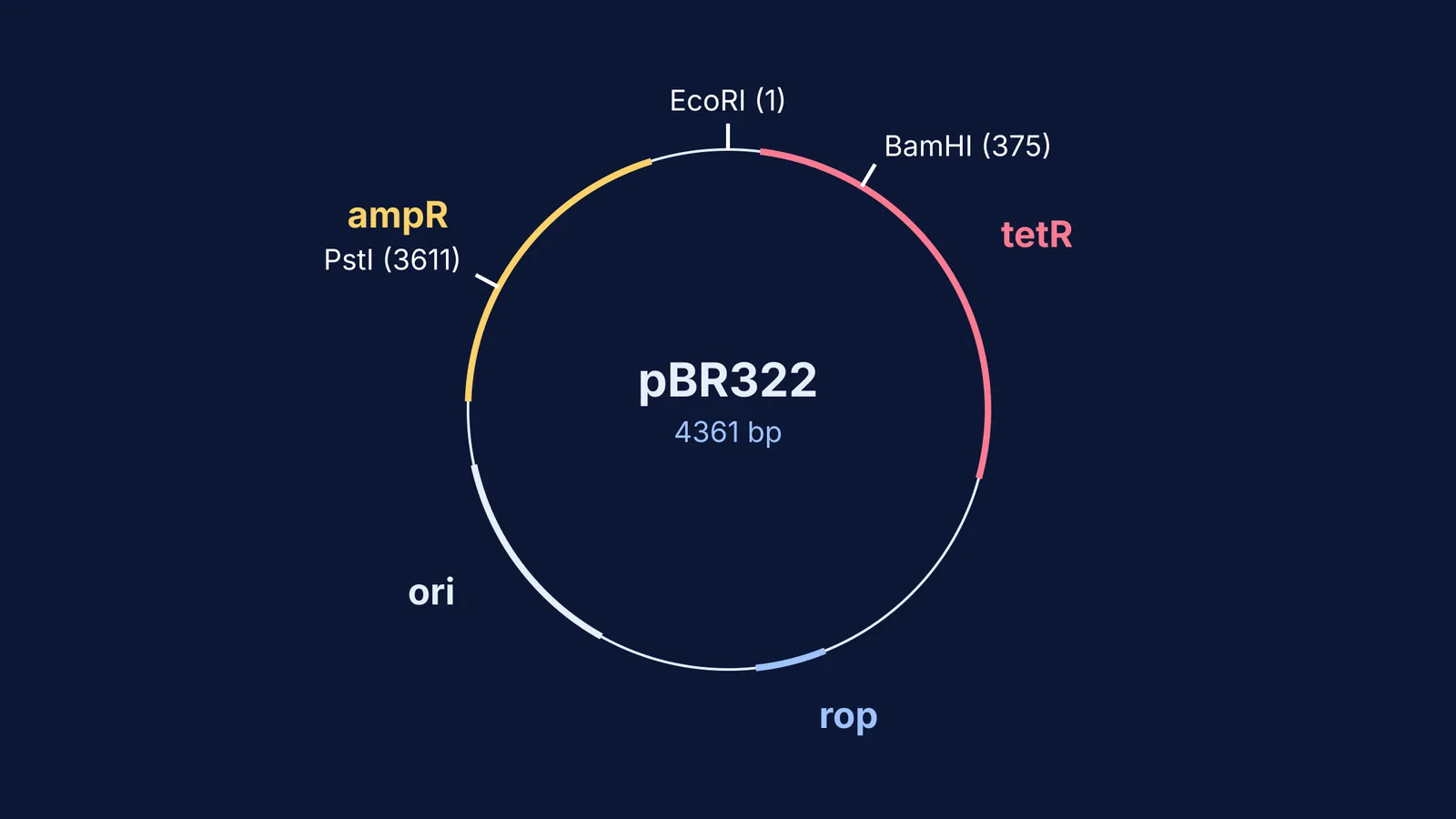
Every plasmid needs to copy itself independently of the main bacterial chromosome. The ori (origin of replication) is where this DNA copying begins. In pBR322, this sequence is derived from the pMB1 plasmid and spans base pairs 2534 to 3122 (SnapGene). Without a functioning ori, a plasmid will simply be lost when the bacterial cell divides.
Next to the origin is the rop gene, covering base pairs 1915 to 2106 (SnapGene). This gene codes for a repressor protein that restricts the plasmid's replication rate. By managing the replication machinery, rop keeps the plasmid to a steady ~20 copies per cell, ensuring it does not overwhelm the host bacterium.
Where are the ampicillin and tetracycline resistance genes?
The true utility of pBR322 lies in its two selectable markers, which allow researchers to spot which bacteria hold the plasmid. These are genes that encode proteins capable of breaking down or pumping out specific antibiotics.
ampR (the ampicillin resistance gene, also called *bla*) sits between base pairs 3293 and 4153 (SnapGene).
tetR (the tetracycline resistance gene) spans base pairs 86 to 1276 (SnapGene).
If an *E. coli* cell takes up this plasmid, it gains the ability to survive on agar plates containing either ampicillin or tetracycline. Cells without the plasmid will die when exposed to these drugs.
Why do the BamHI and PstI sites matter for insertional inactivation?
Restriction sites are the precise locations where restriction enzymes act as molecular scissors, cutting the plasmid open so you can paste in a new gene. While pBR322 has over forty unique restriction sites (Wikipedia), BamHI and PstI are particularly famous because of their strategic placement:
The BamHI site is located at base pair 375, directly inside the tetR gene (SnapGene).
The PstI site is located at base pair 3611, directly inside the ampR gene (SnapGene).
This placement allows for a technique called insertional inactivation. If you cut the plasmid with BamHI and insert a foreign gene there, you split the tetracycline resistance gene in two. The resulting recombinant plasmid still grants ampicillin resistance because ampR remains untouched, but it can no longer protect the cell against tetracycline. Conversely, using PstI destroys ampicillin resistance while leaving tetracycline resistance intact.
If a student struggles to picture how this cutting and pasting logic isolates the right cells, they can use Fermi's AI tutor to draw out the process and trace the surviving colonies step by step.
How to screen for recombinants: a worked example
Suppose you decide to use BamHI to clone a human gene into pBR322. At the end of your experiment, your test tube will contain a mixture of empty cells, cells with the original uncut plasmid, and cells with the new recombinant plasmid. How do you find the ones you actually want?
Transform the bacteria: Mix your ligation product with competent *E. coli* cells using methods like heat shock to force the DNA inside.
First selection (Ampicillin): Plate the bacteria on an agar dish containing ampicillin. Only cells that took up a plasmid (whether recombinant or original) will grow. The empty cells, which are the vast majority, will simply die.
Replica plating (Tetracycline): You now have a plate full of surviving colonies. Transfer an exact physical copy of these colonies onto a second plate containing tetracycline, relying on Esther Lederberg's replica plating technique.
Identify the recombinants: Compare the two plates. The colonies with the original pBR322 will grow on both plates because both of their resistance genes are intact. The colonies that grow on the ampicillin plate but fail to grow on the tetracycline plate are the ones holding your recombinant plasmid.
Because the recombinant cells die on the second plate, you must go back to the first ampicillin plate to actually collect them. The Fermi Concept Library contains further lessons on how these screening techniques underpin the mass production of modern medicines like recombinant human insulin. Once you map out the geography of pBR322, the logical flow of every subsequent screening experiment falls naturally into place.


