

On this page
A ratio question gives you the children and asks for the parents. Each common ratio has a fingerprint: the parts it adds up to tell you how many gamete combinations the cross made. Learn five fingerprints and many board and NEET genetics questions become a lookup and a quick check.
How do you find parent genotypes from an offspring ratio?
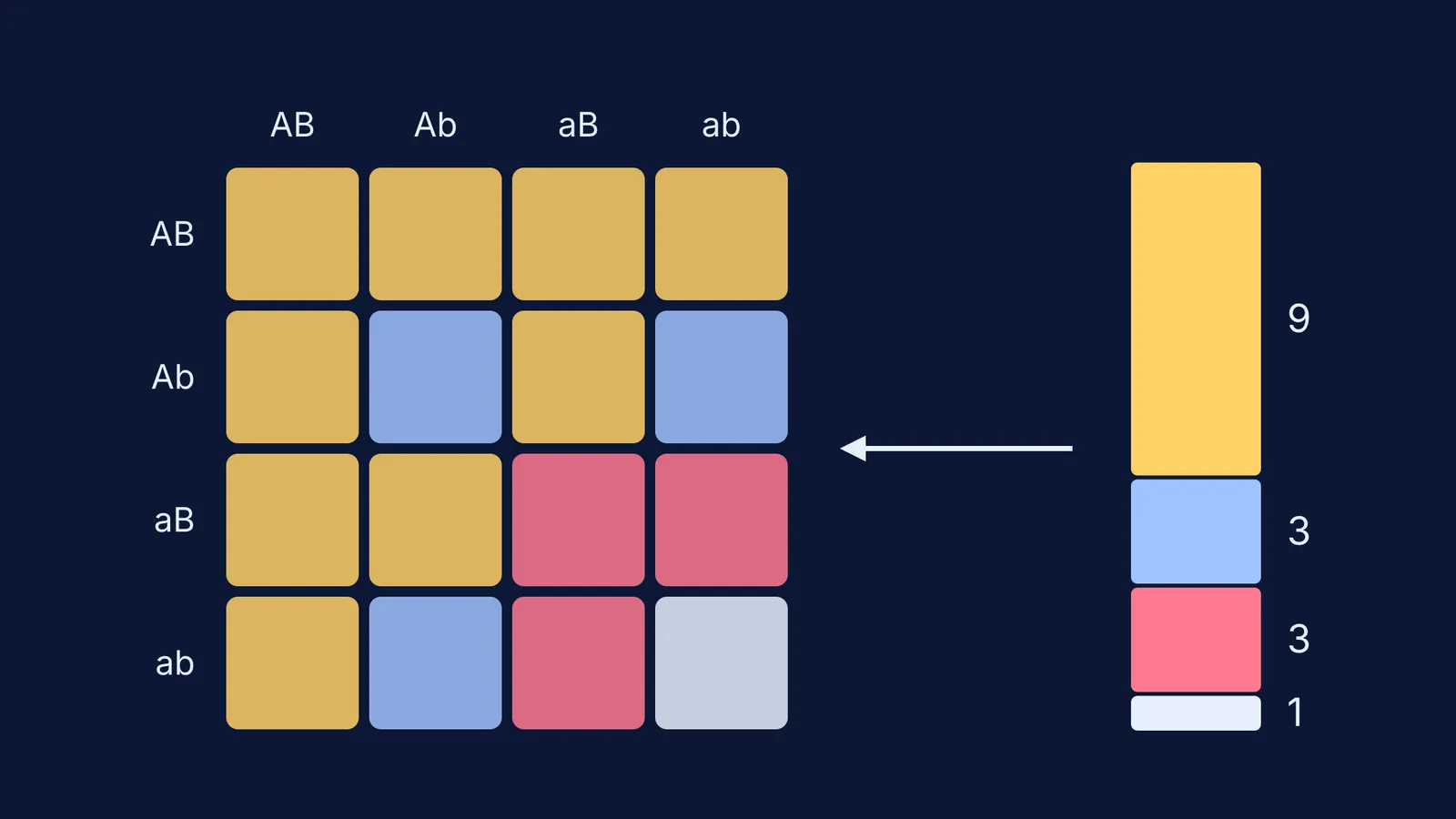
Add up the parts of the ratio. 3:1 is 4 parts, 1:1 is 2, 1:2:1 is 4, 1:1:1:1 is 4 and 9:3:3:1 is 16.
Treat the total as (gamete types from parent 1) × (gamete types from parent 2). A heterozygote makes 2 kinds of gamete, a homozygote 1 and a double heterozygote 4, so 16 parts means 4 × 4 and 4 parts means 2 × 2 or 4 × 1.
Split a two-trait ratio into one trait at a time and read each against the one-gene ratios below.
Check your candidate parents with a small Punnett square.
Step 2 works because Mendel's predictions assumed that "the several forms of the egg and pollen cells of the hybrids were produced on an average in equal numbers" (Mendel's 1865 paper, MendelWeb translation).
What parent cross gives each ratio?
3:1 comes from Aa × Aa with A fully dominant. A monohybrid cross of two heterozygotes gives "3 yellow:1 green" in peas (OpenStax Biology 2e, section 12.2).
1:2:1 as a phenotype ratio means incomplete dominance, again Aa × Aa. In snapdragons the phenotypic ratio is 1:2:1 for red:pink:white (same OpenStax section).
1:1 comes from Aa × aa, the test cross: a heterozygote crossed with a homozygous recessive gives 1:1, a homozygous dominant gives only dominant offspring (same OpenStax section).
All one type means at least one parent is AA under complete dominance, or, with incomplete dominance, both parents homozygous, such as red × white giving all pink.
9:3:3:1 comes from AaBb × AaBb, with the two genes sorting independently (OpenStax Biology 2e, section 12.3).
1:1:1:1 comes from AaBb × aabb, the dihybrid test cross, or from Aabb × aaBb.
For mixed ratios, multiply the one-gene ratios (the product rule, same OpenStax section): 3:1 times 1:1 gives 3:3:1:1, so 3:3:1:1 points to AaBb × Aabb or AaBb × aaBb.
How do you handle incomplete dominance crosses?
With incomplete dominance the heterozygote has its own colour, so you read the parents straight off the flowers. Take the snapdragons of OpenStax Biology 2e, section 12.2, writing R for red and W for white:
1 red : 2 pink : 1 white means pink × pink (RW × RW)
1 pink : 1 white means pink × white (RW × WW)
1 red : 1 pink means pink × red (RW × RR)
all pink means red × white (RR × WW)
With a second, fully dominant gene, multiply 1:2:1 by 3:1. Two pink plants heterozygous for tallness give 3 red tall : 1 red dwarf : 6 pink tall : 2 pink dwarf : 3 white tall : 1 white dwarf. Sixteen parts in six classes means one gene is incompletely dominant.
Codominance reads the same way: both alleles show in the heterozygote, as in the human MN blood group (same OpenStax section), so Aa × Aa again gives 1:2:1.
How do you read real counts that are not neat ratios?
Mendel's own dihybrid count, from 556 seeds, was 315 round yellow, 101 wrinkled yellow, 108 round green and 32 wrinkled green (Mendel 1865, MendelWeb). Read it backwards like this.
One sixteenth of 556 is 34.75, so 9:3:3:1 predicts about 313:104:104:35, close to his counts.
Split by shape: 315 + 108 = 423 round and 101 + 32 = 133 wrinkled, about 3.2:1. The parents were Rr × Rr for shape.
Split by colour: 315 + 101 = 416 yellow and 108 + 32 = 140 green, about 3.0:1. The parents were Yy × Yy for colour.
Together: RrYy × RrYy, Mendel's self-fertilised hybrids.
His dihybrid test cross, hybrid egg cells with double-recessive pollen, gave 31 round yellow, 26 round green, 27 wrinkled yellow and 26 wrinkled green seeds, and he wrote that the forms "came in nearly equal numbers" (same MendelWeb source). Across single traits his average was "2.98:1, or 3:1", so round to the nearest simple ratio.
If your setup looks right but the answer keeps coming out wrong, the Fermi Problem Library has worked problems with a step-by-step solver that explains the reasoning rather than printing an answer. If the gap is the idea itself, such as incomplete dominance versus codominance, the Fermi Concept Library gives each concept its own lesson.
For more crosses and traps, read Mendelian genetics for NEET: Punnett squares, ratios and traps. For the history, see Reginald Punnett, his square and the sweet peas that broke it and Gregor Mendel's pea experiments.


