

On this page
Two unlike cells joined positive to positive are a standard Class 12 Physics topic. Two easy traps are treating the pair like two resistors and simply averaging the emfs. Here's the formula, a worked example and a check that catches sign and arithmetic slips.
What is the equivalent emf of two cells in parallel?
The NCERT Class 12 Physics textbook derives this in Chapter 3, Current Electricity, Eqs. 3.48 to 3.59 (NCERT chapter PDF). Take cells with emfs E₁ and E₂ and internal resistances r₁ and r₂, joined positive to positive:
Equivalent emf: E_eq = (E₁/r₁ + E₂/r₂) / (1/r₁ + 1/r₂), which is the same as (E₁r₂ + E₂r₁)/(r₁ + r₂).
Equivalent internal resistance: 1/r_eq = 1/r₁ + 1/r₂, so r_eq = r₁r₂/(r₁ + r₂).
Read the first line as a weighted average. Each emf is weighted by 1/r, so the cell with the smaller internal resistance pulls E_eq towards its own value. Because both weights are positive, E_eq always lies between E₁ and E₂. Two identical cells give E_eq = E and r_eq = r/2.
The same chapter extends the result to n cells in parallel: E_eq/r_eq = E₁/r₁ + ... + Eₙ/rₙ, and 1/r_eq = 1/r₁ + ... + 1/rₙ.
Where does the formula come from?
The NCERT derivation uses two ideas. Both cells sit between the same two junctions, so they share one terminal voltage V, and each cell's current is I₁ = (E₁ − V)/r₁ or I₂ = (E₂ − V)/r₂. The junction rule gives the external current as I = I₁ + I₂. Add and rearrange to get V = E_eq − I r_eq, the equation of a single cell.
Worked example: 6 V and 3 V cells across a 4 Ω load
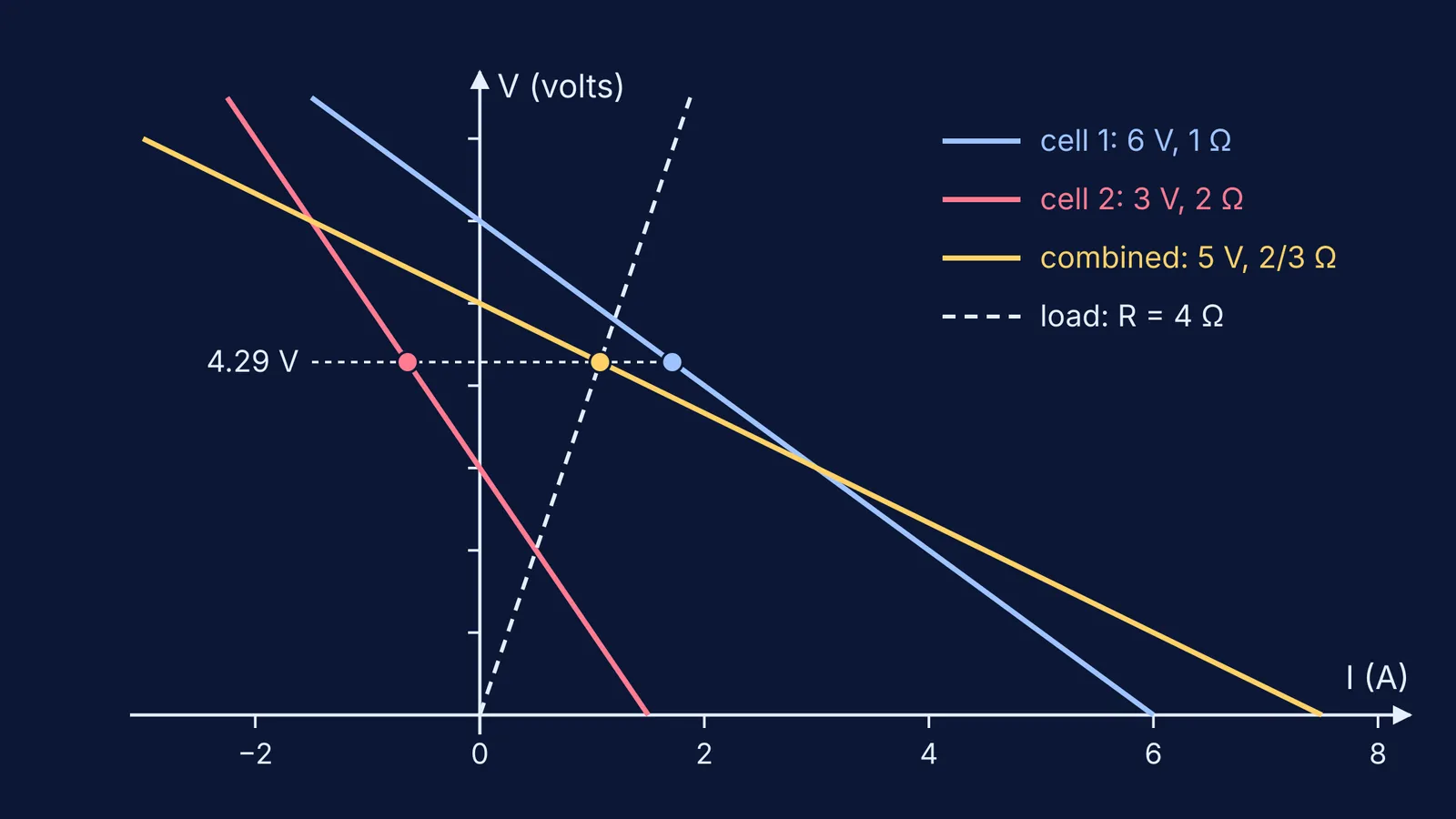
Cell 1 has E₁ = 6 V and r₁ = 1 Ω. Cell 2 has E₂ = 3 V and r₂ = 2 Ω. They are connected in parallel across a resistor R = 4 Ω.
Weights: 1/r₁ = 1 and 1/r₂ = 0.5, total 1.5 per ohm.
E_eq = (6/1 + 3/2)/1.5 = 7.5/1.5 = 5 V.
r_eq = (1 × 2)/(1 + 2) = 2/3 Ω.
Load current: I = E_eq/(R + r_eq) = 5/(4 + 2/3) = 15/14 A, about 1.07 A.
Terminal voltage: V = IR = 30/7 V, about 4.29 V.
Notice that 5 V is closer to 6 V than to 3 V. That is the weighting at work. Cell 1 has half the internal resistance, so it gets twice the say.
How do you find the current through each cell?
This step is easy to skip, but it shows which cell is being charged. Use I = (E − V)/r for each cell, with the V you just found:
I₁ = (6 − 30/7)/1 = 12/7 A, about 1.71 A, flowing out of cell 1's positive terminal.
I₂ = (3 − 30/7)/2 = −9/14 A, about −0.64 A.
The minus sign means current flows into cell 2's positive terminal. Cell 1 is driving the load and also charging cell 2. Check the sum: 12/7 − 9/14 = 15/14 A, which is the load current.
When does the weaker cell actually help? Only when V drops below its emf, here 3 V. Setting 5R/(R + 2/3) below 3 gives R < 1 Ω. Try R = 0.5 Ω: V = 15/7 V (about 2.14 V), I₁ = 27/7 A and I₂ = 3/7 A. Both are positive, so now both cells push current into the load.
Remove the load and (6 − 3)/(1 + 2) = 1 A still circulates from cell 1 through cell 2, so a strong and a weak cell in parallel waste energy even when nothing is switched on.
How should you solve these in an exam?
Check the orientation. If one cell is reversed, use −E for it.
Write the weights 1/r₁ and 1/r₂ first.
Find E_eq = (sum of E/r)/(sum of 1/r) and confirm it lies between the two emfs (with the sign used in step 1).
Find r_eq from the parallel-resistor rule.
Find I = E_eq/(R + r_eq), then V = IR.
For each cell, find I = (E − V)/r. The signs tell you which cell is charging.
Add the cell currents. The sum must equal I.
If internal resistance still feels shaky, start with our explainer on emf, internal resistance and terminal voltage. Then see common Kirchhoff's law mistakes and mixed grouping of cells for maximum current.
To practise, the Fermi Problem Library has worked problems with a step-by-step solver that explains the reasoning rather than printing an answer, so you can compare your current check with each step. If emf itself is the gap, the Fermi Concept Library gives each concept its own lesson.


