

On this page
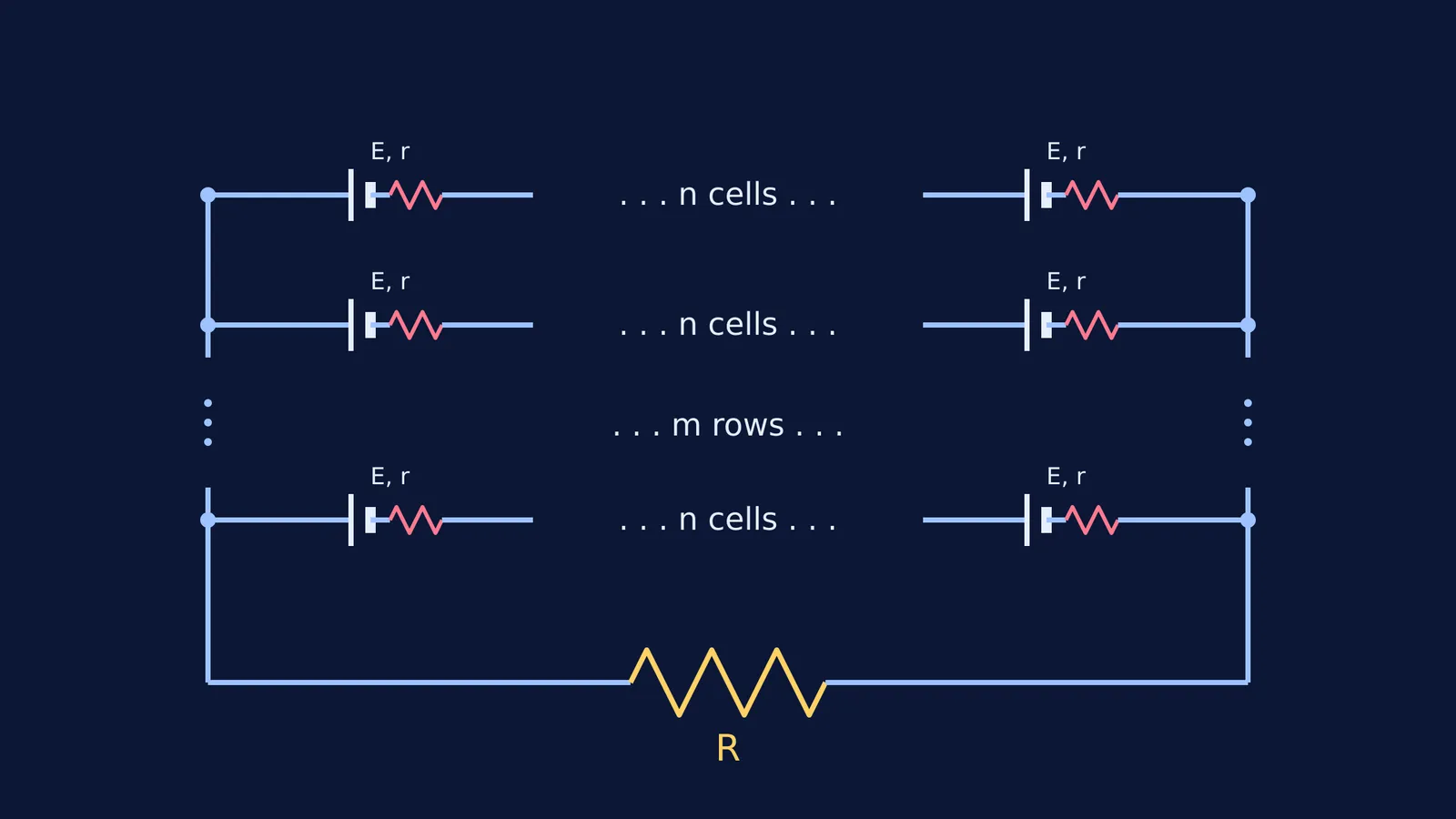
When you have a large number of cells, connecting them all in series or all in parallel might not push the highest possible current through your circuit. A mixed grouping combines both arrangements: you connect n identical cells in series to form one row, and then you connect m such identical rows in parallel.
Total number of cells: N = n × m
EMF of one cell: E
Internal resistance of one cell: r
How do you find equivalent EMF and internal resistance?
To find the current, we first need the total EMF and internal resistance for the whole combination. The rules for this build on the series and parallel cell combinations covered in Chapter 3 of the Class 12 Physics NCERT textbook.
In one row: The n cells are in series. Their equivalent EMF is nE, and their equivalent internal resistance is nr.
Across m rows: Because all m rows are identical and connected in parallel, the total EMF of the battery remains nE. However, the internal resistance drops because parallel resistances divide. The total internal resistance of the battery becomes nr/m.
If you connect this battery to an external load resistor R, the total resistance of the circuit is R + nr/m. Ohm's law gives the total current I flowing through the external resistor:
I = nE / (R + nr/m)
Multiplying the top and bottom of that fraction by m makes it easier to work with:
I = mnE / (mR + nr)
If you want to review the basic rules for series and parallel batteries, see our guide on combining cells, EMF and internal resistance. To understand how current delivers power to a load, explore the heating effect of current.
What is the condition for maximum current?
If you have a fixed total number of cells N (where N = mn) and a specific external resistor R, how should you arrange the rows and columns to get the most current?
Looking at the formula I = mnE / (mR + nr), the numerator mnE is fixed because the total number of cells is fixed. The current I is maximum when the denominator mR + nr is at its absolute minimum.
We can rewrite the denominator using a standard algebra trick (completing the square):
mR + nr = (√(mR) − √(nr))² + 2√(mR × nr)
The term 2√(mR × nr) is fixed. The squared term (√(mR) − √(nr))² must always be zero or positive. To make the whole denominator as small as possible, we must make this squared term equal to zero:
√(mR) − √(nr) = 0
Which simplifies to:
mR = nr
Dividing by m gives the final condition:
R = nr/m
This proves the golden rule of mixed grouping: current is maximum when the external resistance (R) exactly equals the total internal resistance of the cell combination (nr/m).
How do you solve mixed grouping problems?
When you face a mixed grouping numerical in a JEE or NEET exam, you are usually given the total number of cells (N), the internal resistance of each cell (r), and the external resistance (R). Your goal is to find the number of cells in series (n) and the number of rows (m).
Write the cell count equation: n × m = N
Write the maximum current condition: mR = nr
Substitute one variable into the other to solve the system.
For example, suppose a problem gives a total of twenty-four cells, an internal resistance of one ohm each, and an external load of one and a half ohms.
Equation 1: n × m = 24
Equation 2: m × 1.5 = n × 1, which means n = 1.5m
Substitute n into Equation 1: (1.5m) × m = 24
1.5m² = 24
m² = 16, so m = 4.
If m = 4, then n = 1.5 × 4 = 6.
You need 4 parallel rows, each containing 6 cells in series.
If you get stuck on the algebra, the AI tutor in the Fermi Problem Library will explain the reasoning step by step rather than just printing the final answer. You can also explore the core ideas of Ohm's law and DC circuits in the Fermi Concept Library.


