

On this page
Where does Earth's oxygen come from?
If you take a deep breath, the air filling your lungs is exactly 20.95% oxygen by volume. That percentage stays steady because the Earth constantly replaces what living things consume.
When you picture the source of this oxygen, you might imagine a dense forest. Forests are vital, but roughly half of the oxygen production on Earth comes from the ocean. Microscopic organisms called phytoplankton float near the ocean's surface, using sunlight to power photosynthesis. These tiny algae and bacteria are incredibly efficient at capturing solar energy, and their vast numbers across the global ocean mean they produce more oxygen than all the tropical rainforests combined.
How does the oxygen cycle work?
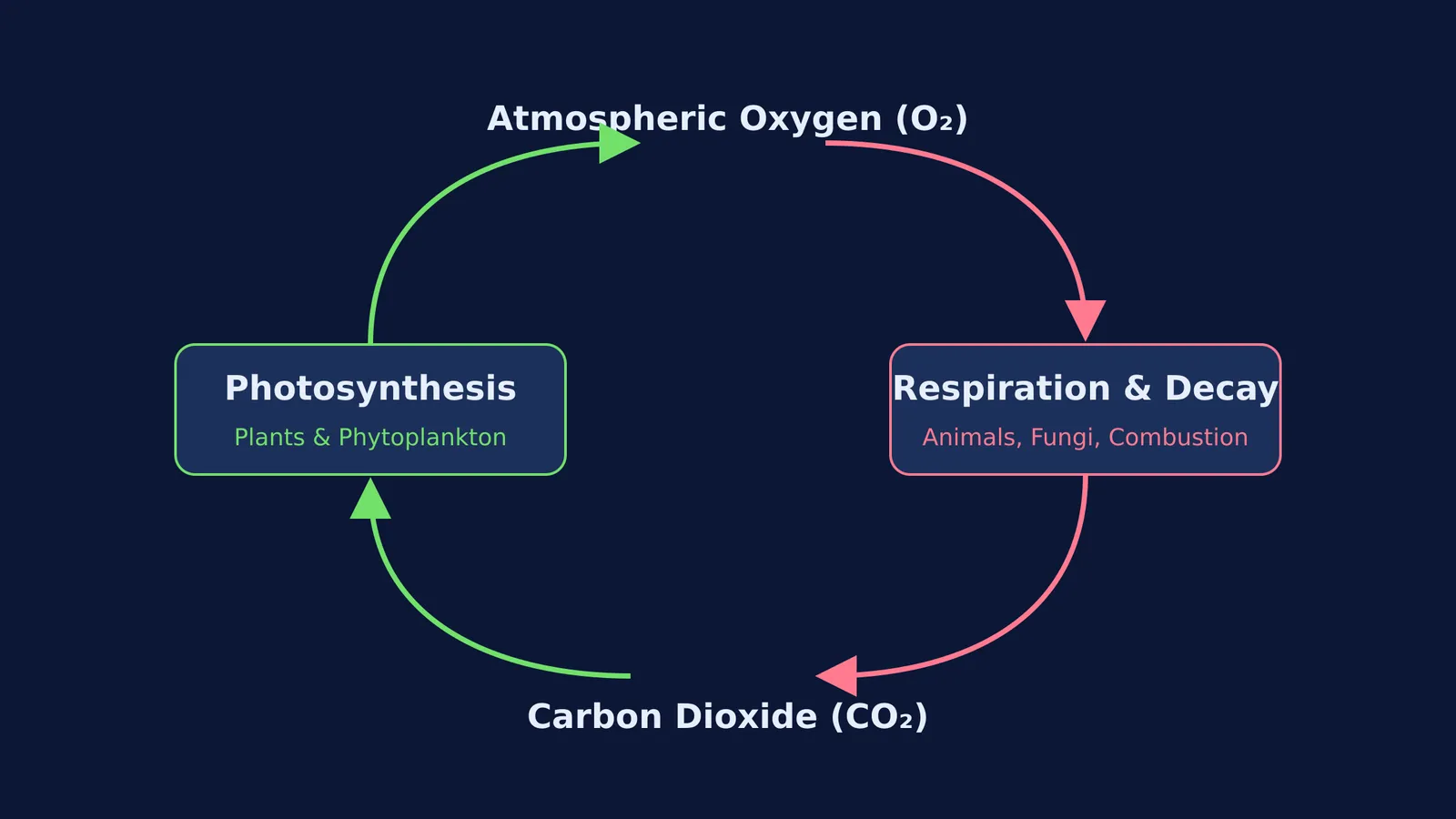
The oxygen cycle is the continuous movement of oxygen between the atmosphere (air), the biosphere (living things) and the lithosphere (Earth's crust). It works through two main halves:
Production: Plants, algae and phytoplankton take in carbon dioxide (CO₂) and water (H₂O). Using the energy from sunlight, they build glucose for their own food and release oxygen (O₂) as a waste product. The idea that plants need sunlight to "purify" the air was first proven centuries ago, as you can read in the story of Jan Ingenhousz and the light that lets plants purify air.
Consumption: When animals and humans breathe, they take in that oxygen to break down food and release energy—a process called cellular respiration. This allows organisms to move, grow and survive.
Respiration is not the only way oxygen gets used up. When a dead tree rots on the forest floor, the fungi and bacteria breaking it down consume oxygen as they digest the organic material. When a forest burns or a car engine runs on petrol, combustion also strips oxygen from the air. In all these cases—respiration, decay and burning—the oxygen reacts with carbon to form CO₂, sending it back into the air.
How are the oxygen and carbon cycles linked?
You cannot separate the oxygen cycle from the carbon cycle. They are two halves of the same biological engine, constantly turning matter from one form into another.
In photosynthesis, carbon is pulled out of the air (as CO₂) and locked into the plant's tissues, while oxygen is freed. In respiration and burning, carbon is released from tissues or fuels, binds with oxygen, and returns to the air. (To see exactly how fats and proteins enter this process, read about Respiration as an amphibolic pathway). When humans burn fossil fuels, we are rapidly reversing millions of years of photosynthesis, consuming oxygen and releasing carbon dioxide back into the modern atmosphere.
If you are studying ecology and struggling to see how these massive systems connect, mapping them out can help. The Fermi Concept Library shows exactly how respiration and photosynthesis link to other topics like the carbon cycle and energy flow. If you encounter a complex exam question on biological magnification or energy pyramids, you can trace the idea back to these fundamental cycles.
The long-term storage of oxygen
While plants and animals trade oxygen back and forth, the Earth's crust stores a vast amount of it. Elements like iron in rocks react with oxygen in the air to form oxides (rust), trapping the oxygen in stone. When phytoplankton die, they sink to the ocean floor, locking carbon away and leaving their generated oxygen behind in the atmosphere over millions of years.
How to learn the oxygen cycle in nature?
Understanding a cycle means being able to predict what happens when one part breaks. If you are preparing for a biology exam, test yourself with questions about limits. What happens to oxygen levels if a lake loses sunlight and the algae die? How does cutting down forests change the balance of respiration and photosynthesis?
Working through application problems is the best way to make the ideas stick. If you get stuck on an ecology question, the Fermi Problem Library will walk you through it step-by-step, explaining the reasoning rather than just printing an answer.
For a simple revision exercise, grab a blank piece of paper and try to draw the oxygen cycle from memory. Start with O₂ at the top, CO₂ at the bottom, and fill in the arrows for photosynthesis, respiration and combustion. If your arrows form a closed loop, you have mastered the basics.


