

On this page
Most flowering plants offer nectar or pollen to insects in exchange for pollination. The Mediterranean *Ophrys* orchid offers nothing. Instead, it relies on sexual deceit, manipulating male insects into acting as couriers for its pollen.
This interaction is a classic example of co-evolution. Understanding how the orchid achieves this deception reveals how intense selective pressures shape species interactions.
How does the orchid mimic a female bee?
In 1916, French botanist Maurice-Alexandre Pouyanne first described the unique pollination mechanism of the *Ophrys* genus. He noticed that male scoliid wasps (*Dasyscolia ciliata*) were drawn to the mirror orchid (*Ophrys speculum*) not for food, but because they mistook the flower for a female wasp.
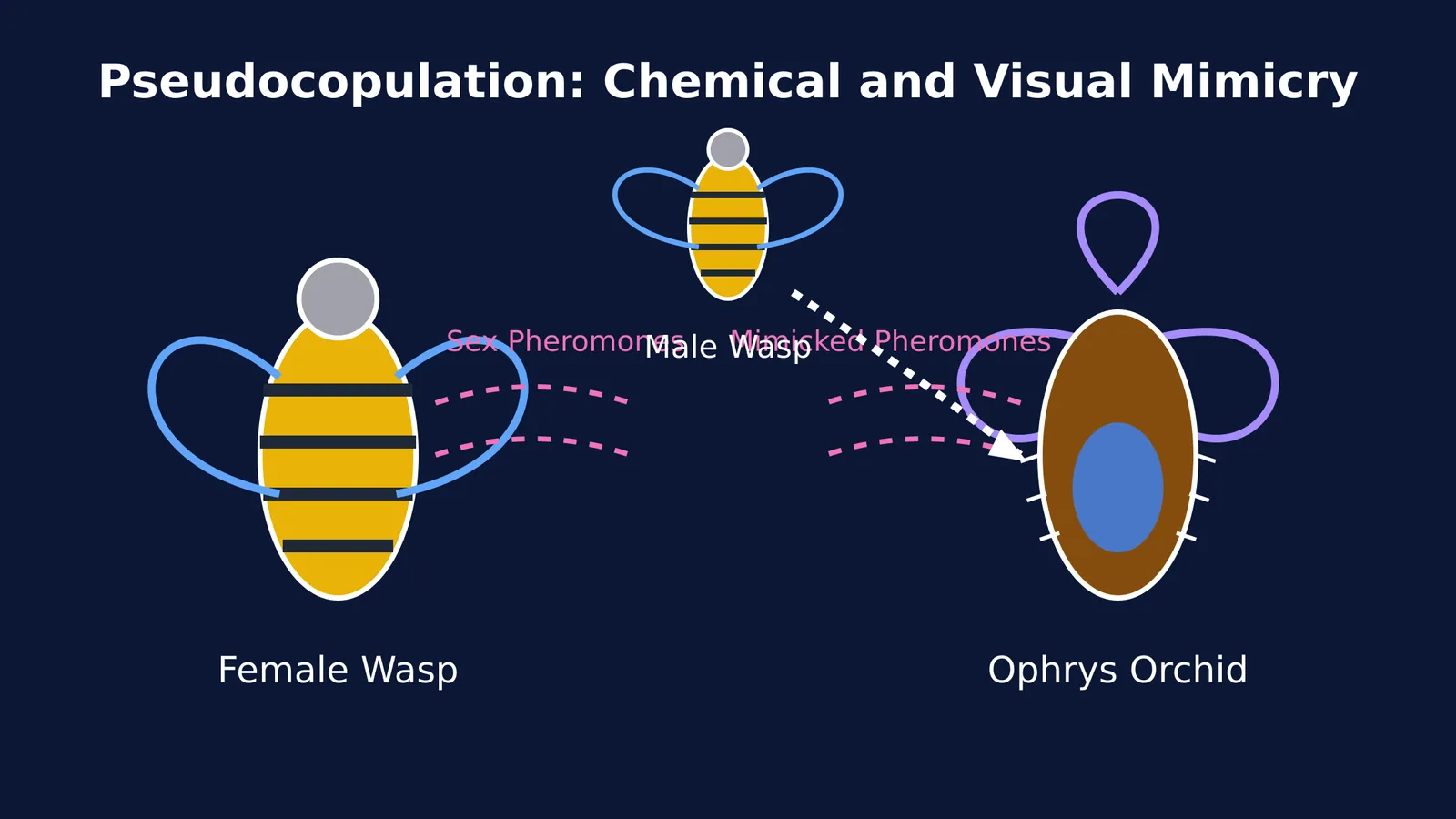
The orchid's deception operates on three sensory levels:
Chemical mimicry: The orchid's labellum (a highly modified petal) emits a blend of volatile chemicals that perfectly mimics the sex pheromones of the female insect. This acts as a long-distance lure.
Visual mimicry: As the male approaches, the shape, colour and metallic patches on the labellum resemble the wings and body of a female resting on a stem.
Tactile mimicry: Once the male lands, the fine hairs covering the labellum provide the physical texture of a female's abdomen, prompting the insect to begin mating behaviour.
What is pseudocopulation?
Deceived by the scent and feel of the flower, the male insect attempts to mate with the labellum. During this act, known as pseudocopulation, the insect's vigorous movements bring its head or abdomen into contact with the orchid's pollen sacs, or pollinia.
The sticky pollinia detach and adhere firmly to the insect. Frustrated by the failure to mate, the male eventually flies away. If the insect is tricked again by another *Ophrys* flower, it will carry the attached pollinia to the new flower's stigma, completing the pollination cycle.
This is a heavily one-sided relationship. The orchid secures its reproduction, while the bee expends time and energy without receiving any nutritional reward, illustrating a sharp contrast to how flowers recruit insects in typical mutualistic pairings.
How does co-evolution drive this arms race?
The relationship between the *Ophrys* orchid and its pollinator is an example of antagonistic co-evolution. The two species evolve in lockstep, locked in an arms race of trait matching.
If natural selection causes the female bee's pheromones or appearance to change, the male bee will adjust its preferences to find a real mate. If the orchid fails to update its own mimicry to match the new female traits, it will lose its pollinators and fail to reproduce. Consequently, any shift in the insect population forces a corresponding shift in the orchid.
If you are finding it difficult to keep track of species interactions, the Fermi Concept Library contains a complete lesson on co-evolution and its place in the map. When you bring a topic like population ecology, Fermi works out what you already know, builds a plan for the session, and teaches through it—drawing the figure and checking your understanding as it goes.
How do you classify species interactions?
Sexual deceit is often classified alongside other population interactions. Use this three-step checklist to understand a relationship:
Identify the reward: Does the pollinator receive nectar, pollen or a safe place to lay eggs? If yes, it is mutualism (e.g. figs and wasps). If no, suspect deceit.
Check the cost: Does the interaction cost one species energy or reproductive success while benefiting the other? Pseudocopulation is a form of parasitism or deceit, as the bee is cheated of a reward.
Look for coupled changes: If a change in species A forces a change in species B to maintain the relationship, the concept being tested is co-evolution.
Understanding the exact mechanism of pollination—from the structure of a pollen grain to the behaviour of the insect carrying it—is essential for mastering ecology.


