

On this page
Traditional acid-base indicators like litmus paper, phenolphthalein, and methyl orange rely completely on colour changes to identify a substance. But what if a student cannot see the colour transition?
In the Class 10 science curriculum, you are introduced to an alternative way to classify chemicals that does not require eyesight: using your sense of smell. This technique not only makes learning more accessible but also demonstrates how chemical properties can be perceived through multiple senses.
What are olfactory indicators?
An olfactory indicator is a substance whose characteristic odor changes depending on whether it is placed in an acidic or a basic medium. The word "olfactory" relates to the sense of smell. In school laboratories, the three most common examples you will test are onion, vanilla essence, and clove oil.
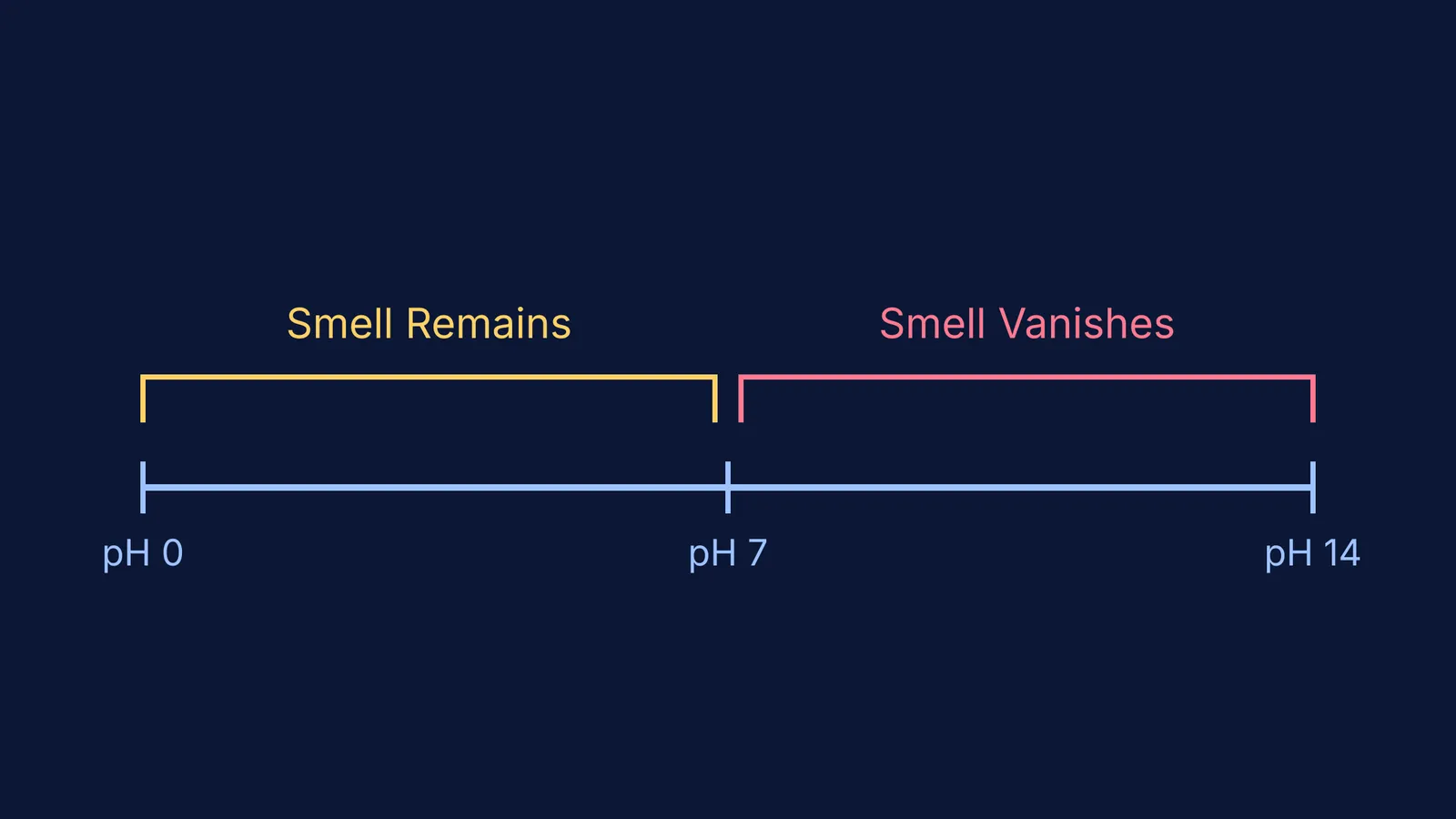
For all three of these indicators, the underlying chemical rule is identical:
In an acidic medium: The characteristic smell remains strongly detectable.
In a basic medium: The smell is completely destroyed and vanishes.
This binary outcome—either you smell it or you do not—makes it a reliable test for distinguishing between strong acids and strong bases.
Why are they useful for visually impaired learners?
Because traditional indicators require a visual observation, they pose a barrier for students with visual impairments or color blindness. Olfactory indicators solve this accessibility issue by shifting the observation from sight to smell, allowing these students to independently confirm the nature of a solution.
The effectiveness of this technique has been formally verified in educational literature. A 1990 study published in the *Journal of Chemical Education* by chemists Mark N. Flair and William N. Setzer evaluated this method directly (DOI: 10.1021/ed067p795). The researchers found that when using clove oil (specifically its active compound, eugenol) as an indicator during an acid-base titration, its pungent fragrance "bursts out" at the exact point of neutralization.
They concluded that olfactory titrations were just as reproducible and accurate as those using standard visual indicators like phenolphthalein. This simple substitution makes the chemistry laboratory truly inclusive, allowing all students to perform quantitative analysis. You can read more about how standard chemical tests are conducted in our guide to Acids, bases and salts in Class 10: indicators, pH and common salts.
How do you test onion and vanilla in the lab?
NCERT Activity 2.2 provides a straightforward way to test olfactory indicators using standard household materials.
First, you treat a clean cloth strip with finely chopped onions, usually by placing them together in a plastic bag in the fridge overnight. Over time, the cloth absorbs the strong onion odor.
The acid test: When you place a few drops of a dilute acid, such as hydrochloric acid (HCl), onto the treated strip, the sharp onion smell persists.
The base test: When you place a few drops of a dilute base, such as sodium hydroxide (NaOH), onto the strip and wash it, the onion smell completely disappears.
The exact same principle applies if you use vanilla essence or clove oil. A few drops of vanilla will keep its sweet, pleasant aroma in an acidic medium, but will lose it entirely if mixed with a strong base. If you want to review how different substances react before stepping into the physical laboratory, the Fermi Concept Library has a lesson for every chemistry concept to help you map out acid-base behavior.
A simple framework for exam questions
Questions about olfactory indicators frequently appear in board exams. To ensure you never lose marks on these questions, use this simple three-step checklist when reviewing a problem:
Identify the indicator: Is the question specifically asking about onion, vanilla, or clove oil?
Identify the medium: Is the test solution an acid (like HCl or H₂SO₄) or a base (like NaOH or KOH)?
Apply the rule: If the solution is an acid, write "smell remains." If the solution is a base, write "smell vanishes."
By relying on odor instead of sight, these indicators prove that chemistry is an experience that goes far beyond what we can see on a test tube rack. For a broader look at how different substances are classified from an early age, check out our guide: Acidic, basic or neutral: a Class 7 guide to indicators.


