

On this page
You cannot find yₙ, the nth derivative, by differentiating n times, because n is a letter. You find a pattern and show it holds for every n. In Class 12 and JEE maths most questions come down to four building blocks: eᵃˣ, sin(ax + b), 1/(ax + b) and log(ax + b).
How do you find the nth derivative of a function?
Use the same five steps every time:
Rewrite first: partial fractions for rational functions, log rules for products, product-to-sum for sin·cos.
Differentiate three times without tidying. Leave 3·2·1 as it is, so a factorial can show itself.
Track each part: the power of a, the sign, any factorial, the power of (ax + b), any phase angle.
Guess yₙ and check it at n = 1 and n = 2.
Prove the guess by induction if the question says prove.
What are the standard nth derivative formulas?
These four results are listed on MathCity's sheet of standard nth derivatives, and each has a reason you can see.
dⁿ/dxⁿ eᵃˣ = aⁿeᵃˣ. Each differentiation pulls out one more factor of a and leaves eᵃˣ unchanged.
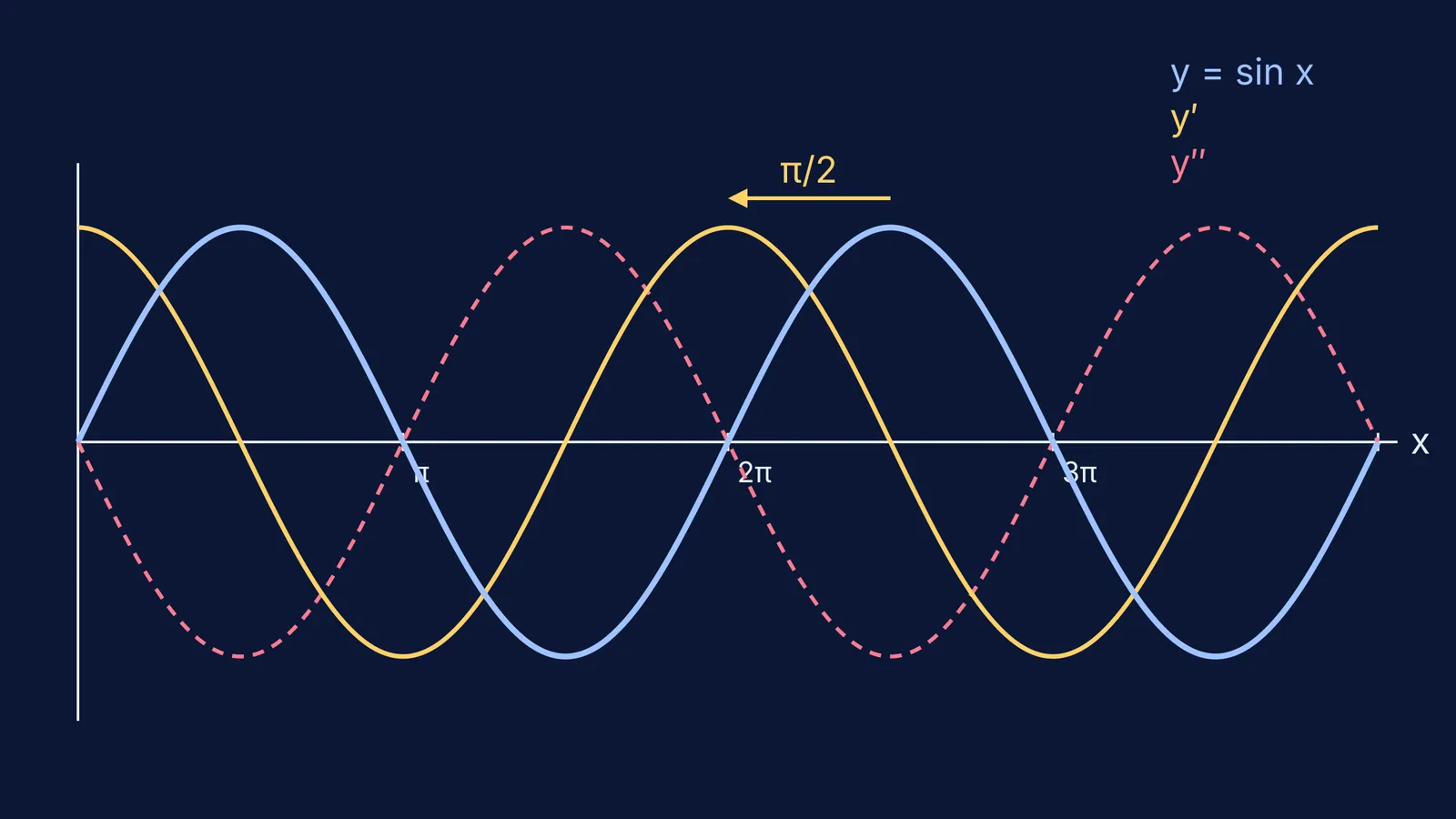
dⁿ/dxⁿ sin(ax + b) = aⁿ sin(ax + b + nπ/2), and the same with cos in place of sin. Each differentiation pulls out a and turns sin into cos, and cos θ = sin(θ + π/2), so the angle moves forward by π/2 every time.
dⁿ/dxⁿ 1/(ax + b) = (−1)ⁿ n! aⁿ/(ax + b)ⁿ⁺¹. The power rule brings down −1, then −2, then −3, and their product is (−1)ⁿ n!.
dⁿ/dxⁿ log(ax + b) = (−1)ⁿ⁻¹ (n − 1)! aⁿ/(ax + b)ⁿ, so for log x the answer is (−1)ⁿ⁻¹ (n − 1)!/xⁿ. One differentiation turns the log into a/(ax + b), and the remaining n − 1 derivatives follow the previous pattern.
Why use partial fractions before differentiating?
A partial fraction decomposition expresses a rational fraction as a sum of a polynomial (possibly zero) and fractions with simpler denominators, as defined in Wikipedia's article on partial fraction decomposition. The quotient rule gets longer with every step; each simple fraction already has a known pattern.
Worked example: find yₙ for y = 1/(x² − 3x + 2).
Factorise: x² − 3x + 2 = (x − 1)(x − 2).
Split: y = 1/(x − 2) − 1/(x − 1). Check by recombining: (x − 1) − (x − 2) = 1 on top.
Apply the 1/(ax + b) pattern with a = 1 to each part: yₙ = (−1)ⁿ n! [1/(x − 2)ⁿ⁺¹ − 1/(x − 1)ⁿ⁺¹].
Test n = 1 at x = 0. Directly, y′ = −(2x − 3)/(x² − 3x + 2)² = 3/4. The formula gives −(1/4 − 1) = 3/4. They agree.
The same split is used in integrals with substitution and partial fractions.
How do you prove an nth derivative pattern by induction?
A proof by induction has two parts: a base case showing the statement holds for the first value, and an induction step showing that if it holds for n, it holds for n + 1, as set out in Wikipedia's article on mathematical induction. Here is the full proof for y = 1/(ax + b).
Let P(n) be the statement yₙ = (−1)ⁿ n! aⁿ (ax + b)⁻⁽ⁿ⁺¹⁾.
Base case. y₁ = −a(ax + b)⁻², which is (−1)¹ · 1! · a¹ · (ax + b)⁻². So P(1) is true.
Induction step. Assume P(k). Differentiate once more using the chain rule: the derivative of (ax + b)⁻⁽ᵏ⁺¹⁾ is −(k + 1) a (ax + b)⁻⁽ᵏ⁺²⁾. So yₖ₊₁ = (−1)ᵏ k! aᵏ · (−(k + 1)) a (ax + b)⁻⁽ᵏ⁺²⁾ = (−1)ᵏ⁺¹ (k + 1)! aᵏ⁺¹ (ax + b)⁻⁽ᵏ⁺²⁾, which is exactly P(k + 1).
So P(n) is true for every natural number n. For sin(ax + b), the step is a cos(θ) = a sin(θ + π/2) with θ = ax + b + kπ/2. More on the format: how to write a proof by mathematical induction.
A checklist before you write the final answer
Put n = 1 into your formula and compare with the first derivative you worked out by hand.
Sign: (−1)ⁿ for 1/(ax + b), (−1)ⁿ⁻¹ for log(ax + b), none for eᵃˣ.
The constant a appears as aⁿ, not once.
Factorial: n! for the reciprocal, (n − 1)! for the log.
Power of the denominator: n + 1 for the reciprocal, n for the log.
If your pattern breaks at n = 3 and you cannot see why, the Fermi Problem Library has worked problems with a step-by-step solver that explains the reasoning rather than printing an answer. To revise the chain rule or partial fractions, each concept has its own lesson in the Fermi Concept Library.
This week, derive one of the four patterns from scratch each day and prove it.


