

On this page
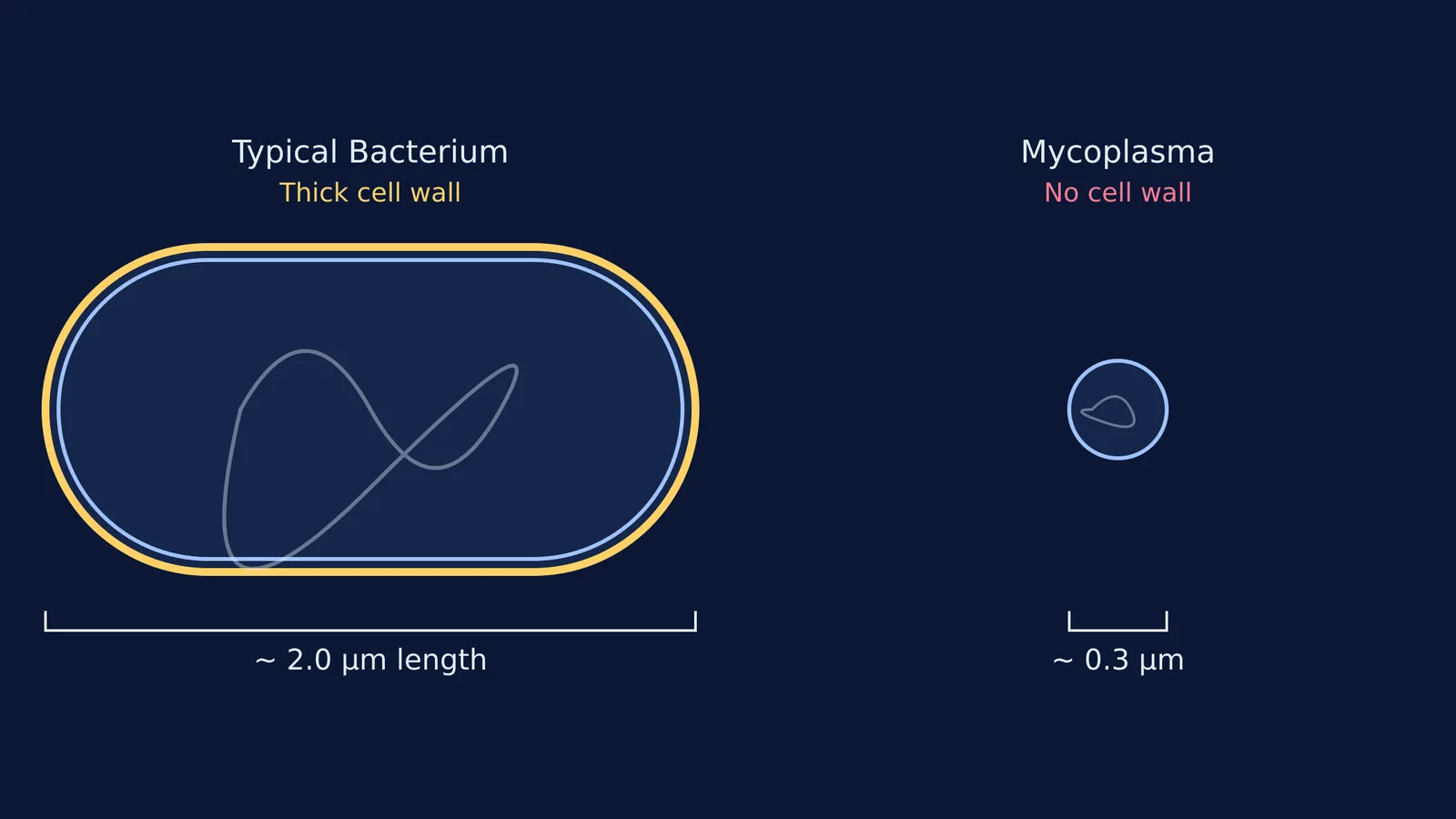
Mycoplasmas are the smallest and simplest self-replicating bacteria, measuring just 0.3 μm across [[1]](https://www.ncbi.nlm.nih.gov/books/NBK7637/). While almost all bacteria have a rigid layer of peptidoglycan protecting them, Mycoplasma species completely lack a cell wall [[1]](https://www.ncbi.nlm.nih.gov/books/NBK7637/).
This structural difference has two major results. First, they are pleomorphic, meaning they can change into different shapes, ranging from tiny spheres to long filaments that can stretch up to 100 μm [[1]](https://www.ncbi.nlm.nih.gov/books/NBK7637/). Second, they are naturally resistant to beta-lactam antibiotics like penicillin, which work by destroying cell walls. If a cell never had a wall to begin with, penicillin has nothing to attack. Their genome is also remarkably small, containing roughly 500 to 1000 genes [[1]](https://www.ncbi.nlm.nih.gov/books/NBK7637/).
How does Mycoplasma survive without oxygen?
Many students assume all bacteria need oxygen, but mycoplasmas can survive and grow whether oxygen is present or not [[1]](https://www.ncbi.nlm.nih.gov/books/NBK7637/). Clinical isolates are typically grown in environments with 5% to 10% carbon dioxide or under strictly anaerobic conditions [[1]](https://www.ncbi.nlm.nih.gov/books/NBK7637/).
Because they possess a truncated respiratory system, they cannot use oxidative phosphorylation to generate energy. Instead, they rely on other methods to survive. Fermentative mycoplasmas break down sugars like glucose through the glycolysis pathway to produce ATP [[1]](https://www.ncbi.nlm.nih.gov/books/NBK7637/). Other non-fermentative species generate their energy using the arginine dihydrolase pathway, breaking down arginine instead of sugars [[1]](https://www.ncbi.nlm.nih.gov/books/NBK7637/). This metabolic flexibility lets them thrive in various host tissues where oxygen levels might be low.
Which Mycoplasma species affect humans?
Mycoplasmas are ubiquitous in nature. While many exist as harmless commensals, several species are significant human pathogens [[1]](https://www.ncbi.nlm.nih.gov/books/NBK7637/). The most well-known is *Mycoplasma pneumoniae*, which is a major cause of primary atypical pneumonia, often referred to as "walking pneumonia" [[1]](https://www.ncbi.nlm.nih.gov/books/NBK7637/). It attaches to the respiratory epithelium using a specialized attachment organelle and causes tissue damage by producing hydrogen peroxide and superoxide radicals [[1]](https://www.ncbi.nlm.nih.gov/books/NBK7637/).
Because these bacteria lack a cell wall, infections caused by *Mycoplasma pneumoniae* cannot be treated with common beta-lactam antibiotics like penicillin. Instead, they are susceptible to antibiotics that inhibit protein synthesis, such as tetracyclines or macrolides [[1]](https://www.ncbi.nlm.nih.gov/books/NBK7637/).
Other species, such as *Mycoplasma hominis* and *Ureaplasma urealyticum*, are commonly associated with infections of the human urogenital tract. *Ureaplasma* is unique because it requires urea for growth and generates ATP through an electrochemical gradient produced during urea hydrolysis [[1]](https://www.ncbi.nlm.nih.gov/books/NBK7637/). In a clinical setting, identifying these specific organisms requires specialized culture techniques on diphasic media or molecular diagnostics, as their small size and lack of a cell wall make them difficult to detect using standard Gram staining procedures.
Where does Mycoplasma fit in Kingdom Monera?
In the traditional five-kingdom classification system, life is divided into Monera, Protista, Fungi, Plantae, and Animalia. You can review how this system works in our guide to biological classification for NEET.
Because Mycoplasma is a prokaryote—meaning its circular DNA is not wrapped inside a nucleus—it is classified under Kingdom Monera. It sits alongside other bacteria, but it remains an exception. While typical monerans are defined by having a tough cell wall, Mycoplasma belongs to a special class called *Mollicutes* (from the Latin for "soft skin") because it is naked [[1]](https://www.ncbi.nlm.nih.gov/books/NBK7637/). If you are reviewing the cell as the unit of life, remember that Mycoplasma is the classic exception to the cell wall rule. You can also trace how early biologists classified these exceptions in our post about viruses, viroids and lichens.
How to remember Mycoplasma facts for exams?
If you are preparing for biology exams, Mycoplasma often appears in assertion-reason questions. If you find yourself forgetting which organisms lack a cell wall, you can explore them further in the Fermi Concept Library, which maps out every concept in biology and its exceptions.
Here is a checklist of the core facts to keep straight for your next exam:
Size: ~0.3 μm or 300 nm [[1]](https://www.ncbi.nlm.nih.gov/books/NBK7637/), making it the smallest known free-living cell.
Structure: Completely lacks a cell wall, but features a plasma membrane stabilized by sterols.
Classification: Placed in Kingdom Monera, Class Mollicutes.
Respiration: Lacks oxidative phosphorylation and relies on glycolysis or the arginine dihydrolase pathway.
Antibiotics: Inherently resistant to penicillin because it lacks peptidoglycan entirely, but susceptible to protein synthesis inhibitors.


