

On this page
When you spot a mushroom on the forest floor or in a grocery store, you are only looking at a tiny fraction of the whole organism. To a biologist, a mushroom is the fruiting body of a much larger fungus that lives hidden underground or inside rotting wood. Its only purpose is to produce and scatter spores.
If you are reviewing kingdom Fungi for an exam, the Fermi Concept Library maps out how different fungal classes reproduce and fit together. You can also explore how fungi differ from other biological outliers like viruses, viroids and lichens.
What is a mushroom?
Plants produce flowers and seeds to reproduce, while fungi produce fruiting bodies and spores. The mushroom you see above ground is a temporary structure that sprouts only when conditions—such as temperature and moisture—are just right.
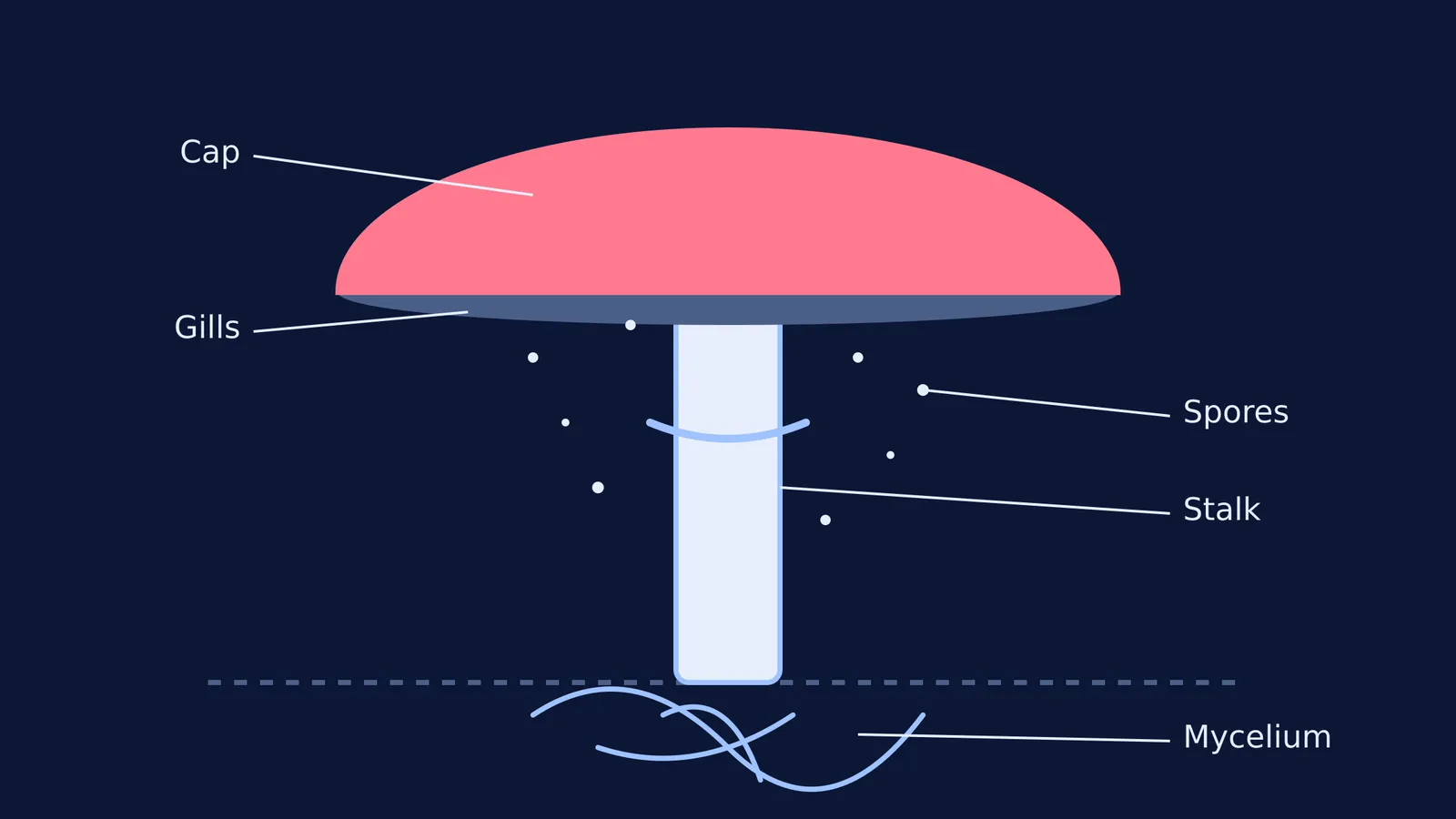
Most of the time, the true body of the fungus is invisible. It consists of a vast network of thread-like cells called hyphae, which weave through the soil or wood, breaking down organic matter and absorbing nutrients. When a mass of hyphae branches and fuses together, it forms a mycelium. The mushroom itself is simply a dense, highly organised bundle of these same hyphae pushed above the surface to reproduce.
How is a mushroom structured?
A typical mushroom, such as the common white button mushroom (*Agaricus bisporus*), is built to protect and release its spores efficiently.
Cap (pileus): The topmost umbrella-like structure. Its main job is to protect the spore-producing surfaces underneath from rain, direct sun and debris.
Gills (lamellae): The thin, paper-like ridges on the underside of the cap. They provide a massive surface area for spores to develop. Not all fungi use gills; some have pores (like boletes) or downward-pointing teeth (like the lion's mane mushroom).
Stalk (stipe): The stem that holds the cap above the ground. By elevating the gills, the stalk ensures that falling spores can be caught by air currents.
Annulus: A skirt-like ring around the stalk found on some mushrooms. It is the remnant of a protective veil that covered the gills while the mushroom was young.
When you are studying biological structures, Fermi's AI tutor can help you trace the anatomy and check your understanding as you go. For a broader overview of the groups these mushrooms belong to, you can review the four classes of kingdom Fungi.
How do spores escape the gills?
Spores are the microscopic reproductive units of the fungus. Because the chances of a single spore landing in a perfect spot to grow are vanishingly small, fungi play a numbers game. A single mature mushroom can release more than 1 billion spores per day (PNAS).
Getting those spores away from the mushroom is an active process. A 2016 study in the *Proceedings of the National Academy of Sciences* (PNAS) revealed that mushrooms do not just rely on external wind. By losing water vapour from their gills, mushrooms create evaporative cooling. This cools the air immediately around them, generating tiny convective airflows that carry spores out from under the cap and lift them tens of centimetres into the air, even in completely still conditions.
Why make a spore print?
Mushroom identification relies heavily on spore colour, which remains remarkably consistent within a species. Mycologists use "spore prints" to see this colour clearly. Making one is a straightforward practical exercise.
Select a mushroom: Choose a fresh, mature mushroom with open, visible gills (like a standard portobello or button mushroom).
Remove the stalk: Carefully twist or cut the stalk off as close to the cap as possible.
Place on paper: Place the cap, gills facing down, halfway across a piece of white paper and halfway across a piece of black paper (or use a glass pane). Because spores can be white, brown, rust, or black, a dual-tone background ensures you can see them.
Cover and wait: Place a glass or bowl over the cap to stop drafts from blowing the spores away. Leave it undisturbed overnight.
Reveal the print: Lift the bowl and carefully remove the cap. You will see a fine, powdery pattern mirroring the gills, made entirely of countless fallen spores.
Understanding the structure of a mushroom is a reminder that in biology, form always follows function. From the protective cap to the microscopic spores, every part of the fruiting body is engineered to keep the fungal life cycle going.


