

On this page
If you draw a card from a deck, keep it, and draw a second card, the second draw is a dependent event. The deck has changed. The multiplication theorem of probability gives you a way to string these changing odds together without having to count every possible combination of cards.
This is a core idea in Class 12 mathematics and a staple of JEE Main probability questions. It bridges the gap between simple counting and complex chains of events.
What is the multiplication theorem for dependent events?
Here, P(B | A) is the conditional probability of B, meaning the chance that B happens given that A has already happened. When events are dependent, the first event physically alters the conditions for the second. You cannot just multiply P(A) and P(B) together because P(B) no longer describes the reality of the second step.
If you are learning this for an exam, this is where a step-by-step approach matters. The Fermi Problem Library breaks down conditional probability problems by showing you exactly how the sample space shrinks after each step, rather than just handing you the final fraction.
How do you find the probability of drawing two kings one after another?
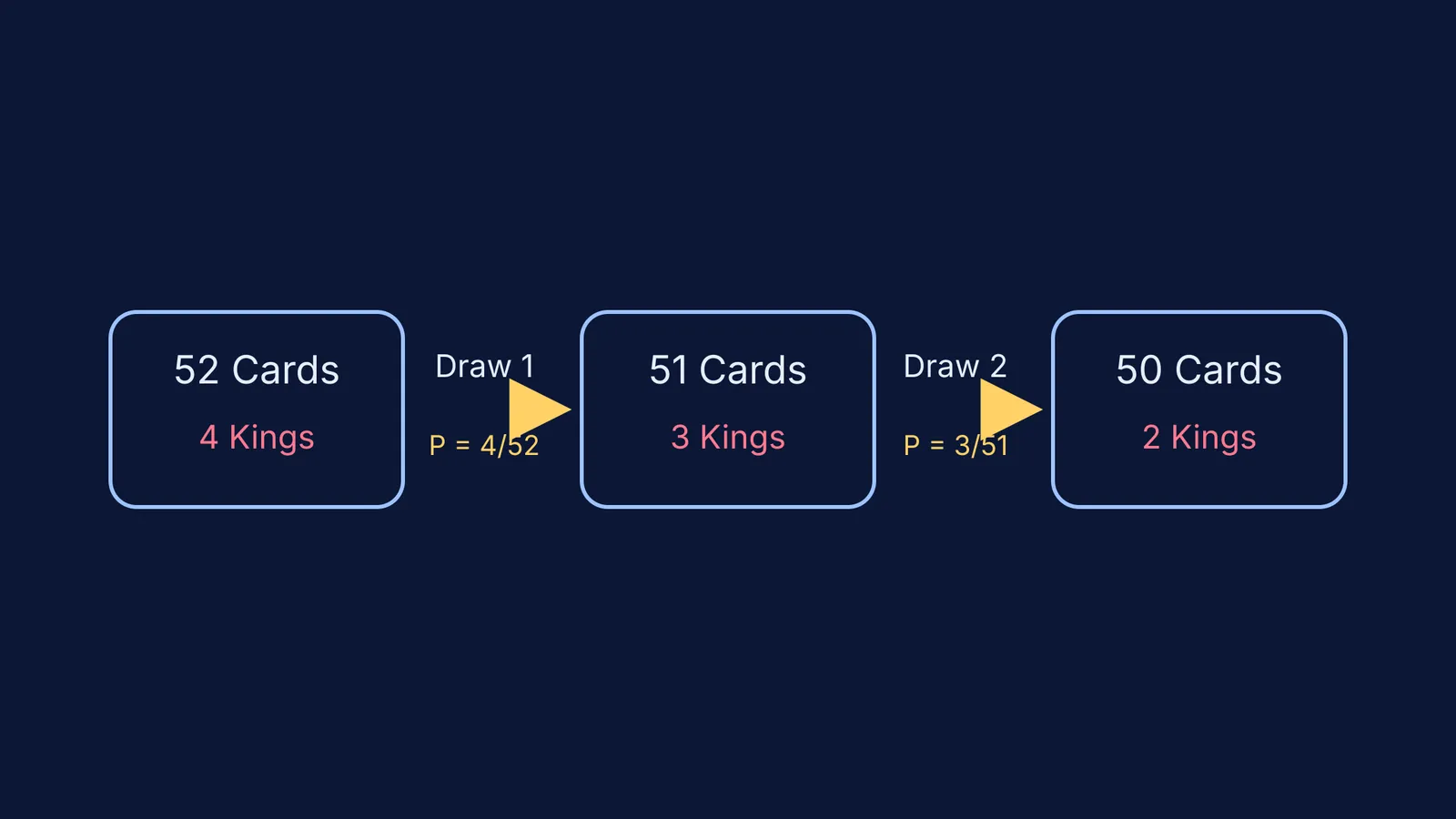
Let us apply the theorem to the classic card problem. You want to draw two kings from a standard deck without replacing the first card. A standard deck has 52 cards with 4 kings.
The first draw (Event A): You start with 52 cards. There are 4 kings in the deck. The probability of drawing a king is P(A) = 4/52, which simplifies to 1/13.
The second draw (Event B): You are holding one king. The deck now has 51 cards, and only 3 kings are left. The probability of drawing a king now, given that you already drew one, is P(B | A) = 3/51, which simplifies to 1/17.
Multiply them together using the theorem:
P(A ∩ B) = 1/13 × 1/17 = 1/221.
This is much lower than the 1/169 chance you would have if you put the first card back. Removing just one successful card from the deck makes the second success significantly harder to pull off.
How does the three-draw chain version work?
The multiplication theorem extends naturally to three or more events. For three dependent events A, B, and C, the chain rule is:
P(A ∩ B ∩ C) = P(A) × P(B | A) × P(C | A ∩ B)
Imagine you want the probability of drawing three kings in a row without replacement:
First draw: 4 kings in 52 cards (4/52).
Second draw: 3 kings in 51 cards (3/51).
Third draw: Now you hold two kings. The deck has 50 cards, and only 2 kings remain. The chance is 2/50, or 1/25.
The total probability of drawing three kings is:
(1/13) × (1/17) × (1/25) = 1/5525.
What is the checklist for dependent probability chains?
When tackling these problems in an exam, use this sequence to avoid simple errors:
Identify your starting totals (e.g., 52 total cards, 4 target cards).
For the second draw, subtract 1 from the total sample space (it becomes 51).
Subtract 1 from your target cards only if the first draw was exactly the card you wanted.
Keep adjusting the top and bottom numbers for every new event in the chain.
Multiply all the individual step fractions together.
When extending the chain, you must update both the total number of items and the number of target items at every step. If you miss one adjustment, the rest of the chain will be wrong.
If you are preparing for exams, you can explore similar ideas in our guides on with and without replacement: probability problems compared and odds in favour and odds against: converting them to probability.


