

On this page
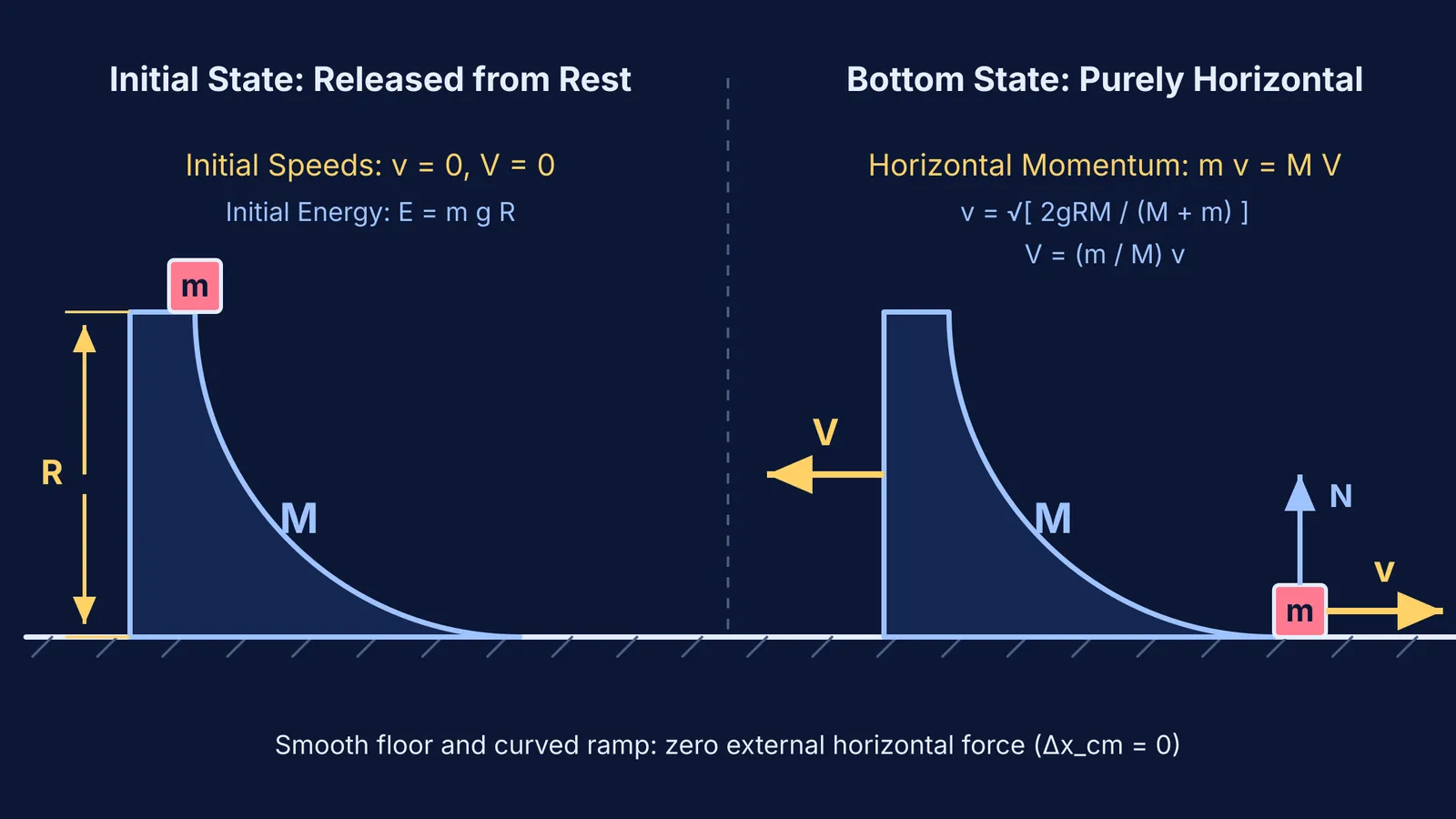
A classic problem in mechanics asks what happens when a small block of mass m slides down a smooth, movable wedge of mass M with a quarter-circular profile of radius R on a frictionless floor. Because the contact slope continuously changes and the wedge accelerates sideways, solving through Newton's second law equations becomes an algebraic mess.
Instead, conservation laws solve the motion directly. By coupling horizontal linear momentum conservation with mechanical energy conservation, you can determine the exact speeds of both the block and the wedge at the bottom without integrating along the curve.
Why is horizontal momentum conserved for the block and wedge?
To see why momentum is conserved horizontally but not vertically, examine the external forces acting on the system. Gravity acts downward on both masses, and the floor exerts an upward normal force on the wedge. Because external forces act along the vertical axis, vertical momentum is not conserved, and the center of mass accelerates downward.
Horizontally, no external forces act because the floor is frictionless. The only horizontal forces are the normal contact forces between the block and the curved wedge face. As Richard Feynman explains in The Feynman Lectures on Physics (Vol. 1, Ch. 10), internal interaction forces between particles always cancel in equal and opposite pairs under Newton's third law. As with an exploding shell midair, internal forces cannot change total linear momentum. Because the system starts from rest, its total horizontal momentum remains zero throughout the slide: m × v_x + M × V_x = 0.
How do you find the speeds of the block and wedge at the bottom?
When the block reaches the bottom of the quarter circle, the tangent to the track is horizontal. At this instant, the block moves purely horizontally relative to the wedge. With the block moving right at speed v and the wedge recoiling left at speed V, horizontal momentum conservation requires:
m × v − M × V = 0, giving V = (m / M) × v
Next, apply conservation of mechanical energy. According to OpenStax University Physics Volume 1, normal forces between frictionless surfaces do zero net work on the system because the work done on the block is equal and opposite to the work done on the wedge. The initial gravitational potential energy m × g × R converts entirely into kinetic energy:
m × g × R = (1/2) × m × v² + (1/2) × M × V²
Substituting V = (m / M) × v into the energy balance gives m × g × R = (1/2) × m × v² × [(M + m) / M]. Solving for the final speeds yields:
v = √[2 × g × R × M / (M + m)]
V = (m / M) × v = √[2 × g × R × m² / (M × (M + m))]
How far does the wedge shift horizontally as the block slides?
Because total horizontal momentum is zero at every instant, the horizontal position of the center of mass cannot change. As noted in OpenStax University Physics Volume 1, when no external horizontal force acts on an initially stationary system, Δx_cm = 0.
Relative to the wedge, the block travels a horizontal distance R. If the wedge shifts left by distance ΔX in the ground frame, the block shifts right by R − ΔX. Setting m × (R − ΔX) − M × ΔX = 0 gives:
ΔX = m × R / (M + m)
For a 1 kg block on a 3 kg wedge with R = 0.8 m, the wedge recoils leftward by (1 × 0.8) / (3 + 1) = 0.2 m (20 cm), while the block advances rightward by 0.6 m (60 cm).
What are the common exam traps and limiting cases?
When solving this setup, watch out for three frequent slips highlighted in our analysis of common mechanics mistakes:
Forgetting the wedge's kinetic energy: Students often write m × g × R = (1/2) × m × v² and get v = √(2 g R). That only holds if the wedge is clamped. On a movable wedge, energy is shared, so the block's speed is strictly less than √(2 g R).
Confusing relative and ground velocity: Normal acceleration at the bottom depends on the relative speed v_rel = v + V, making the upward normal force N = m × g × [3 + 2(m / M)], which exceeds the fixed-track value of 3mg.
Neglecting limiting checks: If M >> m, v approaches √(2 g R) and V approaches 0, recovering the fixed-wedge limit. If m >> M, the light wedge shoots backward while the heavy block drops almost vertically.
Visualizing constraint forces and frames is much easier when drawing the diagram first. If you want structured practice on conservation laws, the Fermi Problem Library has worked problems with a step-by-step solver that explains the reasoning rather than printing an answer. You can also explore these interactions in the Fermi Simulation Lab, which provides interactive simulations for ideas that are easier to see than to read.


