

On this page
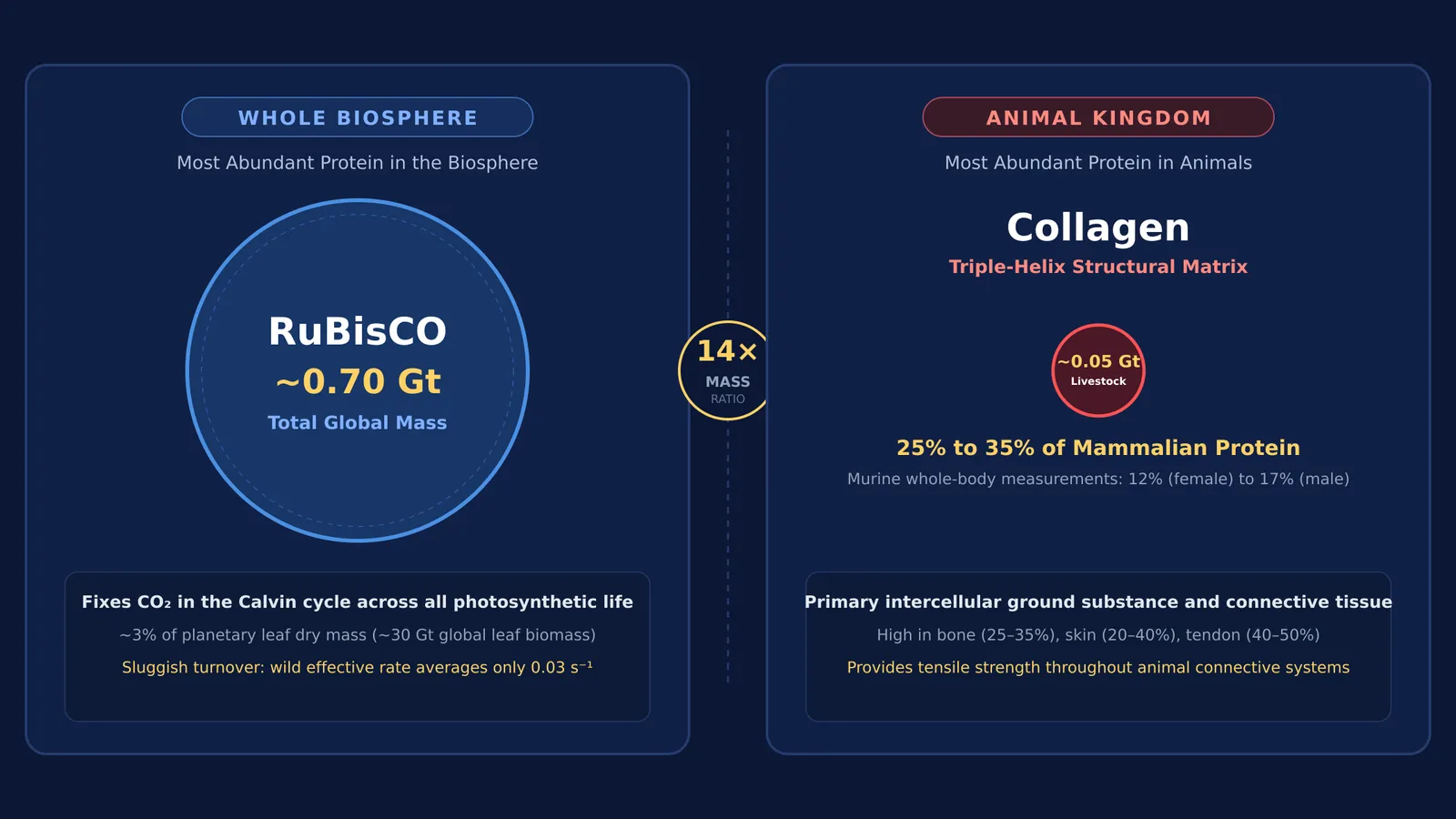
Questions about macromolecular abundance appear straightforward until you read the options. A student asked for the most abundant protein in the biosphere must answer ribulose-1,5-bisphosphate carboxylase/oxygenase (RuBisCO), whereas a question specifying the animal kingdom requires collagen. According to NCERT Class 11 Biology, Chapter 9, collagen serves as the primary intercellular ground substance and is the most abundant protein in the animal world, while RuBisCO is the most abundant protein in the whole biosphere.
The physical scale separating them is vast. A study by Yinon M. Bar-On and Ron Milo in PNAS determined that total global RuBisCO mass is approximately 0.7 gigatonnes. To illustrate this planetary scale, Bar-On and Milo calculated that collagen across all livestock herds totals roughly 0.05 gigatonnes, meaning biosphere RuBisCO outweighs livestock collagen by a factor of 14. Within individual animal bodies, collagen dominates structural biology, historically cited at 25% to 35% of mammalian whole-body protein in the Annual Review of Biochemistry, while whole-body murine measurements in Scientific Reports report 12% in females and 17% in males.
Why is RuBisCO so abundant if it is catalytically inefficient?
If RuBisCO represents roughly 0.7 gigatonnes of planetary biomass, why does biology require so much of it? RuBisCO catalyzes carbon fixation in the Calvin cycle, binding carbon dioxide to ribulose-1,5-bisphosphate to form two molecules of 3-phosphoglyceric acid (NCERT Class 11 Biology, Chapter 11). Yet its active site cannot distinguish perfectly between carbon dioxide and oxygen, triggering photorespiration when oxygen binds instead, an energy-wasting pathway detailed in Photorespiration: why RuBisCO wastes energy in C3 plants.
In addition to low substrate specificity, RuBisCO operates at an unusually slow turnover rate. In wild terrestrial conditions, its effective catalytic rate averages only 0.03 s⁻¹ per active site, nearly 100-fold slower than its saturated in vitro rate (PNAS). Even under optimal laboratory conditions, maximal turnover rate (k_cat) is merely 3 to 4 reactions per second. Photosynthetic organisms compensate through sheer volume: RuBisCO constitutes roughly 3% of total leaf dry weight across Earth, corresponding to roughly 30 gigatonnes of global dry leaf biomass (PNAS).
Which 'most abundant' NCERT statements appear as exam traps?
Examiners design questions around specific boundary conditions. Swapping a single category word turns an intuitive question into an exam trap:
Cellular chemicals: Water is the most abundant chemical in living tissue at 70% to 90% of cellular mass (NCERT Class 11 Biology, Chapter 9). Among organic biomolecules, proteins are the most abundant at 10% to 15% of cell mass, followed by nucleic acids at 5% to 7%.
Protein versus organic compound: While RuBisCO is the most abundant protein in the biosphere, cellulose is the most abundant organic polymer on Earth. Students who confuse proteins with carbohydrates lose marks. Our guide to Biomolecules in chemistry: sugars, proteins and DNA made clear details these carbohydrate structures.
Formed elements of blood: In human blood, erythrocytes are the most abundant formed elements at 5 million to 5.5 million per mm³ (NCERT Class 11 Biology, Chapter 15). Among leukocytes, neutrophils are the most abundant at 60% to 65%, while basophils are least abundant at 0.5% to 1%, as analyzed in Formed elements of blood: RBCs, WBC types and platelets for NEET.
Circulating versus secretory antibodies: In human serum, Immunoglobulin G (IgG) is the most abundant antibody class at roughly 9.0 mg/mL, making up 75% to 80% of serum immunoglobulins (NCBI StatPearls), whereas Immunoglobulin A (IgA) dominates secretions like saliva and tears.
How can you spot and eliminate scope traps during practice?
To avoid losing marks to subtle phrasing, run a four-step scope filter:
Identify the system boundary: Biosphere, animal kingdom, blood, or a single cell.
Check the chemical class: Protein, enzyme, polysaccharide, or total mass.
Verify the compartment: Extracellular matrix, blood serum, or mucosal secretion.
Eliminate cross-category distractors: Drop carbohydrates when asked for proteins, and dismiss biosphere figures when restricted to animals.
Consider: 'Which of the following is the most abundant protein in the animal kingdom? (a) RuBisCO, (b) Cellulose, (c) Collagen, (d) Albumin.' The 'animal kingdom' boundary eliminates RuBisCO. The 'protein' specification rules out cellulose. Within animal tissues, collagen forms the structural matrix across bone, cartilage, and skin, whereas albumin is a circulating plasma protein. Option (c) collagen is correct.
Building confidence with these boundary conditions requires deliberate practice. The Fermi Problem Library features worked problems with a step-by-step solver that explains the reasoning rather than printing an answer. For systematic revision across biochemistry, the Fermi Concept Library maps every concept in physics, chemistry, biology, mathematics and computing, each with its own lesson and its place in the map. When working through metabolic cycles, Fermi's AI tutor notices where a student is stuck and decides whether to explain, ask, or show the next step.


