

On this page
If you are revising Class 12 molecular biology, “monocistronic” and “polycistronic” can feel like two long words for one small idea. They describe how many proteins a single transcription unit can code for. Once you see the picture, exons, introns and the lac operon all fall into place.
What is the difference between monocistronic and polycistronic genes?
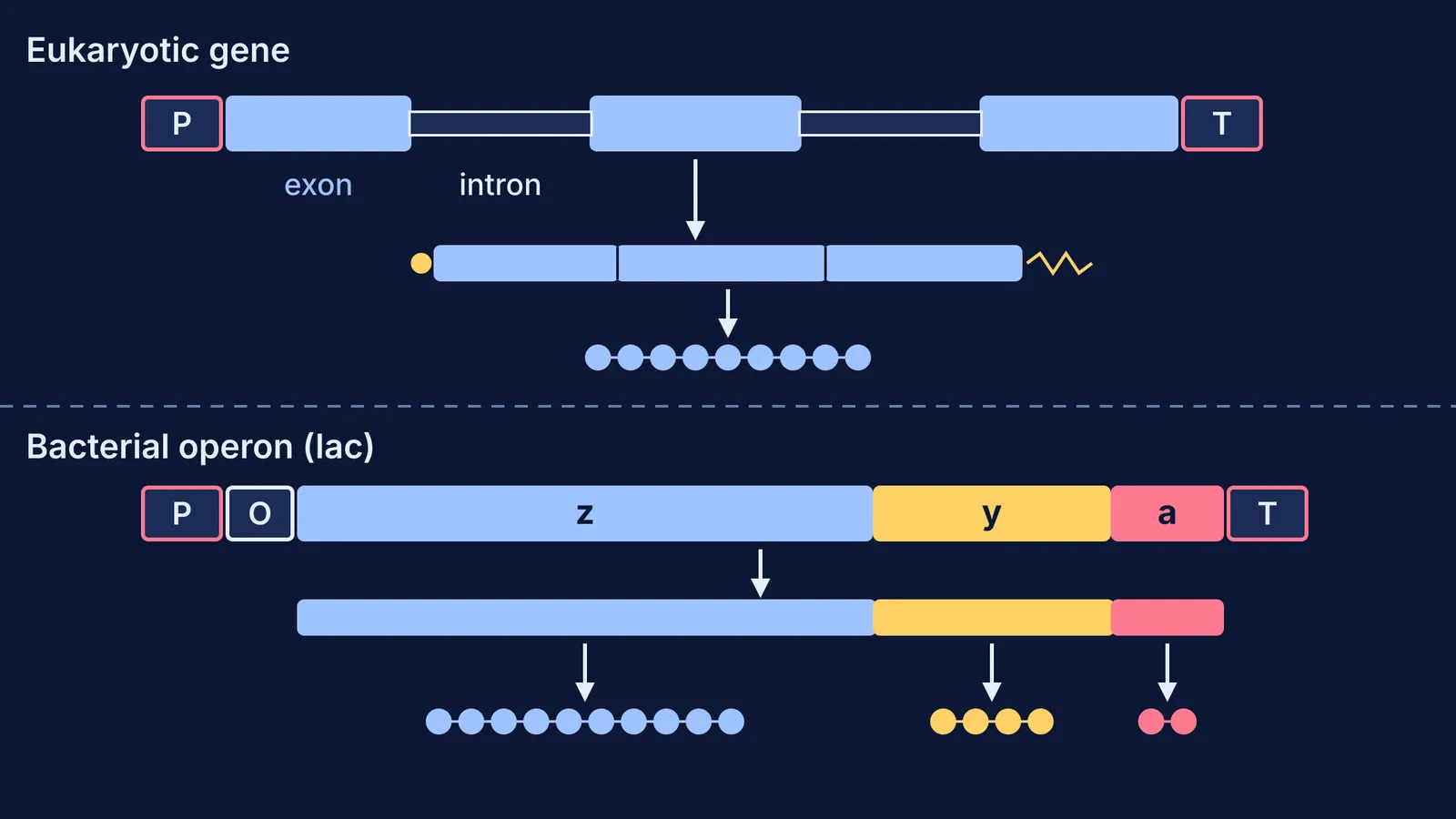
Start with the word cistron. In the NCERT Class 12 Biology chapter Molecular Basis of Inheritance, a cistron is defined as a segment of DNA coding for a polypeptide. The same section says a structural gene in a transcription unit can be monocistronic (mostly in eukaryotes) or polycistronic (mostly in bacteria or prokaryotes).
So the comparison comes down to four points:
Monocistronic: one transcription unit, one mRNA, one polypeptide. Typical of eukaryotes, including humans and plants.
Polycistronic: one transcription unit, one mRNA, several polypeptides. Typical of bacteria.
Shared parts: both sit between a promoter and a terminator, the three regions NCERT uses to define a transcription unit along with the structural gene.
Key difference: the number of polypeptides one mRNA codes for, not the number of genes in the cell.
A common slip is to think “monocistronic” means the organism has only one gene. It means each mRNA carries the instructions for one polypeptide.
If the words cistron, promoter and structural gene still feel shaky, each has its own lesson in the Fermi Concept Library, so you can fill that gap before moving on.
Where do exons and introns fit in?
This is the part that makes eukaryotic genes different in a second way. NCERT says the monocistronic structural genes of eukaryotes have interrupted coding sequences: “the genes in eukaryotes are split”. The same chapter defines exons as the sequences that appear in mature, processed RNA, and introns as the intervening sequences that do not.
The steps, as NCERT lists them:
RNA polymerase II transcribes the precursor of mRNA, called heterogeneous nuclear RNA (hnRNA), which contains both exons and introns.
Splicing removes the introns and joins the exons in a defined order.
Capping adds methyl guanosine triphosphate to the 5′ end.
Tailing adds 200-300 adenylate residues to the 3′ end.
The processed mRNA leaves the nucleus for translation.
Split genes were discovered in 1977. One of the first reports came from Berget, Moore and Sharp in PNAS, who found evidence that an adenovirus mRNA is put together from separate segments of a longer precursor. The 1993 Nobel Prize in Physiology or Medicine went to Richard J. Roberts and Phillip A. Sharp “for their discoveries of split genes”.
Why do bacteria use operons?
An operon is a polycistronic structural gene regulated by a common promoter and regulatory genes, an arrangement NCERT calls “very common in bacteria” in its section on the lac operon. The lac operon was worked out by François Jacob and Jacques Monod, published as “Genetic regulatory mechanisms in the synthesis of proteins”80072-7) in the Journal of Molecular Biology in 1961.
In the lac operon, one regulatory gene (i) codes for a repressor, and three structural genes are read into one mRNA:
z codes for beta-galactosidase, which breaks lactose into galactose and glucose.
y codes for permease, which lets lactose into the cell.
a codes for transacetylase.
All three products are needed to use lactose, so it makes sense to switch them on together. NCERT also notes that bacterial mRNA needs no processing, and because there is no nucleus, translation can begin before transcription has finished.
Are all eukaryotic genes monocistronic?
No, and this is worth knowing beyond the textbook. In the nematode worm *C. elegans*, Blumenthal and colleagues write in WormBook that nearly 15% of its roughly 20,000 genes sit in operons controlled by a single promoter. The worm uses trans-splicing, with a spliced leader called SL2, to process these operon transcripts. For school exams, stick with NCERT's “mostly” in both definitions: it is a rule of thumb, not a law.
How do you tell them apart in an exam question?
Run any question through this four-step check:
Find the organism. A bacterium points to polycistronic; a plant, fungus or animal usually points to monocistronic.
Count the products. Several enzymes from one mRNA means polycistronic.
Look for processing. Splicing, capping or a poly-A tail means a eukaryotic, split gene.
Check the location. Translation starting before transcription ends means a prokaryote.
Worked example: “An mRNA in *E. coli* is translated into beta-galactosidase, permease and transacetylase. Is it monocistronic or polycistronic, and does it need splicing?” Step 1 gives a bacterium. Step 2 gives three products. So it is polycistronic (the lac operon), and it needs no splicing, because bacterial mRNA is not processed.
Try it on a reversed case: “A human hnRNA has four exons and three introns.” It is monocistronic, and splicing will give one mRNA with the four exons joined.
To practise more questions like these, the Fermi Problem Library has worked problems with a step-by-step solver that explains the reasoning rather than printing an answer.


