

On this page
Propane has six primary hydrogens and only two secondary ones, yet chlorinating it gives slightly more 2-chloropropane than 1-chloropropane. To predict this, and answer the percentage questions in board and entrance exams, you need one rule and some division.
How do you calculate the percentage of monochlorinated products?
Two things decide how much of each product forms: how many hydrogens of each type there are (probability), and how fast each type reacts (reactivity). The open textbook Organic Chemistry I by Xin Liu at Kwantlen Polytechnic University turns this into a single rule: the amount of a product equals the number of that type of hydrogen multiplied by its relative reactivity.
The same textbook gives the relative reactivities for chlorination as 5.0 for tertiary, 3.8 for secondary and 1.0 for primary hydrogens. The Wikipedia article on free-radical halogenation gives the same 5 : 3.8 : 1 values and notes that they vary with solvent.
The method is the same every time:
Draw the structure and group the hydrogens into equivalent sets. Each set gives one product.
Count the hydrogens in each set.
Multiply each count by its reactivity: 1.0 for primary, 3.8 for secondary, 5.0 for tertiary.
Add these numbers to get a total.
Divide each number by the total and multiply by 100.
What is the product ratio for chlorination of propane?
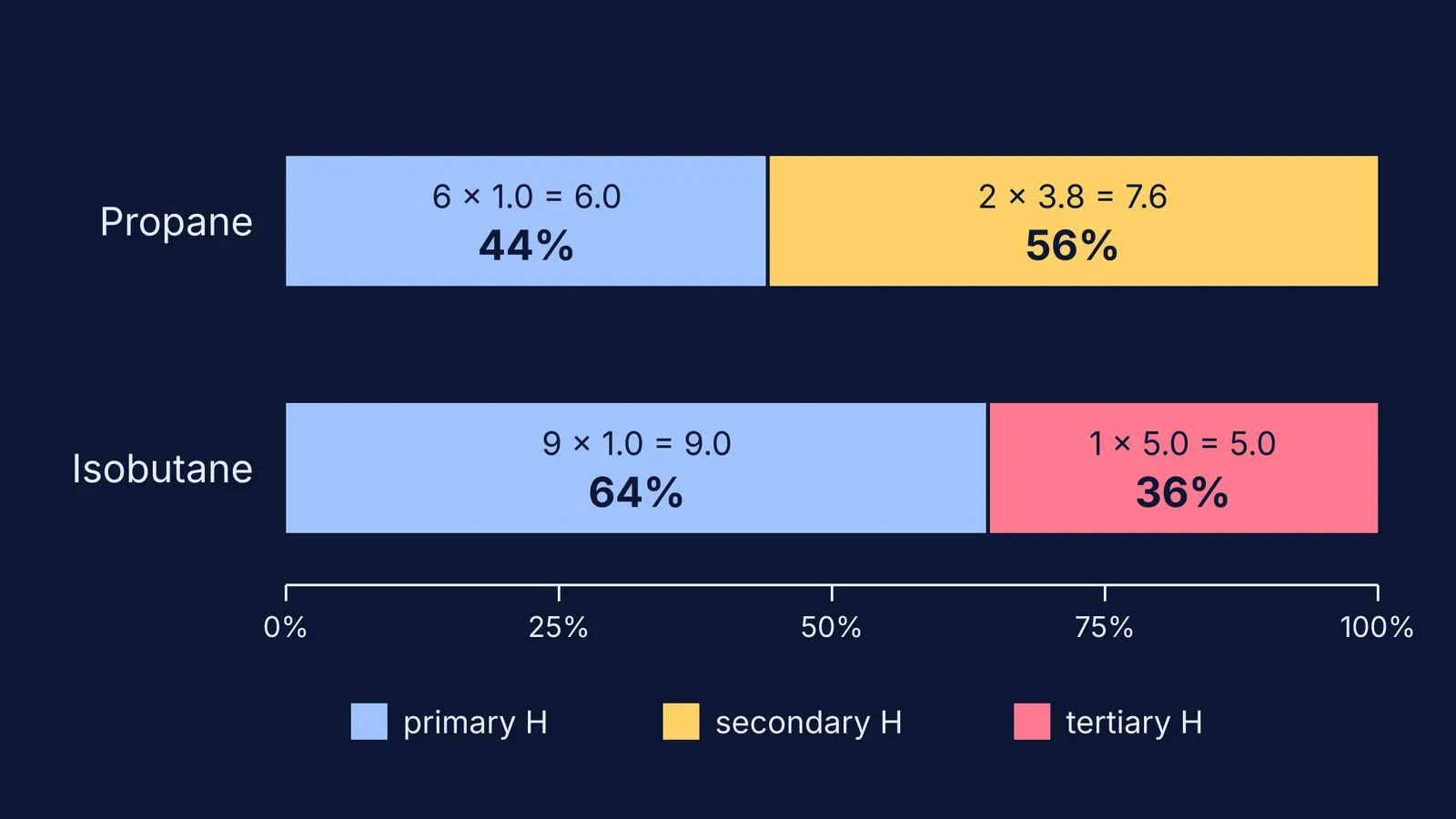
Propane, CH3CH2CH3, has six primary hydrogens on its two end carbons and two secondary hydrogens on the middle carbon.
1-chloropropane: 6 × 1.0 = 6.0
2-chloropropane: 2 × 3.8 = 7.6
Total: 13.6
So 1-chloropropane is 6.0 ÷ 13.6 = 44%, and 2-chloropropane is 7.6 ÷ 13.6 = 56%. The KPU textbook reports the experimental result as 45% 1-chloropropane and 55% 2-chloropropane, so the prediction lands within one percentage point. Master Organic Chemistry gives the same 55 : 45 split for chlorination with light at 25 °C, and points out that counting hydrogens alone would have predicted 75 : 25 in favour of the primary product.
What is the product ratio for chlorination of isobutane?
Isobutane (2-methylpropane), (CH3)3CH, has nine primary hydrogens on its three methyl groups and one tertiary hydrogen.
1-chloro-2-methylpropane (isobutyl chloride): 9 × 1.0 = 9.0
2-chloro-2-methylpropane (tert-butyl chloride): 1 × 5.0 = 5.0
Total: 14.0
With the KPU textbook values, that works out to about 64% isobutyl chloride and 36% tert-butyl chloride. The primary chloride is the major product, even though each tertiary hydrogen is five times as reactive, because there are nine primary hydrogens for every tertiary one.
A University of Texas at Austin teaching page on statistical effects makes the same point about isobutane: the primary product exceeds the tertiary one, because the nine-to-one count of hydrogens outweighs the tertiary hydrogen's higher reactivity (that page uses a per-hydrogen factor of 4.5).
Radical stability tells you which hydrogen reacts fastest, not which product there is most of.
Why does chlorine give a mixture when bromine gives one product?
Chlorine is a reactive reagent, so it does not discriminate greatly between primary, secondary and tertiary hydrogens; the KPU textbook calls this low selectivity. For bromination it explains that the reactivity difference is so large that reactivity decides the outcome, and one major product forms. Master Organic Chemistry reports that brominating propane gives 97% 2-bromopropane.
So the 5 : 3.8 : 1 numbers are for chlorination only. Do not reuse them for a bromination question.
If the reason tertiary hydrogens react faster still feels fuzzy, fix that before drilling more numbers. The Fermi Concept Library has its own lesson for every concept in chemistry, each with its place in the map, so you can go back to radical stability and then return to the calculation.
How do you check your answer in an exam?
Run through this list before you move on:
The percentages add up to 100.
You have one product for each set of equivalent hydrogens, no more.
For chlorination, the primary product's share should be smaller than its share of the hydrogens. In propane, primary hydrogens are 75% of the total but give only 44% of the product.
You used 5.0, 3.8 and 1.0 only for chlorine, not bromine.
To test yourself on a harder molecule, try 2-methylbutane, (CH3)2CHCH2CH3. It has four sets of hydrogens: six primary on the two methyls at C2, one tertiary, two secondary, and three primary at the far end. That gives 6.0, 5.0, 7.6 and 3.0 out of 21.6, or about 28%, 23%, 35% and 14%, the same figures listed in the Wikipedia article on free-radical halogenation.
If your answer does not match, the Fermi Problem Library has worked problems with a step-by-step solver that explains the reasoning rather than printing an answer, so you can see which step went wrong.
Pick one alkane you have not tried, list its hydrogen sets, and run the five steps today.


