

On this page
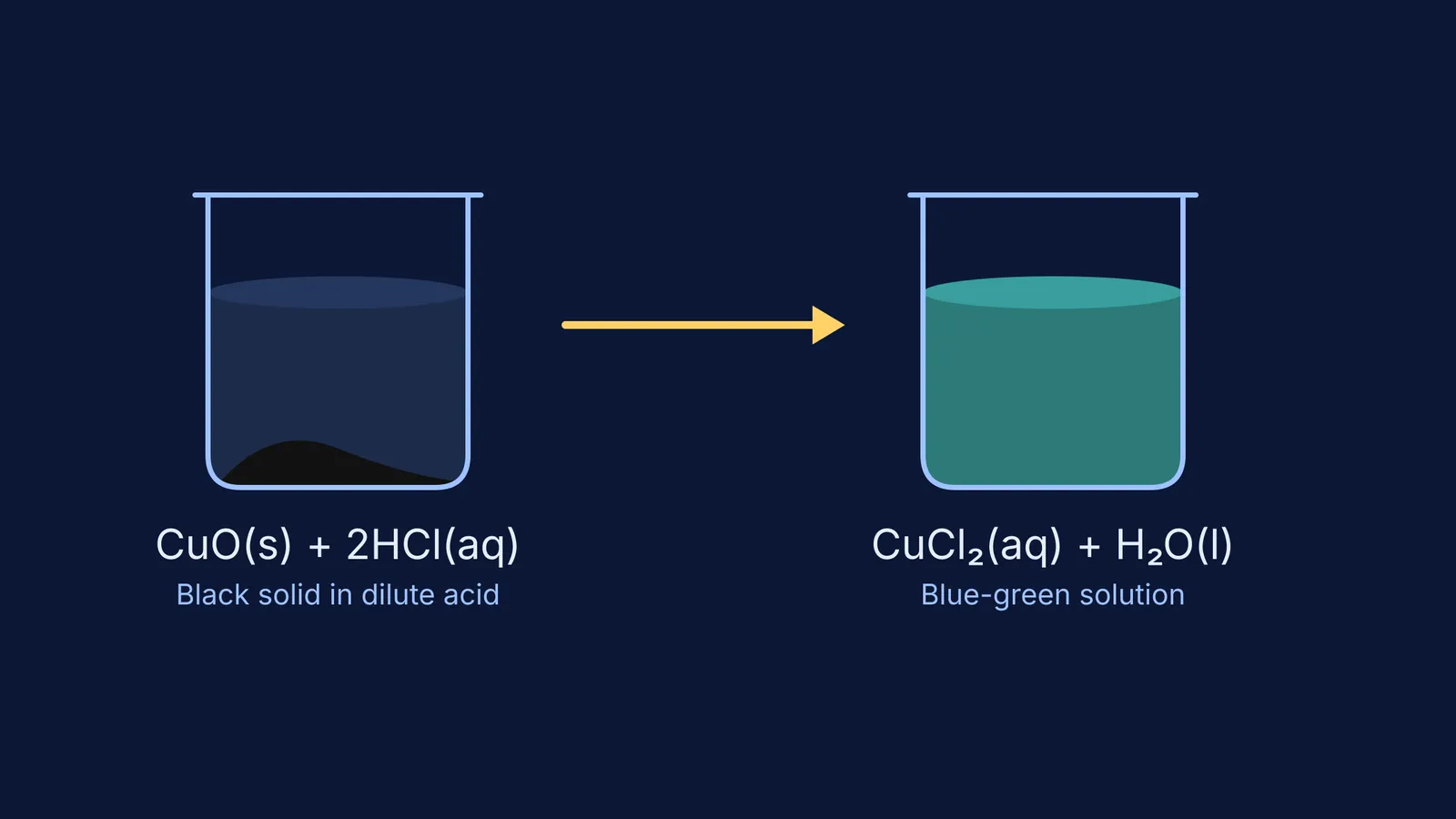
Copper(II) oxide (CuO) is a black, solid powder. When you add dilute hydrochloric acid (HCl) and stir, the black powder slowly dissolves. The previously colourless acid takes on a distinctive blue-green colour.
This is a chemical reaction that forms a new substance, copper(II) chloride (CuCl₂), dissolved in water. The balanced chemical equation for the reaction is:
CuO(s) + 2HCl(aq) → CuCl₂(aq) + H₂O(l) (Wikipedia)_oxide)
Why does the solution turn blue-green?
The colour change comes directly from the copper(II) chloride that is formed. While anhydrous copper(II) chloride is a dark brown solid, it forms blue-green aqueous solutions when dissolved in water (Wikipedia)_chloride).
In the solution, the copper ions (Cu²⁺) are surrounded by water molecules and chloride ions. In solutions with a lower concentration of chloride ions, the colour is more blue because the copper ions form a complex with water molecules. As the concentration of chloride ions increases, the solution looks greenish. At very high concentrations, it can even appear yellow or red, but in a standard school experiment with dilute acid, you will see the classic blue-green shade.
Is copper oxide an acid or a base?
This reaction is a classic example of a neutralisation reaction. You are reacting a metal oxide (copper oxide) with an acid (hydrochloric acid) to produce a salt (copper chloride) and water.
Because the metal oxide reacts with an acid to give salt and water — just like a base does — we say that metal oxides are basic oxides. This is why copper(II) oxide acts as a base in this reaction, neutralising the hydrochloric acid. If you write out the ionic equation, you can see that the oxide ion (O²⁻) from the copper oxide reacts with two hydrogen ions (H⁺) from the acid to form a molecule of water (H₂O).
Where else do we see these copper compounds?
Copper(II) oxide is not just a laboratory chemical. In nature, it occurs as a mineral called tenorite, which is found in copper mining regions (Wikipedia)_oxide). Because of its intense colour properties, copper oxide is used as a pigment in ceramics to produce blue, green, or red glazes. It also acts as a blue colouring agent in fireworks and pyrotechnics.
The copper(II) chloride produced in this reaction is highly useful in industry. Its main industrial use is as a co-catalyst in the Wacker process, which converts ethene into ethanal. It is also used as a mordant in the textile industry to set dyes on fabrics, and as a humidity indicator because of the way its colour changes with moisture (Wikipedia)_chloride).
Performing the experiment safely
If you are carrying out this reaction in a school laboratory, you will usually start with a small amount of black copper(II) oxide powder in a beaker. You then slowly add dilute hydrochloric acid while stirring with a glass rod. The reaction happens gradually, and you might need to warm the beaker gently to help the copper oxide dissolve completely.
Always wear safety goggles. Dilute hydrochloric acid is an irritant, and copper compounds can be toxic if swallowed or if they get into your eyes. You should never dispose of heavy metal salts like copper(II) chloride down the sink; they must be collected in a designated heavy metals waste container to protect aquatic life.
How to remember this for Class 10 science
This exact reaction is a staple in the CBSE Class 10 science syllabus. In exams, you will often be asked to name the blue-green compound, state the colour of copper oxide, or write the balanced equation.
A good way to remember the colour is to associate copper salts in solution with shades of blue and green. The key takeaway is understanding that metal oxides are basic in nature. If you want to review the full chapter or see how this fits with other chemical reactions, you can check our guide to acids, bases and salts in Class 10 or look at how metals and non-metals react.
If you are stuck trying to figure out balancing chemical equations in Class 10, the Fermi Problem Library has worked problems with a step-by-step solver that explains the reasoning rather than printing an answer. You can also explore the Fermi Concept Library to fill any conceptual gaps about how these acid-base reactions work.


