

On this page
Most of Class 10 "Metals and Non-metals" is a list of general rules: metals are hard, shiny solids with high melting points that conduct heat and electricity, and non-metals are dull, brittle and do not conduct. NCERT's own in-text questions test the handful of elements that break those rules. Learn each rule together with the element that breaks it.
What are the exceptions in properties of metals and non-metals?
The NCERT Class 10 Science textbook, Chapter 3 lists the exceptions in Section 3.1.2. These are the ones to learn word for word:
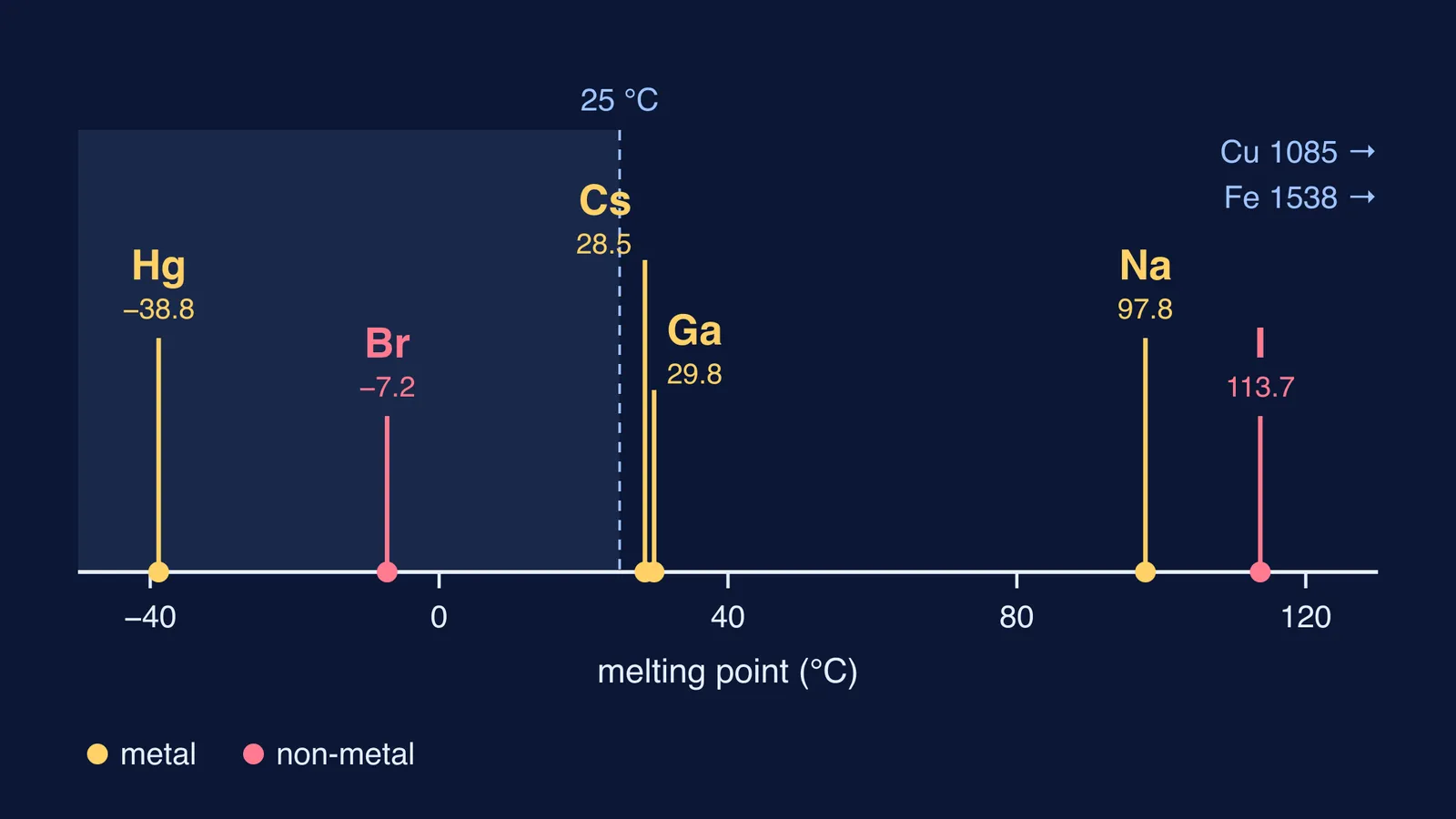
Mercury is a liquid metal. NCERT says all metals except mercury exist as solids at room temperature. Mercury melts at −38.8 °C (Royal Society of Chemistry).
Gallium and caesium melt in your hand. NCERT says these two metals will melt if you keep them on your palm. Gallium melts at 29.8 °C (RSC) and caesium at 28.5 °C (RSC).
Sodium, lithium and potassium are soft. NCERT says these alkali metals are so soft that they can be cut with a knife, and they have low densities and low melting points. Sodium's density is 0.97 g/cm³ and it melts at 97.8 °C (RSC).
Iodine is a lustrous non-metal. The RSC describes iodine as "a black, shiny, crystalline solid" that sublimes to a purple vapour when heated (RSC).
Graphite conducts electricity. Graphite is an allotrope of carbon and a conductor of electricity, NCERT says.
Diamond is the hardest natural substance known. NCERT says this form of carbon, a non-metal, also has a very high melting and boiling point.
Bromine is a liquid non-metal. NCERT says non-metals are either solids or gases, except bromine, which is a liquid.
The section just before it, 3.1.1 on metals, adds two points about heat that work like exceptions. Silver and copper are the best conductors of heat, and lead and mercury are comparatively poor conductors of heat.
Why do examiners keep asking about exceptions?
The chapter itself makes the point. After its activities, the NCERT chapter says we cannot group elements according to their physical properties alone, "as there are many exceptions". It then says elements can be more clearly classified as metals and non-metals on the basis of their chemical properties.
So an exception question is really checking whether you understand that physical properties are general trends, not definitions. NCERT's in-text questions ask for an example of a metal that is a liquid at room temperature, one that can be easily cut with a knife, the best conductor of heat, and a poor conductor of heat.
How do you remember the exceptions for the exam?
Learn them as pairs: the rule first, then the element that breaks it.
Metals are solid. Mercury is a liquid.
Metals have high melting points. Gallium and caesium melt on your palm.
Metals are hard. Sodium, lithium and potassium cut with a knife.
Metals conduct heat well. Lead and mercury are poor conductors of heat.
Non-metals are dull. Iodine is lustrous.
Non-metals do not conduct. Graphite conducts electricity.
Non-metals are not usually hard. Diamond is the hardest natural substance.
Non-metals are solids or gases. Bromine is a liquid.
Then test yourself both ways: from rule to element, and from element to rule.
How should you answer an exceptions question?
Here is a practice question in the board style (we wrote it; it is not from a past paper): "Iodine is lustrous and graphite conducts electricity. Why are they still classed as non-metals?"
A strong answer has three parts:
Name the rule and the exception. Lustre and conductivity are usually properties of metals, but iodine is lustrous and graphite, an allotrope of carbon, conducts electricity.
Say why physical properties are not enough. NCERT points out that elements cannot be grouped by physical properties alone because there are many exceptions.
Give the deciding test. Chemical properties classify elements more clearly. For example, NCERT notes that most non-metals form acidic oxides, while most metals form basic oxides.
Common slips to avoid:
Calling bromine a metal because it is a liquid.
Saying graphite is hard or that diamond conducts. It is the other way round.
Writing "all metals conduct heat equally". Silver and copper are the best conductors, and lead and mercury are poor ones.
Saying "sodium is a non-metal because it is soft". Softness does not change which family an element belongs to.
If allotropes or oxide behaviour still feel shaky, look them up in the Fermi Concept Library, where every concept in chemistry has its own lesson. For practice that goes past recall, the Fermi Problem Library has worked problems with a step-by-step solver that explains the reasoning rather than printing an answer.
Tonight, write the eight pairs from memory, check them against Section 3.1 of your NCERT book, and redo any you got wrong tomorrow.


