

On this page
Suppose a JEE question says |z − (3 + 4i)| = 2 and asks for the greatest and least values of |z|. Read the condition as a picture, measure one distance, then add or subtract the radius. Below we find the exact extreme points, check the answer with an inequality, and give you five variations to practise.
Why is |z − (3 + 4i)| = 2 a circle?
The modulus of a complex number is its distance from the origin, so |x + iy| = √(x² + y²), and the absolute value of the difference of two complex numbers is the distance between them (Wikipedia: Absolute value).
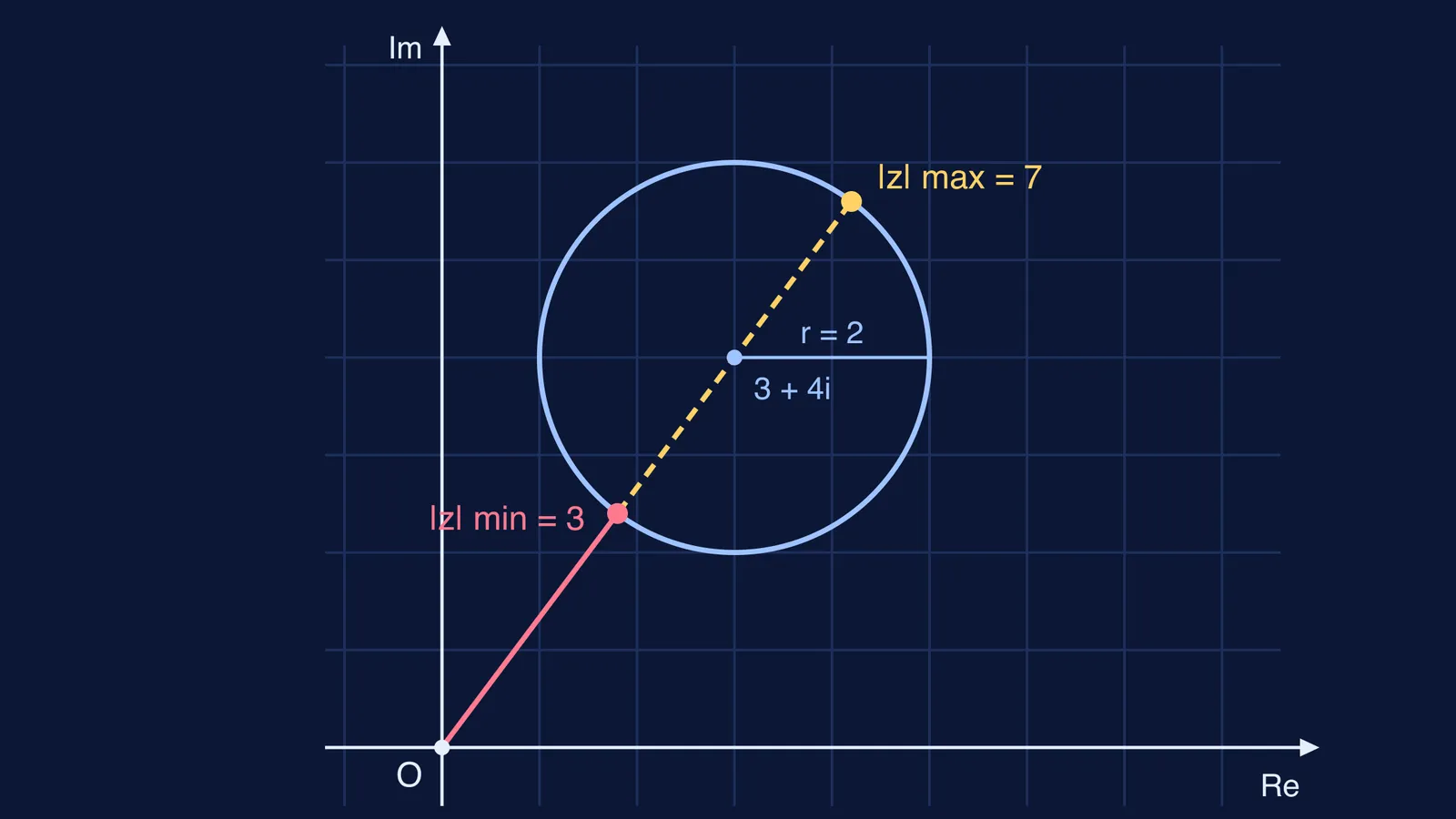
So |z − (3 + 4i)| = 2 says the point z is always 2 units from the point 3 + 4i. In the complex plane, the circle with centre c and radius r is |z − c| = r (Wikipedia: Circle). Here the centre is C = 3 + 4i, the point (3, 4), and the radius is 2.
And |z| is the distance from the origin O to z. The question becomes: which point on this circle is closest to O, and which is farthest?
What are the maximum and minimum values of |z|?
Find the distance from O to the centre: |3 + 4i| = √(9 + 16) = 5.
Since 5 > 2, the origin is outside the circle.
The farthest point is on the far side of the circle along the line OC, so |z| max = 5 + 2 = 7.
The nearest point is on the near side along the same line, so |z| min = 5 − 2 = 3.
So 3 ≤ |z| ≤ 7, and both ends are reached.
Where exactly do the maximum and minimum occur?
Both extreme points lie on the line through O and C. The unit vector in that direction is (3 + 4i)/5 = 0.6 + 0.8i. Walk 7 units along it for the farthest point and 3 units for the nearest:
Farthest: z = 7(0.6 + 0.8i) = 4.2 + 5.6i.
Nearest: z = 3(0.6 + 0.8i) = 1.8 + 2.4i.
Check the nearest one: z − (3 + 4i) = −1.2 − 1.6i, and √(1.44 + 2.56) = 2, so it is on the circle.
How do you prove it without a diagram?
Write c = 3 + 4i. The triangle inequality says |a + b| ≤ |a| + |b|, and its reverse form says the difference of two lengths is at most the length of their difference (Wikipedia: Triangle inequality). That gives:
|z| ≤ |z − c| + |c| = 2 + 5 = 7
|z| ≥ |c| − |z − c| = 5 − 2 = 3
Equality in the triangle inequality needs the two pieces to lie on the same ray (same source), which is why both extreme points are positive multiples of 3 + 4i.
What changes if the point or the circle changes?
The trap is the minimum when the point is inside the circle: then it is r − d, not d − r.
On |z − (3 + 4i)| = 2, find the range of |z + 3 + 4i|. Here a = −3 − 4i, so d = |6 + 8i| = 10. Answer: 8 to 12.
On the same circle, find the range of |z − 1|. Here d = |2 + 4i| = 2√5. Answer: 2√5 − 2 to 2√5 + 2.
On |z − (3 + 4i)| = 7, find the range of |z|. Now d = 5 is less than 7, so O is inside. Answer: 2 to 12.
On |z − (3 + 4i)| = 5, find the range of |z|. The circle passes through O. Answer: 0 to 10.
On |z − (3 + 4i)| = 2, find the range of |z|². Square the ends of 3 ≤ |z| ≤ 7. Answer: 9 to 49.
In question 3 the big circle swallows the origin, so the nearest point lies on the opposite side of O from the centre, 2 units away.
What should you practise next?
If you keep setting z = x + iy and grinding through square roots when a picture would do, work a few of these on paper and then compare your method with a full solution. The Fermi Problem Library has worked problems with a step-by-step solver that explains the reasoning rather than printing an answer.
If the Argand plane itself feels shaky, the Fermi Concept Library gives each concept in mathematics its own lesson and its place in the map.
Your next step: take any |z − c| = r question from your last mock test, find d first, and see how quickly it falls into place.


