

On this page
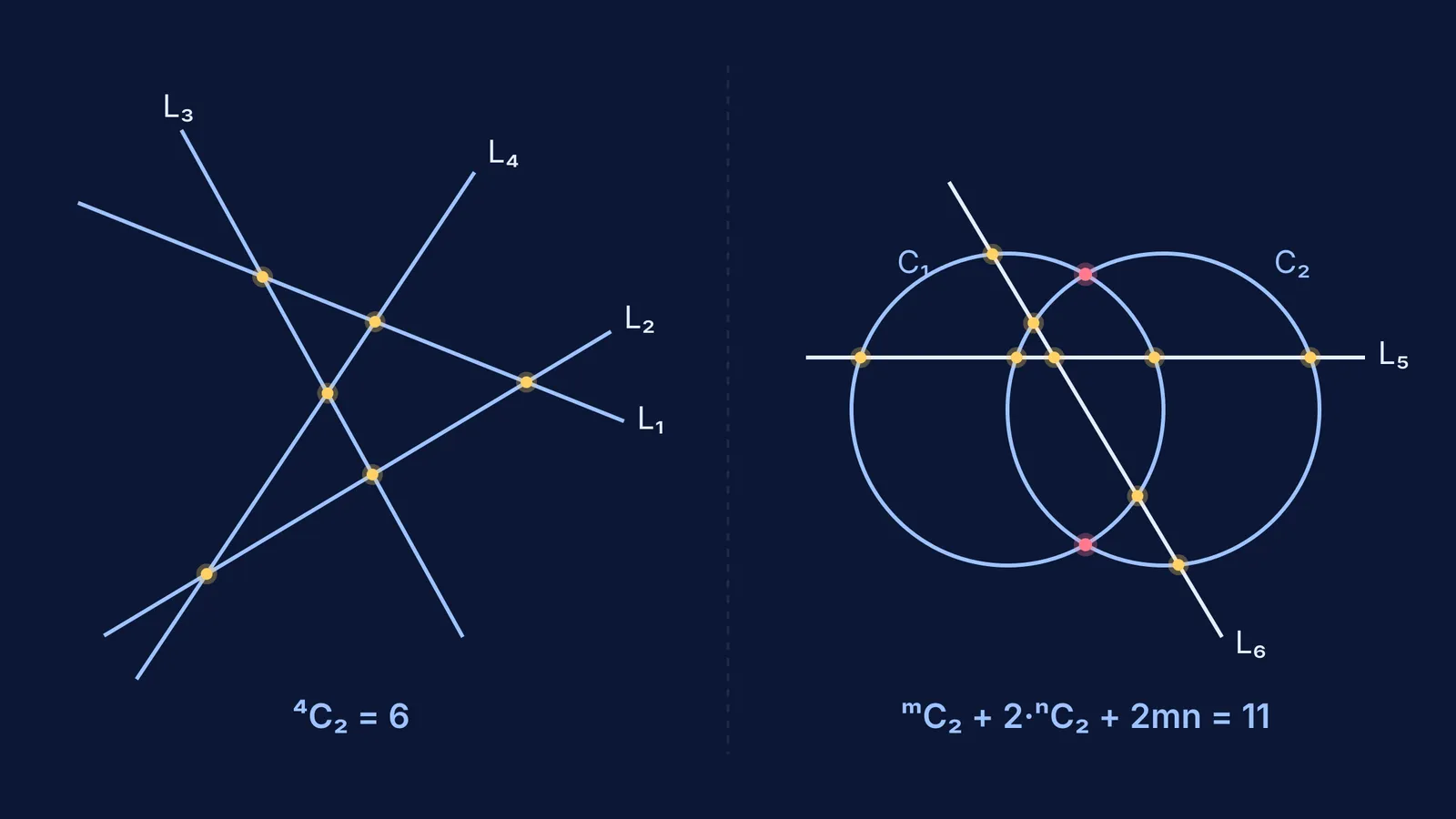
Why is the maximum number of intersection points of n lines equal to nC2?
Two distinct coplanar straight lines intersect at at most one point. If they are not parallel, solving their simultaneous linear equations yields exactly one coordinate pair (x, y), as confirmed in Wolfram MathWorld's Line-Line Intersection analysis. Because each crossing requires choosing two distinct lines, counting the maximum intersections of n lines maps directly to combinations.
In the CBSE Senior Secondary Mathematics curriculum, choosing 2 items from n distinct items without regard to order is denoted as ⁿC₂ = n(n − 1)/2. As explored in selection problems with combinations, this value sets the theoretical upper bound for pairwise interactions.
To achieve this maximum, the lines must lie in general position:
No two lines are parallel, ensuring every pair crosses.
No three lines pass through the same point, ensuring every crossing forms a fresh location.
Under these conditions, each new line k intersects all k − 1 previous lines at distinct points. Summing these successive crossings gives 1 + 2 + ... + (n − 1) = n(n − 1)/2 points. This pairwise geometry also governs how n lines partition a plane into at most n(n + 1)/2 + 1 regions, catalogued as sequence A000124 in the On-Line Encyclopedia of Integer Sequences.
How many intersection points can n circles and m lines create?
Two distinct circles in a plane can intersect at most twice. When the distance d between their centers satisfies |R − r| < d < R + r, solving their quadratic equations yields two distinct real points, as detailed in Wolfram MathWorld's Circle-Circle Intersection analysis. In general position, every pair of circles crosses twice, yielding 2 × ⁿC₂ = n(n − 1) points.
Similarly, a secant line crossing a circle produces two real intersection points when the quadratic discriminant is positive, as verified in Wolfram MathWorld's Circle-Line Intersection reference. In a composite system of m lines and n circles, each line crosses each circle twice, contributing 2mn points.
Combining all pairwise interactions yields the unconstrained upper limit:
Line-line crossings: ᵐC₂ = m(m − 1)/2
Circle-circle crossings: 2 × ⁿC₂ = n(n − 1)
Line-circle crossings: 2mn
Total Maximum = ᵐC₂ + 2(ⁿC₂) + 2mn
These calculations apply the same coordinate principles used when counting intersections of two sketched curves to determine real roots.
How do parallel and concurrent lines reduce the total intersection points?
In competitive examinations such as JEE Main, administered by the National Testing Agency, problems routinely include geometric constraints like parallel sets or points of concurrency. Rather than counting intersections from scratch, the most efficient method is subtracting forfeited points from the theoretical maximum.
Parallelism destroys intersection points entirely. If p lines are mutually parallel, they never meet, losing all ᵖC₂ = p(p − 1)/2 pairwise crossings: Loss from p parallel lines = ᵖC₂.
Concurrency merges separate intersections into one. When q lines pass through a single point, satisfying the algebraic condition for three lines to be concurrent, they produce 1 intersection instead of ᵠC₂ distinct points: Loss from q concurrent lines = ᵠC₂ − 1.
Similar deductions apply to circles. If c circles are concentric, they never cross, eliminating 2 × ᶜC₂ points. If two circles touch tangentially rather than crossing secantly, they share only 1 point instead of 2, subtracting 1 point per tangency.
How do you solve a multi-constraint intersection problem step by step?
When solving multi-condition geometry problems aligned with the CBSE Senior Secondary Mathematics curriculum, apply this four-step deduction framework:
Compute the unconstrained baseline: Baseline = ᵐC₂ + 2(ⁿC₂) + 2mn.
Deduct parallel line losses: Subtract ᵖC₂ for each parallel cluster.
Deduct concurrency losses: Subtract ᵠC₂ − 1 for each concurrent point.
Deduct circle constraint losses: Subtract 2(ᶜC₂) for concentric sets, and 1 per tangency.
Worked example
Question: What is the maximum number of intersection points formed by 8 straight lines and 4 circles, if 3 lines are parallel, another 4 lines are concurrent at a separate point, and 2 circles are concentric?
Unconstrained Baseline:
Line-line (m = 8): ⁸C₂ = 28 points.
Circle-circle (n = 4): 2 × ⁴C₂ = 12 points.
Line-circle: 2 × 8 × 4 = 64 points.
Baseline total = 28 + 12 + 64 = 104 points.
Deductions:
3 parallel lines lose ³C₂ = 3 points.
4 concurrent lines lose ⁴C₂ − 1 = 6 − 1 = 5 points.
2 concentric circles lose 2 × ²C₂ = 2 points.
Final intersection count = 104 − 3 − 5 − 2 = 94 points.
When managing several algebraic constraints at once, students frequently miscalculate by dropping signs or double-subtracting shared points. The Fermi Problem Library provides worked problems with a step-by-step solver that explains the reasoning rather than printing an answer, allowing you to trace combinatorial geometry line by line. To build a solid foundation across permutations and coordinate geometry, explore the Fermi Concept Library, which covers every concept in physics, chemistry, biology, mathematics and computing, each with its own lesson and its place in the map.


