

On this page
When you measure chemicals in a lab, you deal in grams. But chemical equations deal in single atoms and molecules. The bridge between these two scales is the mole, a central idea when learning the mole concept in Class 9 and beyond. A mole of any substance contains exactly the same number of particles, which lets you relate a measurable bulk mass to the invisible mass of a single particle.
As the Avogadro constant page on Wikipedia points out, this constant is the conversion factor that relates the molar mass of a substance to the average mass of a single particle. If you know how much a whole mole weighs, you can easily find the mass of just one piece of it.
How to find mass of one atom in grams chemistry?
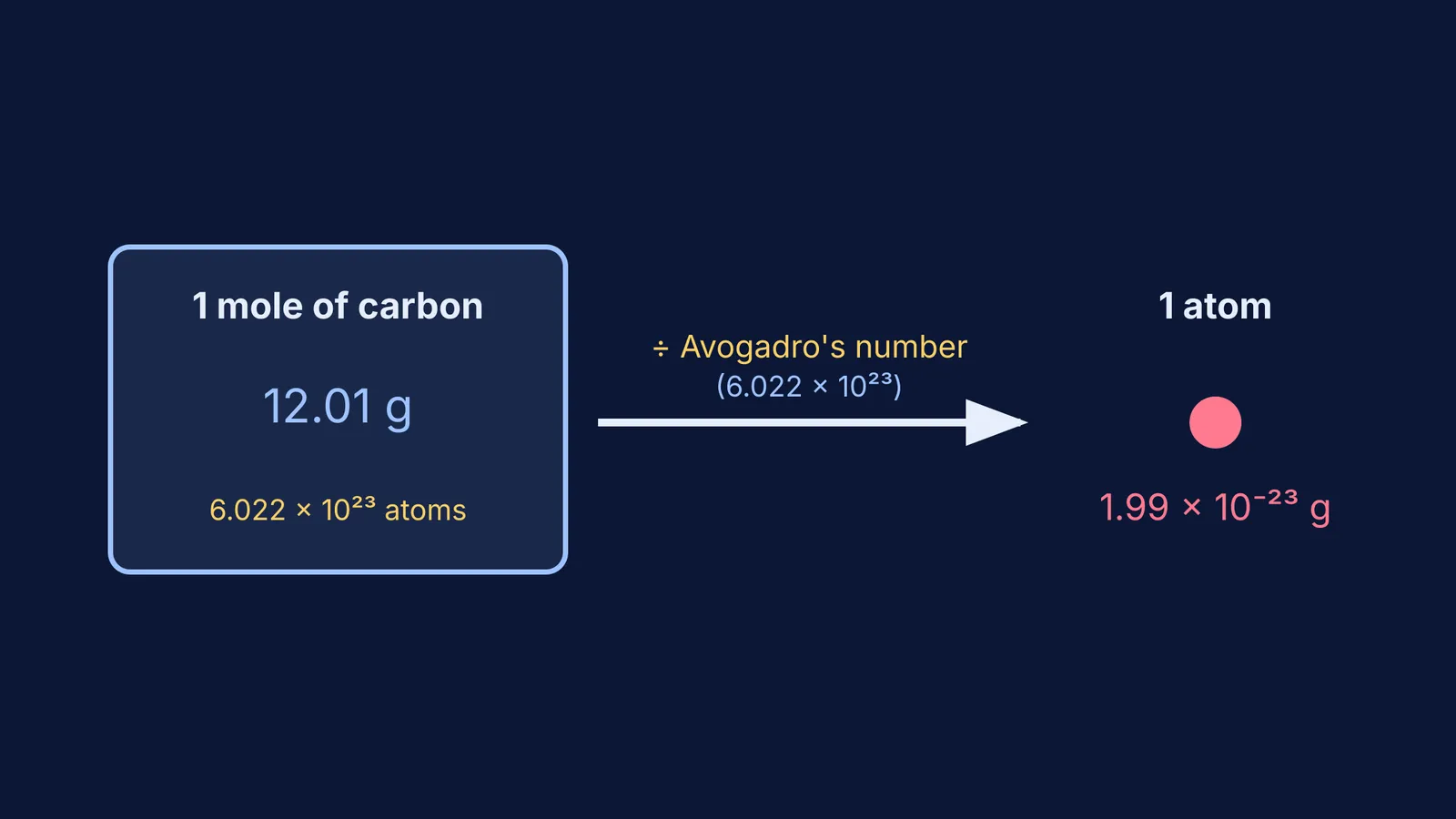
The calculation takes just one step: divide the molar mass by the number of particles in a mole.
Find the molar mass: Look up the atomic mass of the element on the periodic table. For carbon, the average molar mass is 12.01 g/mol.
Divide by Avogadro's number: The National Institute of Standards and Technology (NIST) defines the exact value of the Avogadro constant as 6.02214076 × 10²³ mol⁻¹. For most calculations, 6.022 × 10²³ is enough.
The formula is: Mass of one atom = Molar mass ÷ Avogadro's number
For a carbon atom: Mass = 12.01 g/mol ÷ (6.022 × 10²³ atoms/mol) Mass = 1.99 × 10⁻²³ g
This tells you that a single carbon atom weighs an unimaginably small fraction of a gram. This scale of measurement is why we rely on large constants to make sense of chemical reactions.
What about the mass of a single molecule?
The process is exactly the same for molecules. Instead of the atomic mass, you use the molar mass of the whole molecule. You calculate this by adding up the atomic masses of all the atoms in the chemical formula.
Take water (H₂O), for example:
Two hydrogen atoms: 2 × 1.008 g/mol = 2.016 g/mol
One oxygen atom: 16.00 g/mol
Total molar mass: 18.016 g/mol
Now, divide this molar mass by Avogadro's number: Mass of one water molecule = 18.016 g/mol ÷ (6.022 × 10²³ molecules/mol) Mass = 2.99 × 10⁻²³ g
Whether you are calculating the mass of a water molecule or learning the difference between molecular mass and formula unit mass, the mole concept keeps the arithmetic consistent.
How do you find the mass of one atom using atomic mass units?
Before you divide by Avogadro's number, you might encounter another unit: the atomic mass unit (amu or simply u). Scientists use amu to express the mass of individual atoms without writing out large negative exponents.
One atomic mass unit is defined as exactly one-twelfth of the mass of a single carbon-12 atom. Because of how the mole is defined, the numerical value of an element's atomic mass in amu is identical to its molar mass in grams per mole. For instance, a single oxygen atom has an average mass of 16.00 amu, and a mole of oxygen atoms has a mass of 16.00 g.
If you are given the mass of an atom in amu and need it in grams, you can use the direct conversion factor: 1 amu is approximately 1.66 × 10⁻²⁴ g. Multiplying the mass in amu by 1.66 × 10⁻²⁴ gives you the exact same result as dividing the molar mass by Avogadro's number. Both methods are mathematically equivalent ways to reach the mass in grams.
Why does finding the mass of one atom matter?
You might wonder why you need to know the mass of a single atom when you can only weigh large quantities in the laboratory. This calculation is a foundation for several advanced topics in chemistry and physics.
In solid-state chemistry, finding the mass of one atom is an essential step in calculating the density of a unit cell in a crystal lattice. By knowing the mass of the individual atoms and the geometry of the cell, you can predict the macroscopic density of the entire crystal.
In analytical chemistry, instruments like mass spectrometers measure the mass-to-charge ratio of individual ions. Understanding the absolute mass of a single particle in grams allows scientists to interpret mass spectra, identify unknown compounds, and separate different isotopes of the same element.
Does your answer pass the 10⁻²³ reality check?
In an exam, it is easy to press the wrong button on a calculator and accidentally multiply by Avogadro's number instead of dividing by it. This is where a quick mental check saves marks.
A single atom is incredibly light. When you calculate the mass of one atom or one small molecule in grams, the answer must always have a large negative exponent, typically around 10⁻²² to 10⁻²⁴ grams. If your calculator shows an answer like 7 × 10²⁴ grams, you have calculated the mass of a small planet, not an atom.
If you struggle with the mole concept or often find yourself stuck on the arithmetic, the Fermi Problem Library has a step-by-step solver that explains the reasoning rather than just printing an answer. It will walk you through the unit conversions and point out exactly where your exponent went wrong.


