

On this page
Imagine a seed falling into salty, shifting mud at high tide. It would float away or drown before it could ever grow a root. Mangroves survive this chaotic environment by not dropping seeds at all. Instead, they drop live, growing plants.
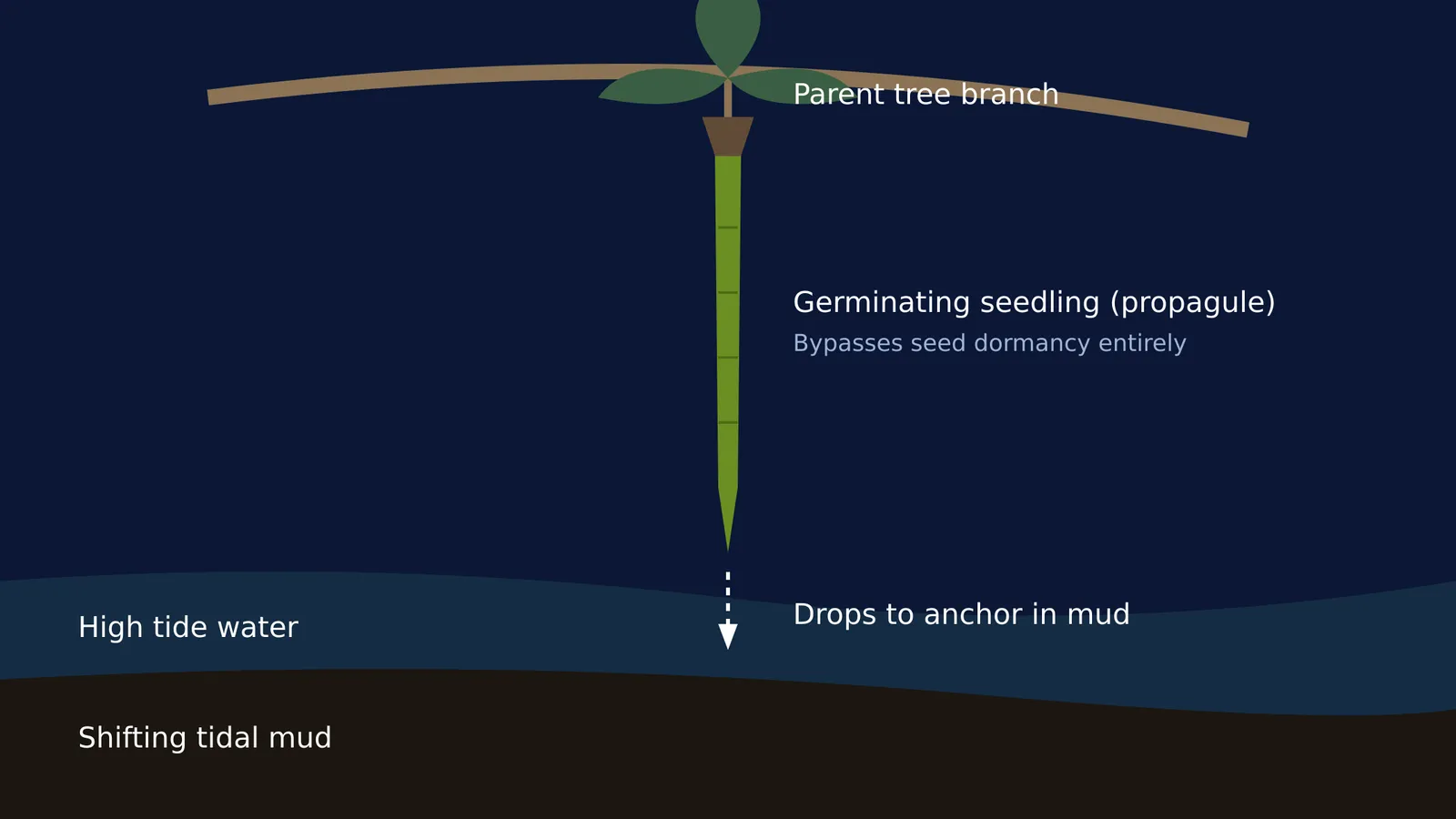
Mangrove seeds germinate while still attached to the parent tree, an adaptation known as vivipary *[Current Biology*]. Rather than waiting for the right conditions, they bypass dormancy completely and begin their life cycle suspended above the water.
Why do mangrove seeds germinate on the tree?
Most plants produce seeds that lie dormant. They wait for a seasonal change—like the arrival of spring, heavy rains, or even the intense heat of a forest fire—to break their dormancy. But in the coastal intertidal zone, the environment does not offer quiet seasons. It is harsh but consistent: the water is highly saline, the temperatures are warm, and the tides are constantly moving the ground beneath them.
A dormant seed dropped into this environment has no advantage. It needs to anchor itself immediately, before the outgoing tide pulls it out to the open sea or the incoming tide buries it too deep in anoxic mud.
By germinating on the tree, the mangrove embryo grows into a propagule, a seedling that draws nutrients and fresh water directly from the parent tree. As it hangs from the branch, it develops its own salt tolerance before it ever touches the ocean. When it finally drops, its heavy, pointed base plunges like a dart into the mud, allowing it to take root quickly. If it misses the mud and lands in the water, its built-in buoyancy lets it float horizontally. It can disperse across the sea, turning vertical only when it is ready to root on a new shoreline.
What turns the dormancy switch off?
For years, biologists understood the evolutionary reasons why mangroves were viviparous, but the exact genetic mechanism remained elusive. How did these trees manage to turn off the deep-seated dormancy found in almost all other flowering plants?
In August 2024, a team of researchers published a comparative genomic study in *Current Biology* to answer this exact question. They sequenced the full genomes of viviparous mangroves and compared them side-by-side with their non-viviparous inland relatives.
They found that the DELAY OF GERMINATION 1 (DOG1) family genes—which act as a master dormancy switch in most plants—are either entirely lost or completely dysfunctional in true viviparous mangroves.
In a typical plant, DOG1 genes ensure that seeds remain dormant by maintaining a high sensitivity to abscisic acid, the hormone that halts growth. Without functional DOG1 genes, mangrove seeds simply cannot remain dormant. They do not build up this sensitivity to abscisic acid. Instead, they bypass the pause button entirely and keep growing continuously from embryo to seedling. (For more on unusual seed development, read about seeds without fertilisation and what counts as a true fruit.)
How should you study biological adaptations?
It is easy to memorise the fact that mangroves show vivipary. But learning biology effectively is about connecting the why and the how. When studying a biological adaptation for an exam, do not just memorise the term. Use this three-step framework to connect the facts:
The environmental pressure: What problem does the organism face in its habitat? (In this case, shifting tidal mud makes it impossible for a dormant seed to safely anchor).
The physical trait: How does the organism solve this problem physically? (Vivipary produces a heavy, buoyant, ready-to-root propagule instead of a dry seed).
The molecular mechanism: What changed in the cells to make this happen? (The loss of the DOG1 gene family removes the ability to enter seed dormancy).
When you can trace an idea from the ecosystem down to the genome, you stop memorising disconnected facts and start understanding the system. The Fermi Concept Library maps out these deep connections across all sciences. Rather than giving you a flat list of definitions to learn, Fermi's AI tutor works through the evolutionary pressures and genetic mechanisms with you. It checks your understanding as it goes, making sure you can picture the whole system clearly before moving on to the next topic, such as the mathematics of arithmetic vs geometric plant growth.


