

On this page
When you study the human male reproductive system for biology exams, it is easy to focus on the testes and forget the plumbing. But sperm cells alone cannot survive the journey to fertilisation. They need a transport medium, chemical protection, and fuel.
That medium is seminal plasma, and it is manufactured by three male accessory glands: the seminal vesicles, the prostate gland, and the bulbourethral glands.
When sperm mix with seminal plasma, the resulting fluid is semen. If you are asked to define the composition of seminal plasma in an exam, the standard definition is that it is rich in fructose, calcium, and certain enzymes (Wikipedia). Here is what each gland contributes to the mix.
What does the seminal vesicle do?
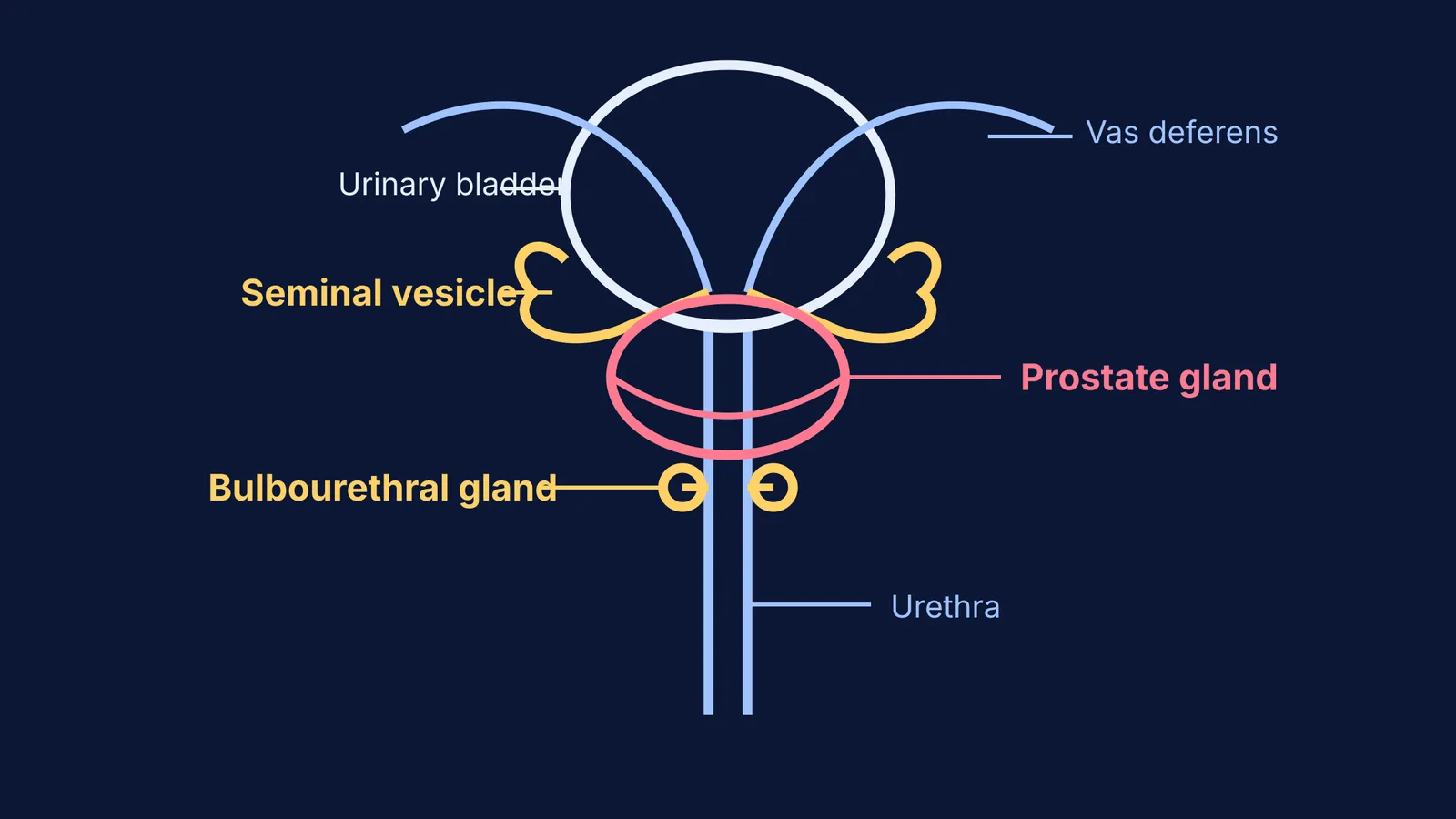
The paired seminal vesicles sit just behind the urinary bladder. Despite the name "vesicle", they do not store sperm; they are active factories.
The seminal vesicles contribute the majority of the seminal volume—roughly 70 to 85 percent (Wikipedia). Their most important contribution is fructose. Because sperm have to swim a long distance, their mitochondria need a dense, immediate source of energy, and fructose provides this fuel.
The vesicles also secrete prostaglandins, which help stimulate contractions in the female reproductive tract, and clotting proteins that temporarily coagulate the semen after ejaculation.
What is the function of the prostate gland?
There is only one prostate gland, and it is about the size of a walnut. It sits directly below the bladder and wraps entirely around the urethra.
The prostate adds a significant portion of the seminal volume. It secretes a milky fluid containing zinc, citric acid, and various enzymes (including prostate-specific antigen, or PSA) that help break down the clotting proteins from the seminal vesicles so the sperm can swim freely. Because the prostate surrounds the urethra, an enlarged prostate in older age can compress the tube and make urination difficult (Wikipedia).
What does the bulbourethral gland do?
The bulbourethral glands, also known as Cowper's glands, are a pair of pea-sized structures located beneath the prostate at the base of the penis.
Their contribution to the total volume of semen is very small, but their timing is critical. During sexual arousal, the bulbourethral glands secrete an alkaline mucus before ejaculation occurs (Wikipedia). The male urethra is a shared pathway for both urine and semen, and residual urine makes the environment acidic. The mucus neutralises this acidity, creating a safe pathway for the sperm that follow, while also providing lubrication.
The pathway of the ducts
The accessory glands do not just sit near the ducts; they are integrated into the transport system.
Sperm leave the testes and travel up through the vas deferens (the main sperm duct). As the vas deferens loops over the urinary bladder and approaches the prostate, it meets the duct coming from the seminal vesicle.
These two tubes merge to form the ejaculatory duct. This short duct passes straight through the tissue of the prostate gland and opens into the urethra. Because the prostate surrounds this junction, its secretions are added right as the sperm enter the urethra. Finally, the bulbourethral glands add their secretions to the urethra slightly further down, before the fluid exits the body.
Why is fructose so important?
Sperm are essentially packages of DNA with a flagellum (tail) attached. To minimise weight, they shed most of their cellular machinery during development, but they keep a tightly packed spiral of mitochondria wrapped around the base of their tail.
These mitochondria require an external energy source to generate ATP, the chemical battery that powers the tail's movement. While most cells in the human body rely on glucose for energy, sperm use fructose. The high concentration of fructose provided by the seminal vesicles ensures the sperm have a dedicated energy supply (Wikipedia).
How to remember the glands for exams
When labelling a diagram, trace the path from the bladder downwards:
Seminal vesicles: Leaf-like paired structures behind the bladder.
Prostate gland: The single large gland completely encircling the urethra just below the bladder.
Bulbourethral glands: The tiny paired dots further down the urethra.
If you are revising reproductive anatomy and find it hard to picture how the ducts join, search for it in the Fermi Concept Library. The AI tutor can help you walk through the system layer by layer and check your understanding before you face a diagram-based question in an exam.
Related reading:


