

On this page
When you were younger, you might have noticed that looking through a drop of water on a piece of clear plastic makes the print underneath appear larger. This isn't just an illusion or a trick of the eye—the water drop is acting as a true magnifying glass.
By understanding the physics of optics, you can turn a simple drop of water into a microscopic lens. This phenomenon is a brilliant way to test the principles of refraction in your own home, bridging the gap between textbook physics and the real world.
How does a water drop work as a magnifying lens?
When a small drop of water rests on a flat, transparent surface (such as a sheet of plastic), surface tension pulls the liquid tightly together. Because the water molecules attract one another, they try to form a shape with the least possible surface area. On a surface that resists water, this results in a dome shape. In the language of optics, this structure is a plano-convex lens: it is perfectly flat on one side and curved outward on the other.
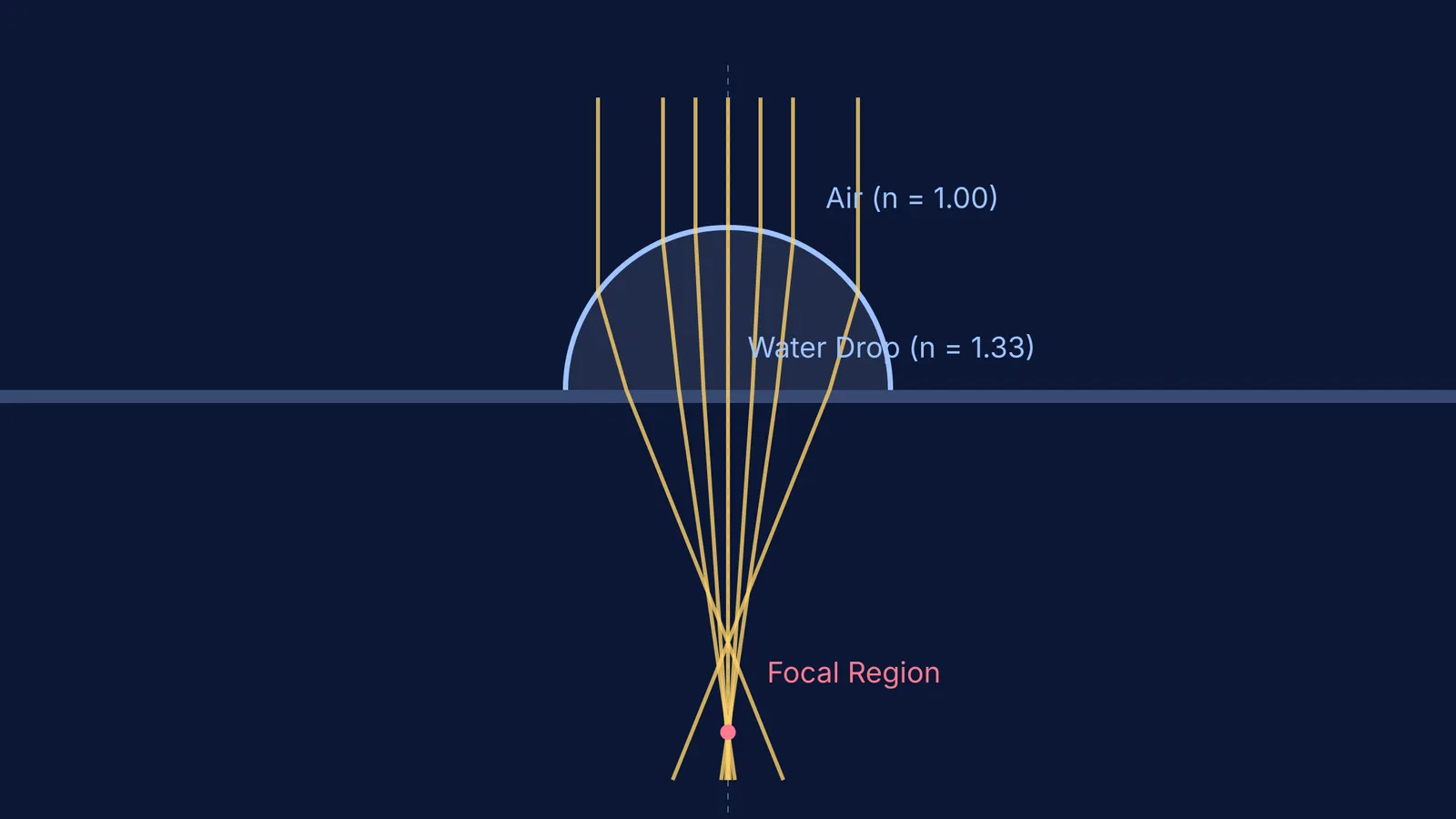
When light travels from the air into the denser medium of water, it slows down and changes direction—a process known as refraction. Because the water drop's top surface is curved, the parallel light rays entering it do not just bend; they bend toward the centre of the drop. These rays pass through the water, reach the flat bottom surface, bend again as they re-enter the air, and converge at a specific point called the focal point.
When you place a printed page closer to the water drop than this focal distance, the diverging light rays that reach your eye trick your brain. Your eyes trace the rays back in straight lines, creating a virtual, upright, and magnified image of the text. If you are having trouble picturing how these light paths change through different curved media, the Fermi Simulation Lab lets you interact with optical surfaces and see exactly where the rays go.
Why do smaller drops magnify better?
The magnifying power of your water drop depends heavily on its size, or more specifically, its radius of curvature (R). According to the lensmaker's equation, the focal length (f) is determined by the material's refractive index (n) and the curve of its surface.
For water, the refractive index is approximately 1.33, as shown in University Physics. If we plug this index into the lensmaker's equation for a plano-convex lens, we get a beautifully simple approximation:
1/f = (n - 1) / R
1/f = (1.33 - 1) / R
1/f = 0.33 / R
f ≈ 3R
This mathematical relationship reveals a key rule: the focal length of a water drop is roughly three times its radius of curvature.
Smaller water drops have a tighter curve (a smaller R), which means a shorter focal length. In optics, a shorter focal length produces higher magnification, allowing you to see much finer details. If you make the drop too large, however, gravity overcomes the surface tension and flattens the drop out. This flattening increases the radius of curvature dramatically, lengthening the focal point and ruining the magnification effect. For students working through these exact types of lens calculations, such as the rule that an object and real image are at least 4f apart, the Fermi Problem Library provides a step-by-step solver that explains the reasoning behind focal lengths rather than just printing an answer.
Why does the surface material matter?
Not all transparent surfaces will give you a good magnifying drop. The material you place the water on changes how the drop behaves.
If you use a hydrophobic (water-repelling) surface, such as a piece of stiff plastic or wax paper, the water beads up tightly. This preserves the small radius of curvature necessary for high magnification.
If you use a hydrophilic (water-attracting) surface, like a perfectly clean piece of glass, the water will simply spread out into a flat puddle. A flat puddle has an almost infinite radius of curvature, meaning it will not bend the light to a focal point at all. This is why a drop on a clean window just looks wet, rather than magnifying the world outside.
How do you make a water drop magnifier?
Cut a flat piece of clear, stiff plastic. The lid of a takeaway container, a CD case, or a clean ziplock bag works perfectly because plastic naturally repels water.
Use a toothpick or a clean dropper to place one tiny, round drop of water onto the plastic. Do not smear it.
Hold the plastic roughly one centimetre above a printed book, a map, or your phone screen, and look straight down through the drop.
To see the physics in action, experiment with the size of the drop. Notice how a tiny, perfectly spherical droplet magnifies the text intensely, while a larger drop barely distorts the words.
This simple experiment is a perfect reminder that the equations you learn in physics—from tracing a ray through a glass slab to refraction through a glass sphere—are constantly at work in the everyday world around you.


