

On this page
A bar magnet from a school lab usually has N and S painted on it. Pick one up from a pencil box, a fridge door or a toy and there are no labels. Is it even a magnet, or just a piece of iron? You can answer both questions with a thread, a compass and one rule about which poles push and which pull. This guide follows NCERT's Class 6 chapter Exploring Magnets and the Class 12 chapter Magnetism and Matter.
How do you find the north pole of a magnet?
The simplest method needs only a thread. A freely suspended magnet comes to rest along the north-south direction, according to NCERT's Class 6 science textbook. The end that points north is called the North-seeking pole, or simply the North pole.
Tie a thread around the middle of the magnet and hang it from the edge of a table or shelf.
Slide the knot until the magnet hangs level.
Turn it gently and let it come to rest, away from steel almirahs and other magnets.
Mark the two ends on paper below it.
Push it again. If it settles along the same line, that is the north-south line.
Use sunrise (east) and sunset (west) to tell which end faces north. Mark it N.
It settles this way because the Earth itself behaves like a giant magnet (NCERT Class 6), with its field pointing approximately from the geographic south to the north (NCERT Class 12). That gives a classic exam point: the magnetic pole near the geographic North Pole behaves like a south pole, because it pulls the north end of every compass.
A compass is quicker. The north-pointing end of a compass needle is usually painted red (NCERT Class 6). Bring one end of your magnet slowly towards it. If the red end swings away, you are holding a North pole. If it swings closer, it's a South pole.
Why do like poles repel and unlike poles attract?
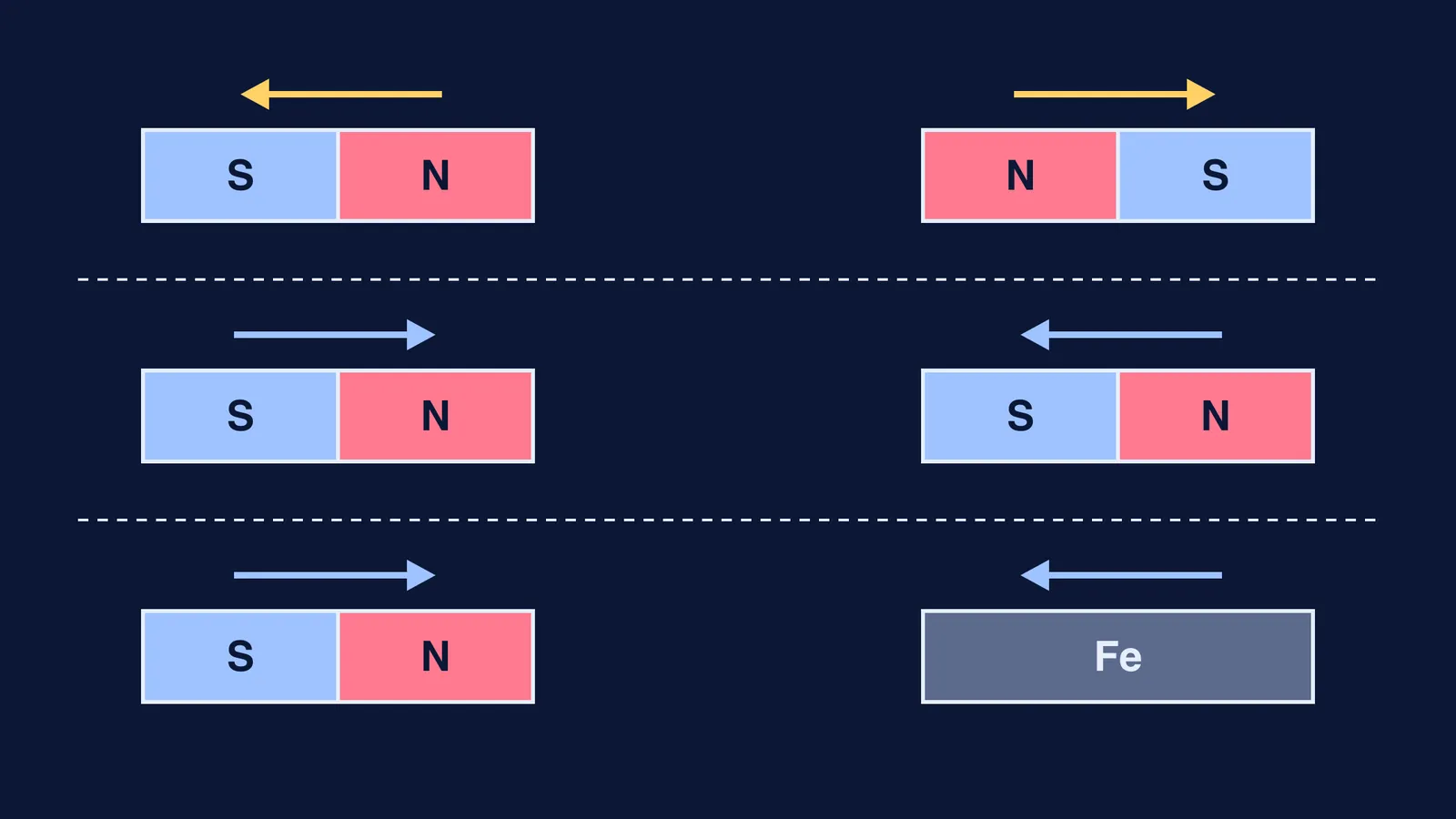
There is a repulsive force when the north poles (or the south poles) of two magnets are brought close together, and an attractive force between the north pole of one magnet and the south pole of another, as the NCERT Class 12 Physics chapter states.
You also cannot isolate a single pole. If a bar magnet is broken into two halves, you get two smaller bar magnets, each with its own north and south pole, because isolated magnetic monopoles do not exist (NCERT Class 12).
Why is repulsion the sure test of a magnet?
Attraction has two possible explanations. Repulsion has only one. In NCERT's Activity 4.5, when an iron bar replaces one of the two magnets, both ends of the iron bar are attracted by both the North and South poles of the magnet. The textbook concludes that a magnet can be identified by its property of repulsion (NCERT Class 6, Chapter 4).
If an object is pulled towards your magnet, it could be a magnet or plain iron. If one end pushes your magnet away, it is definitely a magnet. The thread test is a second check: a hanging iron bar can rest in any direction, but only a magnet rests along north-south (Class 6, Chapter 4).
Worked example: three bars, one known magnet
You have a labelled magnet M and two identical-looking bars, P and Q. Here is the reasoning an examiner wants to see.
Bring the N end of M towards each end of P. One end of P is pushed away. So P is a magnet, and that end is its North pole, because only like poles repel.
Bring the N end, then the S end, of M towards both ends of Q. Every end is pulled in. So Q is not a magnet; it is a magnetic material such as iron.
Check: hang P from a thread. Its North pole should settle facing north. Q need not.
Step 2 needs both poles of M. One attraction alone rules nothing out.
What mistakes cost marks on magnet questions?
Writing that attraction is the sure test. It is repulsion.
Assuming a broken magnet gives one piece with only an N pole and another with only an S pole.
Calling the pole near the geographic North Pole a magnetic north pole without explaining why a compass points to it.
Thinking a sheet of wood, cardboard, plastic or glass blocks a magnet. NCERT's Activity 4.7 finds no appreciable change in a compass needle's deflection with any of them in between (Class 6, Chapter 4).
If the pole rules feel shaky, go back to the idea of a field. The Fermi Concept Library gives every concept in physics its own lesson and its place in the map. To test yourself, the Fermi Problem Library has worked problems with a step-by-step solver that explains the reasoning rather than printing an answer.
Next time you find an unlabelled magnet, try for a push before you trust a pull.


