

On this page
Magnesium is the last cation you look for in Class 12 salt analysis. There is no group reagent to add. The precipitate can be slow to appear. And if you rushed an earlier step, the result can fool you. Here is what the test is, the chemistry behind it, and a plan you can follow at the bench and in your viva.
What is the confirmatory test for magnesium ion in Group VI?
In the NCERT Class 12 chemistry laboratory manual, Unit 7, Group VI lists only one cation, Mg²⁺, and its group reagent is listed as "None" (Table 7.11).
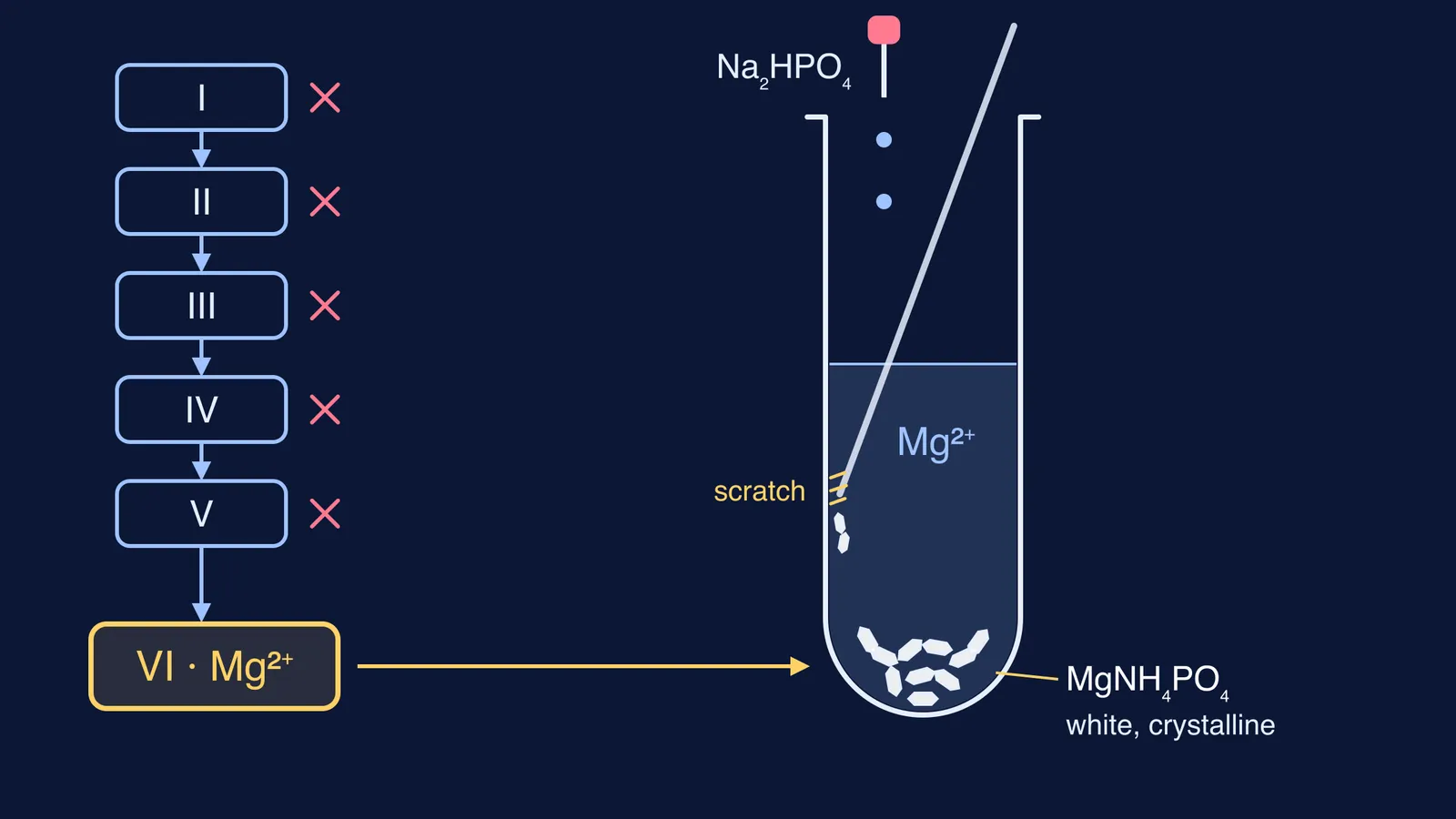
The confirmatory test, from the same manual: add disodium hydrogen phosphate (Na₂HPO₄) solution and scratch the inner walls of the test tube with a glass rod. A white crystalline precipitate of magnesium ammonium phosphate shows that Mg²⁺ is present.
Written with ions, a balanced version of the reaction is:
Mg²⁺ + HPO₄²⁻ + NH₄OH → MgNH₄PO₄ (white precipitate) + H₂O
The ammonium in the precipitate has to come from somewhere, which is why the test is done in a solution that contains ammonium salts and ammonia. The solid usually crystallises with water: PubChem's struvite record gives it as magnesium ammonium phosphate hexahydrate, (NH₄)MgPO₄·6H₂O.
Why does magnesium not precipitate in Group V?
For Group V, the NCERT manual has you take the original solution, add a little solid ammonium chloride, an excess of ammonium hydroxide and then solid ammonium carbonate. Barium, strontium and calcium come down as white carbonates.
Magnesium carbonate stays dissolved. The ammonium ions take up carbonate ions:
NH₄⁺ + CO₃²⁻ ⇌ NH₃ + HCO₃⁻
The manual explains that, with this equilibrium shifted to the right, the carbonate concentration needed to precipitate magnesium is not reached, so Mg²⁺ stays in solution and passes on to Group VI. This is the solubility product and the common ion effect at work, the two principles NCERT names at the start of the unit.
If those two ideas still feel shaky, the Fermi Concept Library has a lesson for every concept in chemistry, so you can go over them before your practical rather than memorising the steps blind.
How do you do the magnesium test, step by step?
Make sure Group V is absent: no white precipitate after ammonium chloride, excess ammonium hydroxide and solid ammonium carbonate. NCERT tells you to test for Mg²⁺ only if Group V is absent.
Take some of that clear solution, which already contains ammonium salts and ammonia, in a clean test tube.
Add disodium hydrogen phosphate solution.
Scratch the inner walls of the test tube with a glass rod.
If nothing appears, warm the solution and scratch again. NCERT notes that the precipitate sometimes appears only after some time.
A white crystalline precipitate means Mg²⁺ is confirmed.
There is also an early clue from the dry tests. If the salt leaves a white residue in the charcoal cavity, NCERT's cobalt nitrate test turns magnesium oxide pink (CoO·MgO). Treat this as a hint only: the manual says preliminary tests are not conclusive.
What if the result looks wrong?
NCERT's own discussion questions include this one: why do we sometimes get a white precipitate in Group VI even if the salt does not contain Mg²⁺? It is worth thinking through before your viva. Use this checklist when your result does not make sense:
No precipitate straight away? Warm, scratch and wait before you write "absent".
White precipitate in the Group V step? Then you are not at Group VI. Confirm Ba²⁺, Sr²⁺ or Ca²⁺ instead.
Not sure Group V was really absent? Repeat it on fresh original solution, because the Group VI result only counts once Group V is clearly negative.
How should you write it in your practical record?
NCERT asks you to record observations and inferences in a table. Here is a worked entry you can adapt:
Experiment: To the solution left after the Group V test (no precipitate), added disodium hydrogen phosphate solution and scratched the inner walls of the test tube with a glass rod.
Observation: White crystalline precipitate.
Inference: Mg²⁺ confirmed, as magnesium ammonium phosphate.
Three viva questions you should be able to answer in one breath:
What is the group reagent for Group VI? There is none; Mg²⁺ is tested directly.
Why doesn't Mg²⁺ come down in Group V? Ammonium ions turn carbonate into hydrogencarbonate, so there is not enough carbonate to precipitate magnesium carbonate.
Why scratch the tube? The precipitate can be slow to form; scratching the glass helps the crystals start growing, and NCERT adds warming for the same reason.
When a solubility product or common ion problem trips you up, the Fermi Problem Library has worked problems with a step-by-step solver that explains the reasoning rather than printing an answer.
Next time you reach Group VI, you will know what you are waiting for: a white crystalline solid, a scratched tube, and a reason for every step.


