

On this page
If a chemistry lab experiment goes wrong and a strip of magnesium catches fire, reaching for a standard red carbon dioxide extinguisher is a dangerous mistake. Most fires die in CO₂ because the heavy gas pushes away the oxygen the fire needs to burn. Magnesium, however, does not need free oxygen in the air—it takes what it needs directly from the carbon dioxide.
What is the chemistry of the reaction?
Magnesium is a highly reactive alkaline earth metal that burns with a brilliant, blinding white flame. At these extreme temperatures, the solid metal acts as an exceptionally powerful reducing agent.
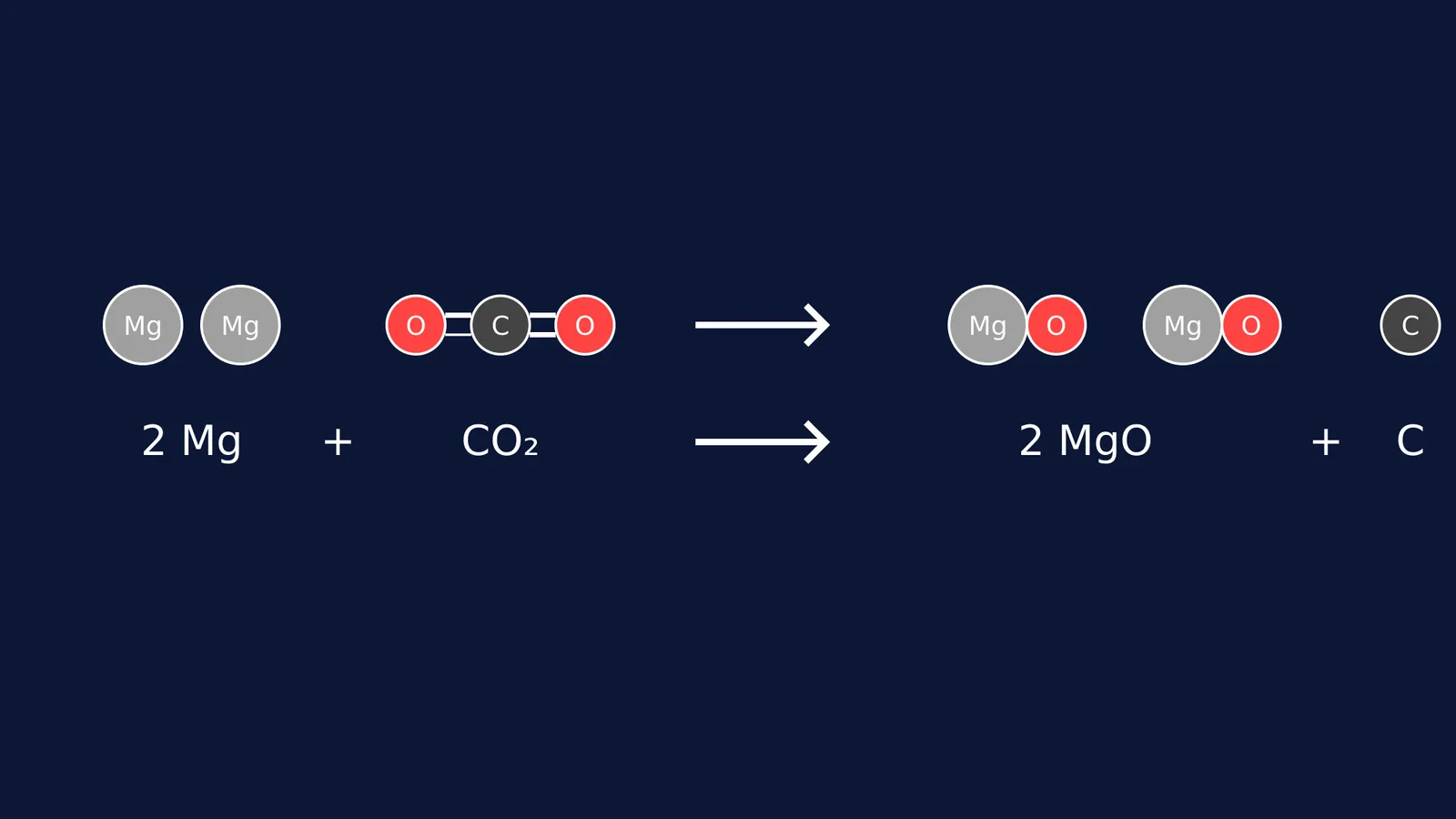
When burning magnesium is plunged into a cloud of CO₂ gas or placed inside a block of solid dry ice, it rapidly breaks the strong carbon-oxygen double bonds. The balanced equation for this reaction is:
2 Mg (s) + CO₂ (g) → 2 MgO (s) + C (s) (Purdue University)
As the reaction progresses, it leaves behind two distinct products: a crumbly white ash made of magnesium oxide, and tiny specks of black carbon soot. Thermodynamically, the formation of magnesium oxide is so stable that it releases far more energy than is required to break apart the CO₂ molecules. Consequently, the fire continues to sustain itself, burning vigorously even without atmospheric oxygen. (For a different look at how metals burn in air, see our post on Why Do Sparkler Sparks Not Burn Your Hand Like the Wire Does?).
Why does water fail to put out a magnesium fire?
You cannot put out a magnesium fire with water, either. Throwing water onto burning magnesium creates a completely new, equally dangerous chemical hazard. At high temperatures, the reactive magnesium strips the oxygen from the water molecules (H₂O).
This rapid chemical reaction produces magnesium hydroxide and releases highly flammable hydrogen gas. Because the fire is already burning at extreme temperatures, the sudden pocket of newly formed hydrogen gas ignites instantly. This can cause a violent explosion that shatters the metal and scatters burning magnesium fragments across the room, spreading the fire further.
Learning to spot these exceptions is a core part of inorganic chemistry. If you need a safe space to practice, the Fermi Concept Library covers every concept in chemistry, each with its own lesson and its place in the map.
How do you put out a Class D metal fire?
Because magnesium fires—which are formally classified as Class D combustible metal fires (Dust Safety Science)—cannot be put out with water, foam, or carbon dioxide, they require highly specialized extinguishing methods.
A Class D fire extinguisher contains specialized dry powders, most commonly sodium chloride (table salt) or graphite-based compounds. When sprayed onto the burning metal, these powders perform two vital functions:
They absorb the extreme heat from the metal, acting as a thermal sink to bring the magnesium below its ignition temperature.
They melt and fuse together to form a hard, physical crust over the magnesium, completely sealing it off from the surrounding air and smothering the reaction.
In a school laboratory, a simpler emergency method is often used: dumping a bucket of clean, dry sand directly over the burning strip. The sand acts as a heavy, non-reactive blanket that cuts off the oxygen supply and safely absorbs the excess heat.
Lab safety checklist for magnesium
Before lighting a magnesium ribbon in class, run through these four essential checks:
Locate the sand: Ensure a bucket of dry sand is uncovered and within arm's reach of your workstation.
Check the extinguisher: Confirm your lab has a yellow-starred Class D extinguisher mounted nearby, not just the standard red ABC or CO₂ canisters.
Protect your eyes: Wear UV-filtering safety goggles, as the bright white light emitted by burning magnesium can damage your retina.
Keep it dry: Remove all beakers, flasks, and wash bottles of water from the immediate workbench to prevent accidental spills.


