

On this page
We have all been there during a celebration: you are holding a sparkler, and a tiny, glowing spark lands on your skin. You feel a quick prick, but it does not burn. Yet, you are warned never to touch the glowing wire itself.
Why the difference? It comes down to a fundamental physics lesson: the difference between temperature and heat.
Temperature vs heat: The physics of a spark
The National Fire Protection Association (NFPA) notes that a sparkler burns at roughly 1,200 °F (about 650 °C), hot enough to melt some metals. The tiny sparks flying off are burning at this exact same temperature.
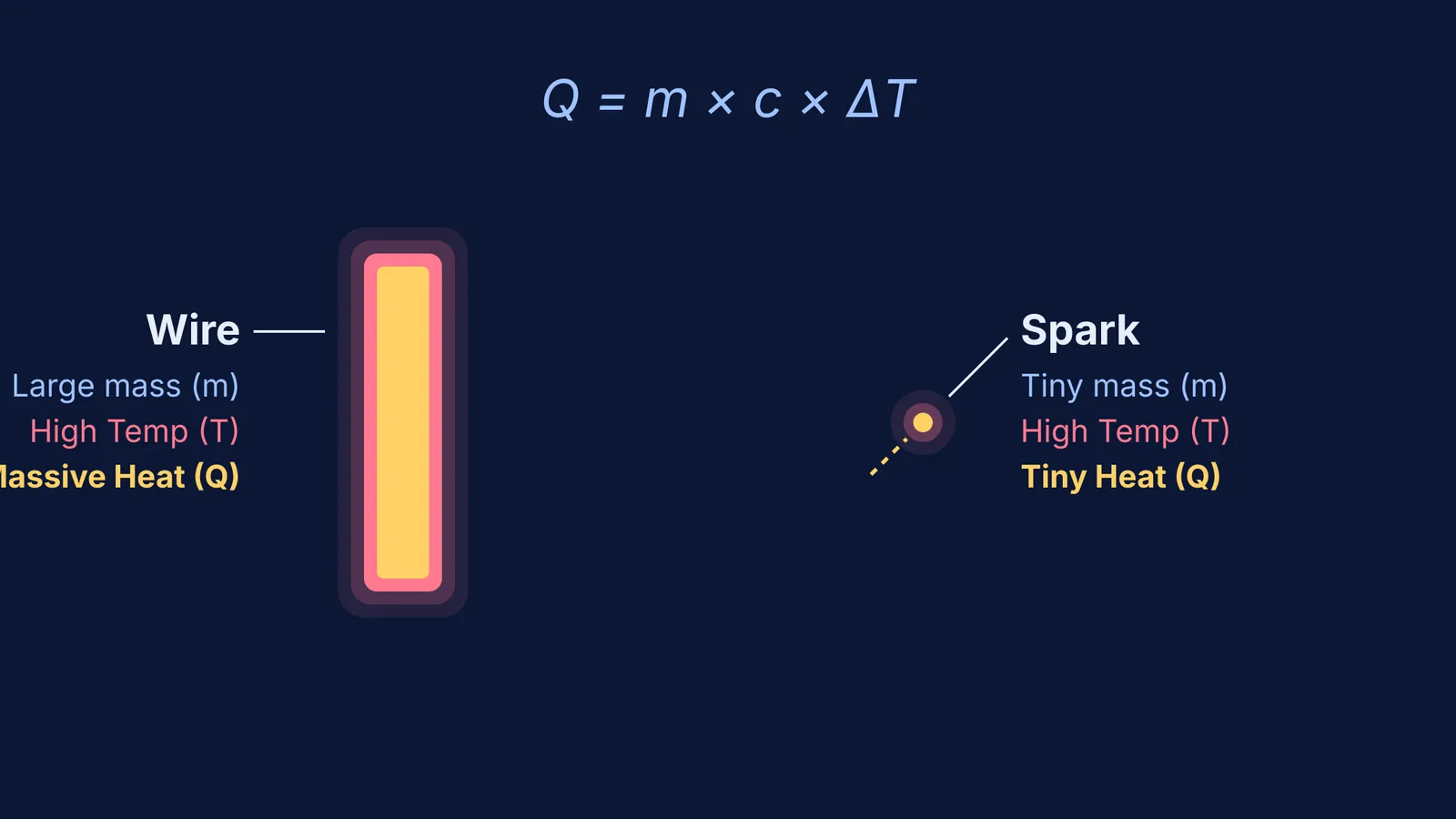
However, temperature is only a measure of the average kinetic energy of the particles. Heat, or thermal energy, is the total amount of energy transferred, and it depends heavily on mass.
According to the specific heat formula explained by Lumen Learning, Q = mcΔT, where Q is the heat transferred, m is the mass, and c is the specific heat capacity.
A single spark is a microscopic droplet of burning metal. Because its mass is incredibly small, the total heat it carries is near zero. When it lands on your skin, it cools almost instantly, lacking the thermal energy to actually raise your skin's temperature enough to cause a burn.
Why do the sparks cool so quickly in the air?
Another reason the sparks do not burn you is how they behave while flying through the air. Because the sparks are microscopic, they have a very high surface-area-to-volume ratio. This allows them to radiate and dissipate their heat into the surrounding air almost instantly. By the time a spark travels a short distance and hits your skin, it has already lost a significant portion of its initial energy.
The role of specific heat capacity
We often talk about mass and temperature, but the material's specific heat capacity (the c in Q = mcΔT) also plays a crucial role. Specific heat is the amount of energy required to raise the temperature of 1 kilogram of a substance by 1 °C.
Water has a very high specific heat capacity, which is why a drop of hot water can carry a surprising amount of thermal energy. The metals used in sparklers, such as iron or aluminum flakes, have a much lower specific heat capacity than water. This means that, gram for gram, metal holds less heat energy than water does at the same temperature. When you combine the lower specific heat of metal with the microscopic mass of the spark, the resulting heat energy is negligible.
Why does the wire burn you?
If the sparks are harmless because of their tiny mass, the sparkler wire is the exact opposite. The wire core acts as a huge reservoir of thermal mass. It has the same high temperature, but a massive amount of material. If you touch it, a huge amount of heat transfers into your skin, causing a severe, immediate burn.
This thermal mass is why the National Fire Protection Association warns against their use, noting that children under fifteen account for roughly one-third of all fireworks-related injuries and that 35% of all injuries affect hands and fingers. It is also why we are told to drop spent sparklers into a bucket of water—to safely remove the heat.
If you are studying these principles for an exam, the Fermi Simulation Lab allows you to visualize how mass affects heat transfer and interact with these physics equations dynamically.
A framework for explaining this to a student
When explaining calorimetry and heat transfer concepts to a student, use extreme comparisons to help them intuitively grasp the difference before getting bogged down in the math:
The Temperature Question: "Which is hotter: a tiny sparkler spark or a warm bathtub?" (The sparkler.)
The Heat Question: "Which has more total heat energy: a tiny sparkler spark or a warm bathtub?" (The bathtub, because it has thousands of kilograms of mass.)
The Conclusion: "So, if heat is what melts an ice cube, which one would melt more ice?"
If your student still gets stuck connecting these ideas to isobaric or isochoric processes, Fermi's AI tutor can work out exactly where their intuition is breaking down and guide them to the right conclusion without just handing them the answer.


