

On this page
Most linear differential equations you meet will ask you to find y as a function of x. The standard approach is to write them in the form dy/dx + Py = Q, find an integrating factor, and integrate.
But occasionally, an equation completely resists this method. If you try to isolate dy/dx and end up with a messy fraction where y is trapped in the denominator or raised to a power, you are likely looking at an equation that is linear in x instead.
Switching your perspective—treating x as the dependent variable and y as the independent variable—clears the path to the solution immediately.
How do you spot a dx/dy linear differential equation?
The standard linear differential equation with y as the dependent variable looks like this:
dy/dx + Py = Q
where P and Q are constants or functions of x.
According to the NCERT Class 12 mathematics textbook, the alternative form flips the script:
dx/dy + Px = Q
In this version, P and Q must be constants or functions of y only. The variable x and its derivative dx/dy can only appear to the first power.
When should you check for the dx/dy form?
Students often waste time trying every substitution before realising an equation is linear in x. A good rule of thumb is to look at the terms involving variables without differentials. If the equation features higher powers of y, such as y² or y³, but only single, unpowered instances of x, it is a strong candidate for the dx/dy method.
Another clue hides in the structure of fractions. When you express the equation as dy/dx and find a multi-term polynomial in the denominator, you cannot split the fraction. However, flipping it to dx/dy moves the polynomial to the numerator, allowing you to divide each term separately.
What is the integrating factor for dx/dy?
Because y is now the independent variable, the integration happens with respect to y. The integrating factor (I.F.) is:
I.F. = e^(∫ P dy)
When you multiply the entire differential equation by this integrating factor, the left side collapses into the exact derivative of the product of x and the I.F. Integrating both sides with respect to y gives the general solution:
x × (I.F.) = ∫ (Q × I.F.) dy + C
If you have concept gaps around which variable to solve for, the Fermi Concept Library explains every concept in mathematics, helping you see the structural differences between these forms before you begin calculating.
How do you solve y dx − (x + 2y²) dy = 0?
Let's look at a classic example that looks impossible if you try to find dy/dx.
If you isolate dy/dx, you get dy/dx = y / (x + 2y²). This is not linear in y, and the x in the denominator makes it difficult to separate or substitute.
Instead, isolate dx/dy:
y dx = (x + 2y²) dy dx/dy = (x + 2y²) / y dx/dy = x/y + 2y
Bring the x term to the left to match the dx/dy + Px = Q form:
dx/dy − (1/y)x = 2y
Now, identify P and Q:
P = −1/y
Q = 2y
Next, find the integrating factor: I.F. = e^(∫ −1/y dy) I.F. = e^(−ln y) I.F. = e^(ln(y⁻¹)) I.F. = 1/y
Multiply the standard solution formula by the I.F.: x × (1/y) = ∫ (2y × 1/y) dy + C x/y = ∫ 2 dy + C x/y = 2y + C
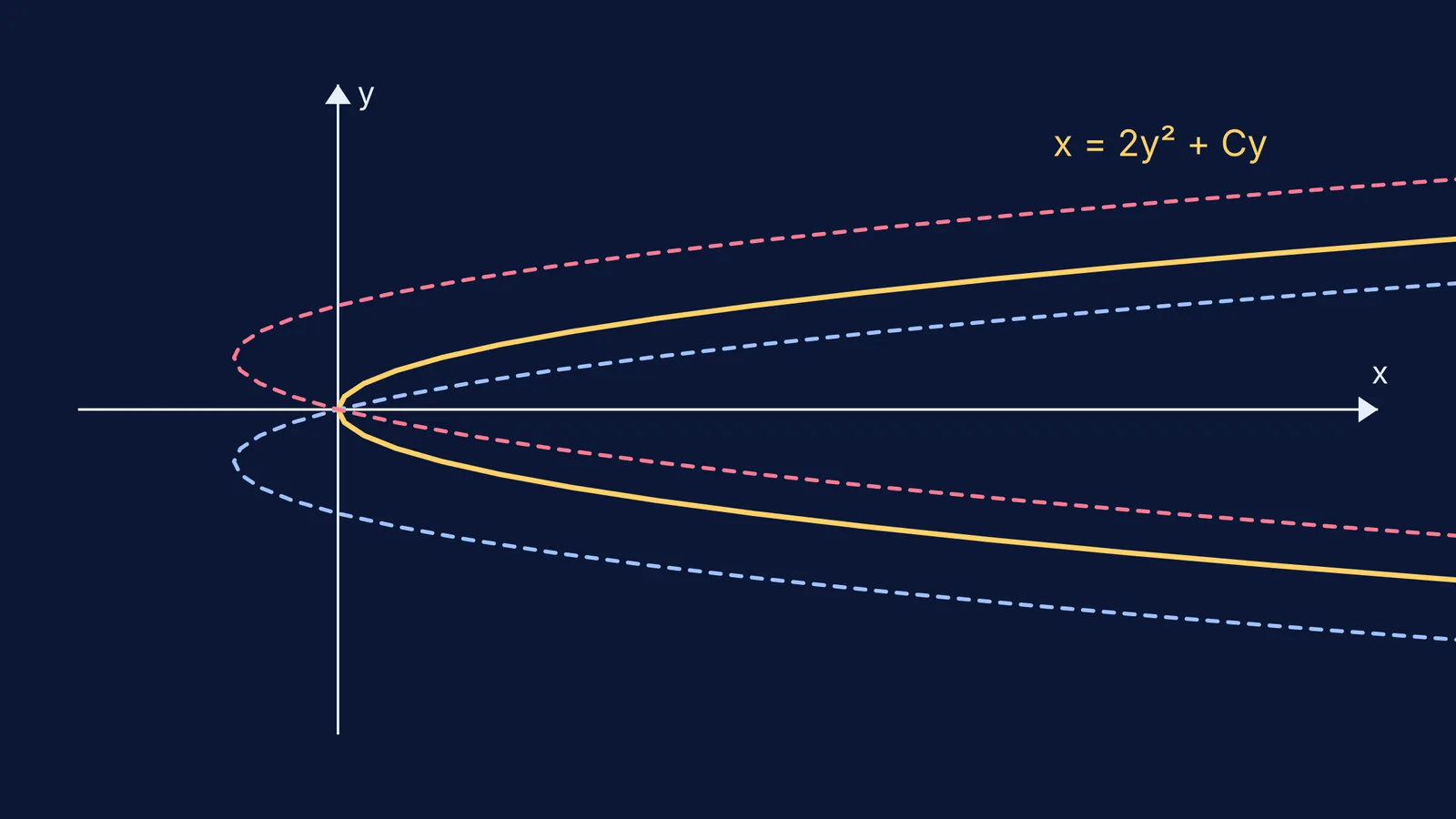
Finally, multiply by y to get the general solution: x = 2y² + Cy
By switching your perspective and treating x as the dependent variable, a seemingly complex non-linear equation becomes a straightforward three-step integration. If you make a wrong-method mistake during these steps, the Fermi Problem Library has worked problems with a step-by-step solver that explains the reasoning rather than just printing an answer.
How do you handle signs in the integrating factor?
When integrating P with respect to y, you often encounter logarithmic functions. In our example, P = −1/y, which integrates to −ln |y|. It is a common mistake to drop the negative sign or place it incorrectly.
Using logarithm properties, −ln y must be rewritten as ln(y⁻¹) before the exponential and natural logarithm can cancel each other out. If you merely cancel e and ln while ignoring the negative coefficient, you will end up with an integrating factor of y instead of 1/y, leading to a completely incorrect solution.
Read more:


