

On this page
In short
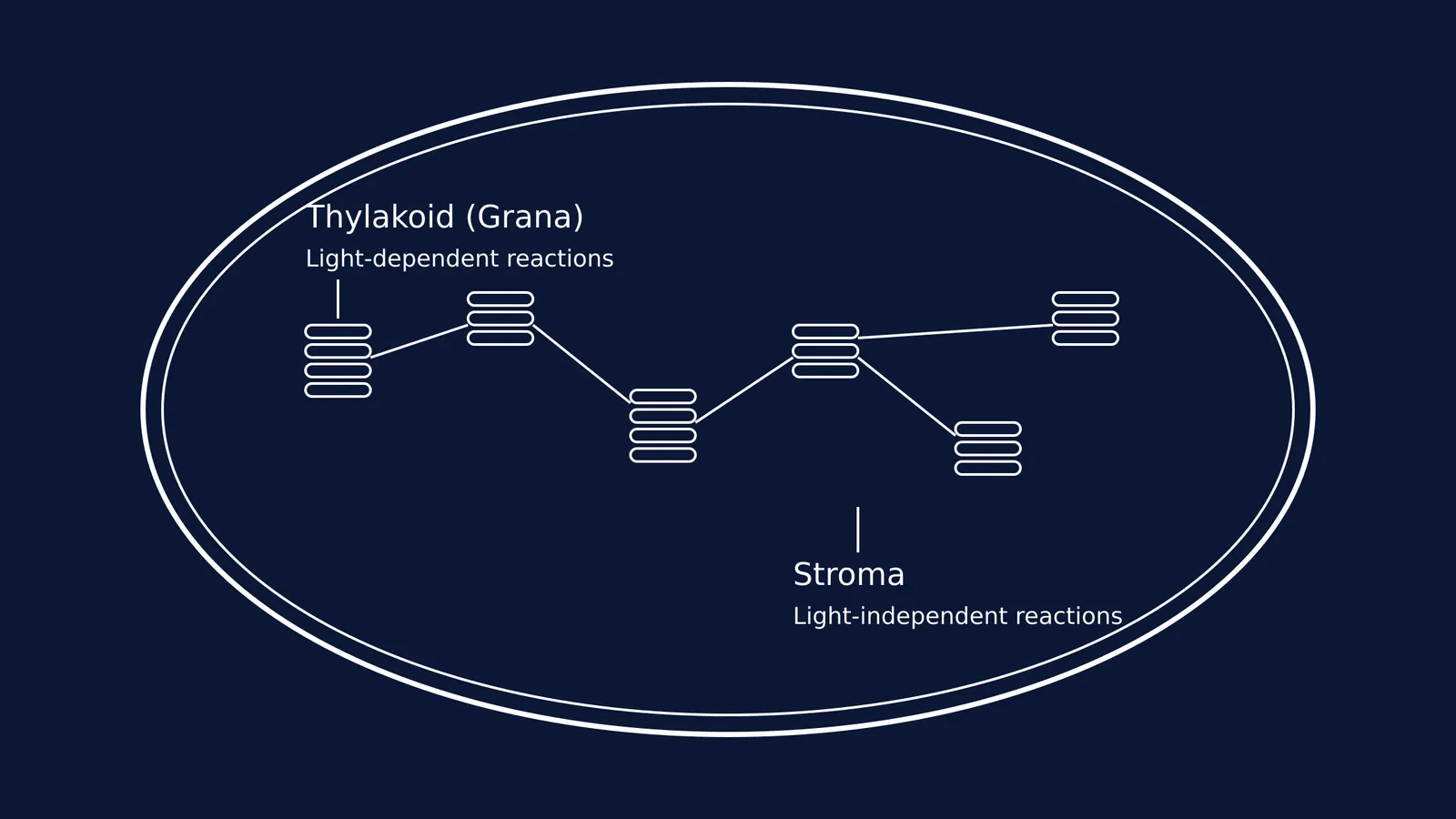
Light-dependent reactions take place in the thylakoid membranes (grana) of the chloroplast, where sunlight is captured. The light-independent reactions occur in the stroma, using the ATP and NADPH produced earlier to build sugars. The term "dark reaction" is misleading because these stroma reactions rely on products from the light stage and use light-activated enzymes, meaning they rarely happen in the dark.
Photosynthesis is often taught as a tale of two halves: the light reactions that capture energy, and the dark reactions that build sugars. But this framing creates one of the most common points of confusion for students studying cell biology.
Knowing exactly where these reactions happen inside the chloroplast—and why they happen there—is crucial for making sense of plant metabolism and tracing the energy flow from a photon to a glucose molecule.
Where do light and dark reactions take place?
Both stages of photosynthesis happen inside the chloroplast, but they are physically separated into two distinct compartments.
Light-dependent reactions take place in the thylakoid membrane. Thylakoids are flattened, disc-like sacs arranged in tight stacks called grana. A typical mature chloroplast contains approximately 40 to 60 grana stacks. This membrane is embedded with chlorophyll and massive protein complexes, including Photosystem I and II. These complexes absorb light and drive the electron transport chain. As electrons move through the membrane, protons are pumped into the small space inside the thylakoid (the lumen), creating a gradient that powers the production of ATP and NADPH.
Light-independent reactions (the Calvin cycle) take place in the stroma. The stroma is the thick, aqueous fluid surrounding the thylakoids inside the chloroplast. It contains a high concentration of the enzymes needed to take the ATP and NADPH from the light reactions and use them to fix carbon dioxide into sugars.
This separation of space is highly deliberate. The folded thylakoid membranes provide the massive surface area needed to catch as many photons as possible, while the stroma provides a liquid medium where soluble enzymes can float freely and mix with dissolved carbon dioxide. You can see how external elements affect this delicate balance when looking at limiting factors in photosynthesis.
Why is the term dark reaction misleading?
The term "dark reaction" suggests a process that happens at night or in the absence of light. In reality, the light-independent reactions happen almost entirely during the day, simultaneously with the light reactions.
According to *Biology 2e* by OpenStax, the term is misleading for two primary reasons:
It needs light products: The Calvin cycle requires a constant, rapid supply of ATP and NADPH to function. Because these molecules are produced exclusively by the light-dependent reactions, they quickly run out when the sun goes down.
Light-activated enzymes: Several key enzymes in the Calvin cycle are directly regulated by light and become inactive in the dark.
A 2021 study in *Frontiers in Plant Science* confirmed that the abundance and activity of Calvin cycle enzymes are highly dependent on light levels. Plants use a chemical switch called the ferredoxin-thioredoxin system to turn these enzymes on. When light hits the chloroplast, electrons are used to break disulfide bonds in the stroma's enzymes, changing their physical shape and activating them. When the light stops, the enzymes revert to their inactive state.
This mechanism ensures the plant does not waste energy running the cycle when it lacks the ATP to finish the job. If the plant closes its stomata to save water on a hot day, it can also lead to a related problem: why RuBisCO wastes energy in C3 plants.
How does energy flow from the thylakoid to the stroma?
When you are tackling biology problems, memorising locations is less effective than understanding the flow of energy. If you are struggling to connect theory to exam questions, the Fermi Concept Library maps out these biological pathways so you can see exactly how they fit together.
Here is a simple three-step framework for tracing the energy handover in a chloroplast:
Capture (Thylakoid): Light hits the grana. Water is split to provide a steady stream of electrons, releasing oxygen as a byproduct.
Transfer (Membrane to Stroma): The energy from the excited electrons is used to build ATP and NADPH. These energy-carrying molecules are released on the stroma-facing side of the thylakoid membrane, perfectly positioned to be picked up by the next stage.
Build (Stroma): The Calvin cycle enzymes floating in the stroma grab the ATP and NADPH, using their stored energy to stitch carbon dioxide molecules together into a three-carbon sugar (G3P).
If you get stuck on a tricky photosynthesis pathway, you can bring it to Fermi's AI tutor. Instead of just giving you the answer, the tutor helps you work out what you already know and builds a plan for the session, guiding you through the energy flow step by step.
By understanding the physical layout of the chloroplast, the reason behind the "dark reaction" name becomes completely clear. It is not a night-shift process, but a daylight partner that simply does not need photons to hit its own enzymes.


