

On this page
The probability that a leap year chosen at random has 53 Sundays is 2/7. NCERT's Class 10 Exemplar asks the non-leap version of this question as a multiple-choice question (question and solution reproduced on Teachoo). The trick is to stop thinking about all 366 days and look only at the few days left over after the full weeks.
Why does a leap year have two extra days?
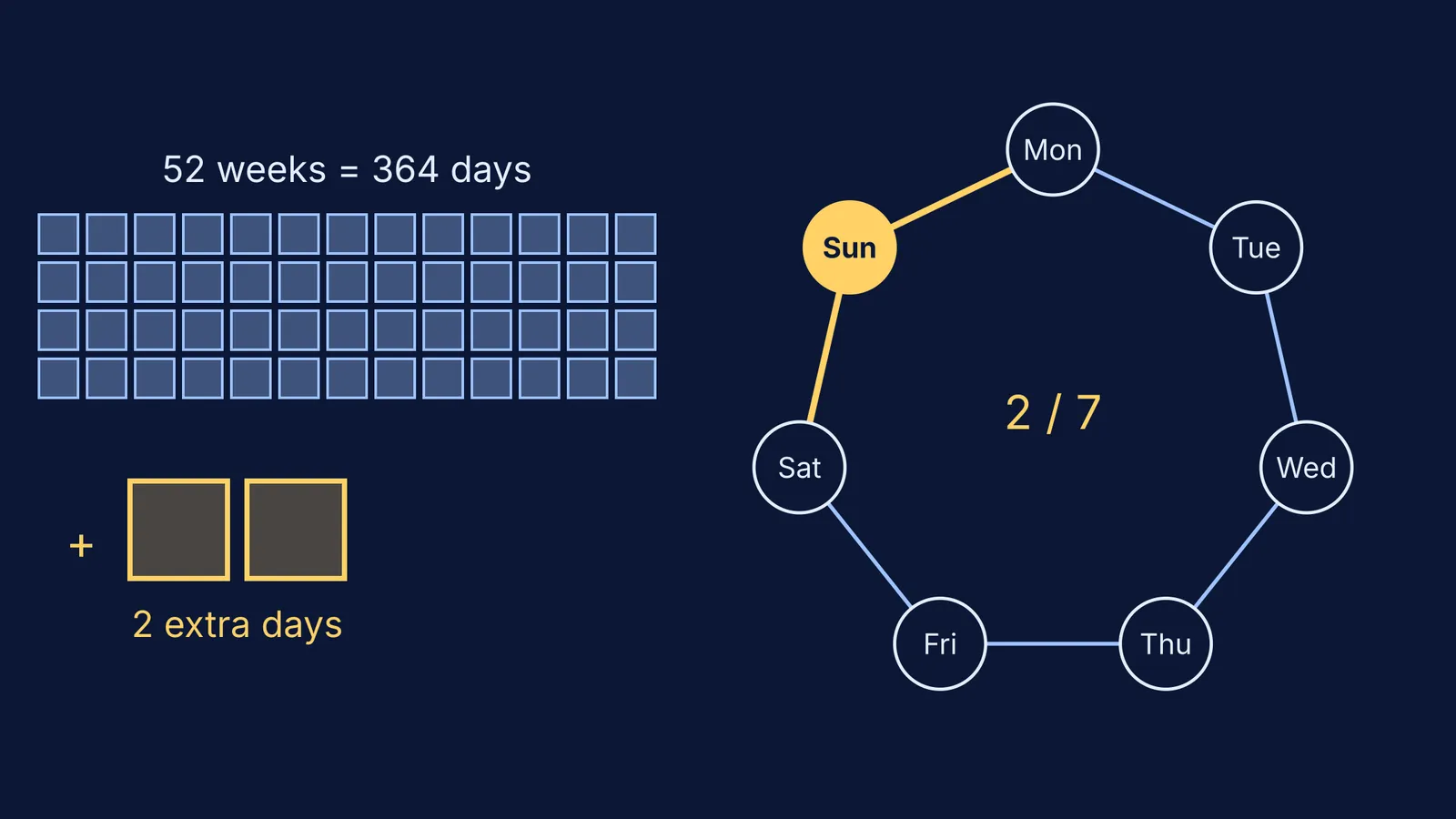
A leap year has 366 days, and the extra one is 29 February (Maths is Fun: leap years). Divide by 7 and you get 366 = 52 × 7 + 2.
Those 52 full weeks contain exactly 52 of every weekday. So every leap year has at least 52 Sundays. Whether it gets a 53rd depends only on the 2 leftover days.
The two leftover days are always consecutive. Day 365 falls exactly 52 weeks after 1 January, so the leftover days, 30 and 31 December, fall on the same weekdays as 1 and 2 January. For why the calendar needs the extra day at all, see why we have a leap year every four years.
What are the seven possible pairs of extra days?
The pair starts on one of seven weekdays, and the next day follows it:
Monday, Tuesday
Tuesday, Wednesday
Wednesday, Thursday
Thursday, Friday
Friday, Saturday
Saturday, Sunday
Sunday, Monday
Sunday appears in pairs 6 and 7. That gives 2 favourable outcomes out of 7 equally likely ones, so P(53 Sundays) = 2/7, or about 0.286.
Here is the answer as an examiner wants it:
A leap year has 366 days = 52 weeks + 2 days.
The 2 extra days can be (Mon, Tue), (Tue, Wed), (Wed, Thu), (Thu, Fri), (Fri, Sat), (Sat, Sun) or (Sun, Mon): 7 equally likely outcomes.
Favourable outcomes: (Sat, Sun) and (Sun, Mon), so 2.
Required probability = 2/7.
What is the probability for a non-leap year?
A non-leap year has 365 days, which is 52 weeks + 1 day. The single leftover day can be any of the seven weekdays, so P(53 Sundays) = 1/7. That is option (A) in the NCERT Exemplar question (Teachoo's reproduction).
What about 53 Mondays, 53 Tuesdays or two days together?
The same seven pairs answer every version. Count the ones that fit:
53 Mondays in a leap year: (Sun, Mon) and (Mon, Tue), so 2/7.
53 Tuesdays in a leap year: (Mon, Tue) and (Tue, Wed), so 2/7. Any single weekday gives 2/7.
53 Sundays and 53 Mondays in a leap year: only (Sun, Mon), so 1/7.
53 Sundays or 53 Mondays in a leap year: (Sat, Sun), (Sun, Mon) and (Mon, Tue), so 3/7.
Exactly 52 Sundays in a leap year: the other five pairs, so 5/7.
53 Sundays or 53 Mondays in a non-leap year: the one extra day is Sunday or Monday, so 2/7.
53 Sundays and 53 Mondays in a non-leap year: impossible with one extra day, so 0.
You can check this against real years. 2024 was a leap year starting on Monday (Wikipedia: 2024), so its extra days were Monday and Tuesday: it had 53 Mondays and 53 Tuesdays. 2028 will be a leap year starting on Saturday (Wikipedia: 2028), so it will have 53 Saturdays and 53 Sundays. To work out the starting weekday of any year yourself, use our guide to finding the day of the week for any date.
Does the real calendar match 2/7?
Almost. "Selected at random" tells you to treat all seven pairs as equally likely, but the real Gregorian calendar repeats every 400 years and its weekdays are not spread perfectly evenly.
In each 400-year cycle, 13 of the 97 leap years start on a Saturday (Wikipedia: leap year starting on Saturday) and 15 of the 97 start on a Sunday (Wikipedia: leap year starting on Sunday). Those 28 years are exactly the leap years with 53 Sundays: 28/97 is about 0.289, against 2/7 at about 0.286.
For common years, 43 of the 303 in each cycle start on a Sunday (Wikipedia: common year starting on Sunday). That is about 0.142, against 1/7 at about 0.143. In an exam, write 2/7 and 1/7; "equally likely" is an assumption you make, not a promise from the calendar.
For more counting problems like this, the Fermi Problem Library has worked problems with a step-by-step solver that explains the reasoning rather than printing an answer. If the gap is the idea of a sample space itself, the Fermi Concept Library gives each concept its own lesson.
If a chatbot's answer looks off, try our three ways to check an AI probability answer.


