

On this page
If you have ever wondered what day of the week you were born on, or what day a future event will land on, you can calculate it using simple arithmetic. The odd-days method breaks down the calendar into remainders of seven. By adding up these remainders, you can find the day of the week for any date.
This approach is popular in competitive exams like JEE and NEET because it tests pure mathematical logic and modular arithmetic without needing a calculator.
What is the odd-days method?
The core idea is that a week repeats every seven days. The odd-days method is a practical application of modular arithmetic, which is the mathematics of remainders. Since every week has exactly seven days, any period of seven days does not change the current day of the week. If today is Monday, adding seven days, fourteen days, or seventy days will still land on a Monday.
When we need to find the day of the week for a distant date, counting every single day would be exhausting and prone to error. Instead, we divide the total number of days by 7. An "odd day" is simply the remainder when you divide a given number of days by 7. These odd days are the only numbers that actually shift the day of the week forward.
For instance, an ordinary year has 52 weeks and 1 odd day because dividing 365 by 7 leaves a remainder of 1 (GeeksforGeeks). A leap year has 366 days, which means it leaves 2 odd days. When you calculate the day of the week, you only need to count these extra odd days and ignore the complete weeks.
If you are stuck on similar counting problems, the Fermi Problem Library has worked problems with a step-by-step solver that explains the reasoning rather than printing an answer.
How do Gregorian calendar leap year rules work?
To count odd days accurately over long periods, you must know exactly how many leap years fall within your chosen time frame. The Earth takes roughly 365.24 days to orbit the Sun, which means a flat 365-day year would slowly fall out of sync with the seasons. According to the standard calendar rules, a year is a leap year if it is evenly divisible by 4 (Wikipedia). Adding a 366th day every four years corrects most of this drift.
However, century years (like 1700, 1800, and 1900) follow an extra rule. Even though they are divisible by 4, they are not leap years unless they are also evenly divisible by 400. That is why the year 2000 was a leap year, but 1900 was not. This rule prevents the calendar from overcorrecting over long stretches of time.
How to calculate odd days for centuries?
When dealing with centuries, the pattern of odd days becomes highly predictable. Because the calendar repeats exactly every 400 years, you do not have to count all the way from the year zero. You can use fixed century blocks to jump forward in time.
First, let us look at a single century. In 100 years, there are 76 ordinary years and 24 leap years. Multiplying 76 by 1 odd day and 24 by 2 odd days gives 124 odd days in total. Dividing 124 by 7 leaves exactly 5 odd days. Therefore, the odd days for the first 100 years calculate to 5 odd days (GeeksforGeeks).
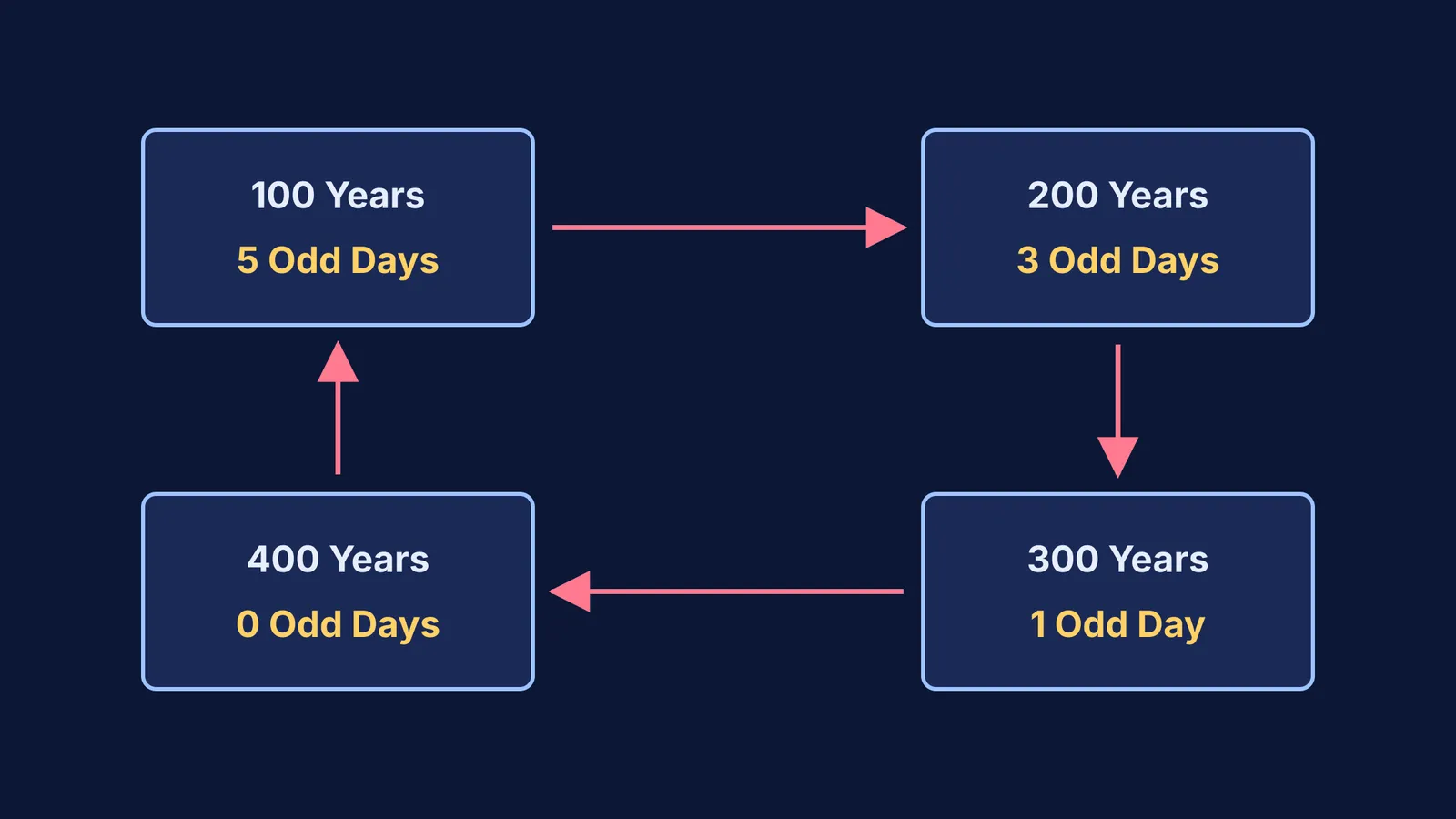
From this, the rest of the centuries follow a clear pattern:
100 years = 5 odd days
200 years = 3 odd days (5 × 2 = 10; 10 ÷ 7 leaves a remainder of 3)
300 years = 1 odd day (5 × 3 = 15; 15 ÷ 7 leaves a remainder of 1)
400 years = 0 odd days (20 odd days + 1 extra leap day for the 400th year = 21; exactly divisible by 7)
Any multiple of 400 years (like 1600 or 2000) always has 0 odd days.
How to find the day of the week for any date?
Let us walk through an example using the method from GeeksforGeeks: finding the day of the week for 15 August 1947. We must find the total odd days from the start of the calendar up to this exact date.
Step 1: Break down the completed years The date falls in 1947, so the last fully completed year is 1946. We split 1946 into manageable blocks: 1600 years + 300 years + 46 years.
1600 years = 0 odd days (multiple of 400).
300 years = 1 odd day.
Step 2: Count leap years in the remaining years In the remaining 46 years, we divide 46 by 4 to find there are 11 leap years.
46 total years = 11 leap years + 35 ordinary years.
Leap years have 2 odd days: 11 × 2 = 22.
Ordinary years have 1 odd day: 35 × 1 = 35.
Total odd days for these years = 22 + 35 = 57.
Dividing 57 by 7 gives 8 full weeks and 1 odd day.
Step 3: Count days in the current year Now, count the days in 1947 up to August 15. Always check if the current year is a leap year to know whether February has 28 or 29 days. The year 1947 is not a leap year, so February has 28 days.
January: 31 days (3 odd days)
February: 28 days (0 odd days)
March: 31 days (3 odd days)
April: 30 days (2 odd days)
May: 31 days (3 odd days)
June: 30 days (2 odd days)
July: 31 days (3 odd days)
August: 15 days (1 odd day)
Total odd days for the months = 3 + 0 + 3 + 2 + 3 + 2 + 3 + 1 = 17 odd days.
Dividing 17 by 7 leaves 3 odd days.
Step 4: Add them all up Total odd days = 0 (from 1600) + 1 (from 300) + 1 (from 46 years) + 3 (from months) = 5 odd days.
Step 5: Match the number to the day The final step is mapping the remainder to the day of the week, starting with Sunday as 0. If the remainder is 0, the days have perfectly completed a week, landing on Sunday.
0 = Sunday
1 = Monday
2 = Tuesday
3 = Wednesday
4 = Thursday
5 = Friday
6 = Saturday
So, 15 August 1947 was a Friday.
Next steps for mastering maths
Building a solid grasp of remainders and logic loops is just as important as knowing the formulas. When you study, reading how to solve permutations and combinations or probability problems can strengthen your foundations.
If you get stuck while practising on your own, Fermi's AI tutor can work out what you already know and build a plan for the session, so you sit down to a clear next step.


