

On this page
When identifying basic radicals in a salt analysis practical, lead (Pb²⁺) is one of the first cations you encounter. It belongs to Group I, meaning it precipitates as a white, insoluble chloride (PbCl₂) when you add dilute hydrochloric acid to your original salt solution.
Because lead chloride dissolves readily in hot water, you can separate it from other Group I cations (like silver and mercury) simply by heating the mixture and filtering it. Once you have this hot water extract, you must perform tests to confirm that lead is actually present.
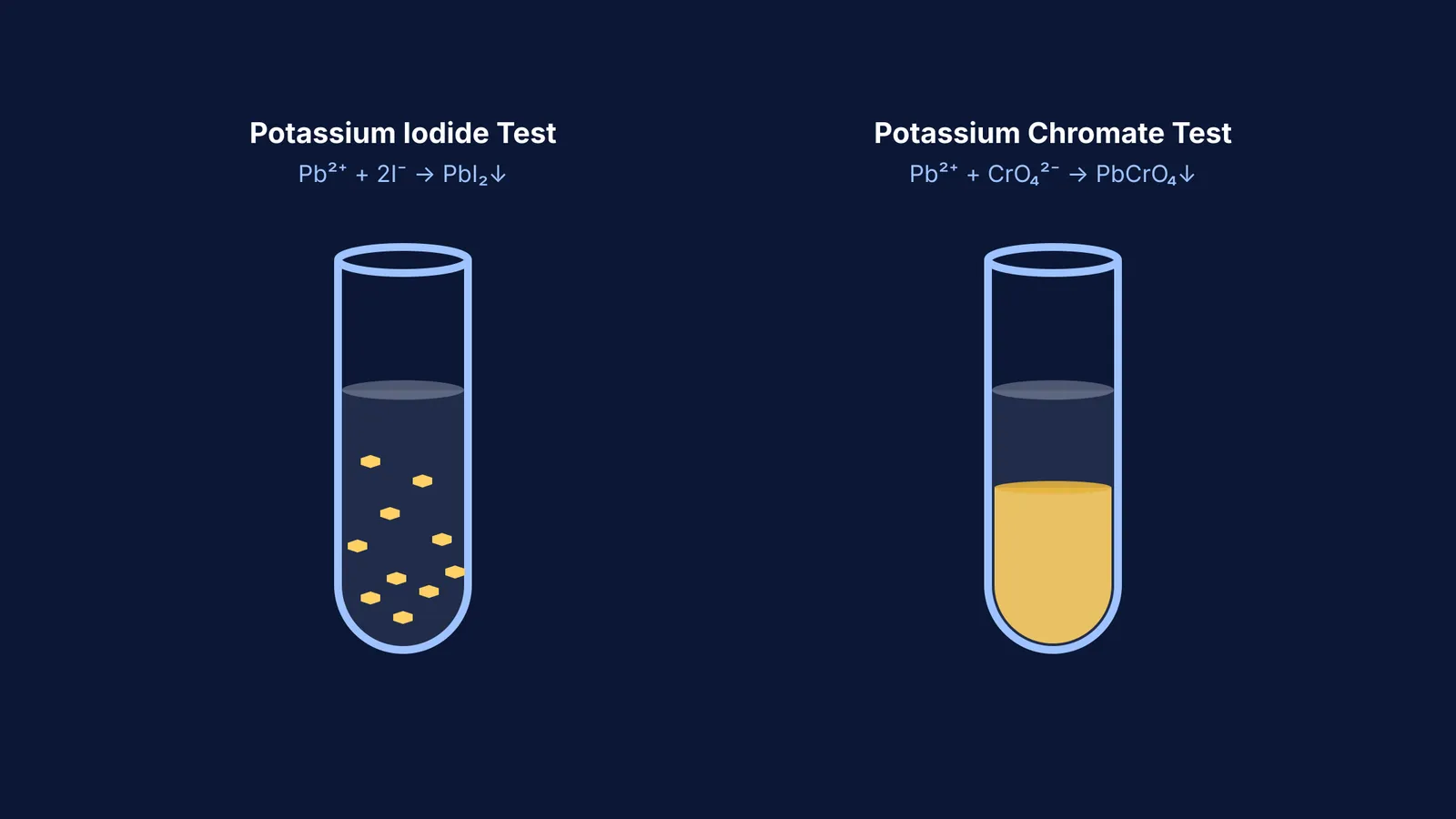
According to standard qualitative analysis procedures, you confirm the lead(II) ion by reacting it with either potassium chromate or potassium iodide. Both reactions produce a bright yellow precipitate, but they behave very differently when heated or treated with other chemicals.
What is the potassium iodide test for lead?
To perform the iodide test, you add a few drops of potassium iodide (KI) solution to the hot water extract containing the lead ions.
The iodide ions react instantly with the lead ions to form lead(II) iodide:
Pb²⁺(aq) + 2I⁻(aq) → PbI₂(s)
This produces a bright yellow precipitate that instantly clouds the test tube. However, lead(II) iodide has a very specific property: its solubility increases by more than 5 times—from 0.76 g/L at room temperature to 4.1 g/L in boiling water (Wikipedia_iodide)). If you add a little more water to the test tube and heat the mixture in a boiling water bath, the yellow precipitate will dissolve completely, leaving a clear, colourless solution.
When you take the test tube off the heat and let it cool slowly, the lead iodide precipitates back out. Because it cools gradually, the molecules have time to arrange themselves into large, flat, hexagonal crystals. These crystals catch the light and look like glittering gold flakes settling in the water—a phenomenon often called the "golden rain" or "golden spangles" effect.
How does the potassium chromate test work?
The second confirmatory test uses potassium chromate (K₂CrO₄). When you add this reagent to another portion of your hot water extract, the chromate ions bond with the lead ions to form lead(II) chromate:
Pb²⁺(aq) + CrO₄²⁻(aq) → PbCrO₄(s)
This reaction also yields a heavy, bright yellow precipitate. Historically, this striking colour was highly prized; lead chromate was used for decades by painters as the brilliant pigment known as "chrome yellow" (Wikipedia_chromate)). For example, around 37,000 tons were produced in 1996 for use in paints and coatings.
Unlike lead iodide, lead chromate does not dissolve when you heat the water. It is also completely insoluble in acetic acid. However, if you add excess sodium hydroxide (NaOH) to the test tube, the yellow lead chromate precipitate will dissolve. Lead forms the soluble, colourless tetrahydroxoplumbate(II) complex ion, but the solution itself remains yellow due to the released chromate ions.
How do you tell the two yellow precipitates apart?
In a busy laboratory, getting a yellow solid at the bottom of your test tube is a great start, but you must know which chemical you have just made. (You will see other yellow precipitates in chemistry, such as when performing the iodoform test for methyl ketones).
If you are asked to distinguish between the two lead precipitates in a viva or an exam, use this simple checklist:
Hot water solubility: PbI₂ dissolves in boiling water and returns as golden spangles when cooled. PbCrO₄ remains a yellow solid no matter how much you heat the water.
Reagents used: The iodide test requires KI, while the chromate test requires K₂CrO₄.
Solubility in base: Both precipitates dissolve in strong bases like sodium hydroxide. However, dissolving PbCrO₄ yields a yellow solution, whereas PbI₂ yields a completely colourless one.
Understanding the principles behind these solubility rules and complex formations can help you predict reactions rather than just memorising them. Other confirmatory tests in your syllabus rely on distinct visual changes—such as the silver mirror in Tollens' test for aldehydes—but the golden spangles of lead iodide are among the most striking.
If you want to explore the trends in solubility and precipitation for different ion groups, the Fermi Concept Library breaks down the chemistry of qualitative analysis step by step. Whether you are matching observations to an unknown salt or predicting products for a multiple-choice question, knowing exactly how these two yellow precipitates behave will ensure you never mix them up.


