

On this page
Whole numbers are straightforward when you need to find a lowest common multiple (LCM) or highest common factor (HCF). But what happens when the numbers are fractions? Whether you are solving a physics problem about runners on a track or a geometry question about lengths, a simple pair of formulas gets you the exact answer without relying on decimals.
What is the LCM and HCF of fractions formula?
The formula for fractions splits the calculation between the top numbers (numerators) and the bottom numbers (denominators).
The formula for the LCM of fractions is the LCM of the numerators divided by the HCF of the denominators (GeeksforGeeks). In short: LCM of fractions = LCM of numerators / HCF of denominators.
Conversely, the formula for the HCF of fractions is the HCF of the numerators divided by the LCM of the denominators (GeeksforGeeks). In short: HCF of fractions = HCF of numerators / LCM of denominators.
Before applying either formula, you must simplify every fraction to its lowest terms. If you leave a fraction like 6/4 as it is instead of reducing it to 3/2, the formulas will give you the wrong answer. This rule is absolute because the formulas rely on the prime factors of the numbers in their most basic form.
These foundations are critical for high school physics and chemistry. In fact, mastering fraction rules early on is one of the strongest ways fractions predict later maths achievement. A 2012 study found that a 10-year-old's knowledge of fractions uniquely predicts their math achievement five years later (Siegler et al., 2012).
How do you find the LCM of fractions?
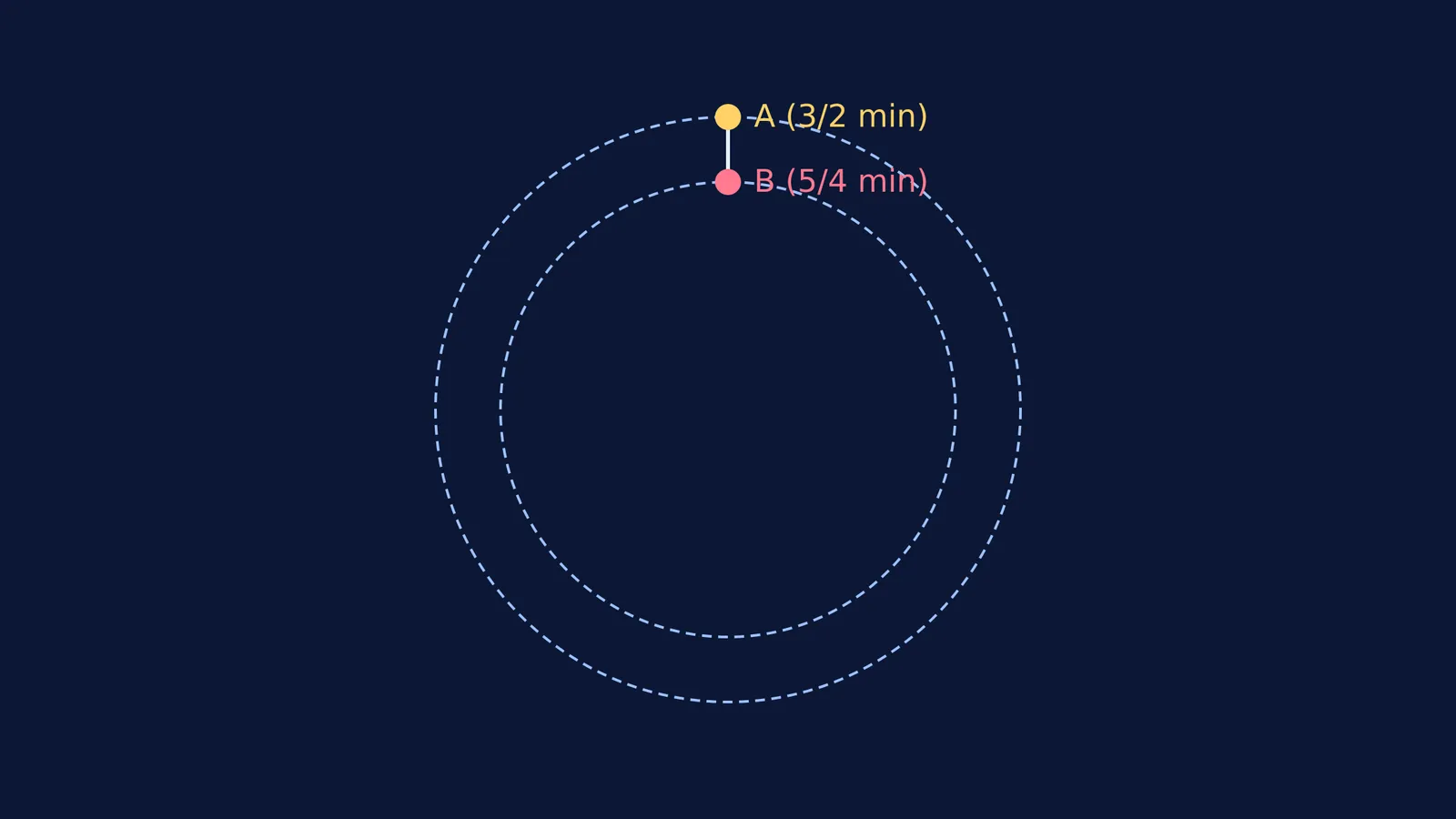
Imagine two runners training on a circular track. Runner A completes a lap in 3/2 minutes (1.5 minutes). Runner B is faster and completes a lap in 5/4 minutes (1.25 minutes). If they start at the same time and place, how long will it take for them to meet again at the starting line?
They will meet at a time that is a common multiple of both lap times. We need the LCM of 3/2 and 5/4.
Simplify: Check that both 3/2 and 5/4 are in their simplest form. Since 3 and 2 share no common factors, and 5 and 4 share no common factors, they are ready to use.
Numerators (3 and 5): Find the LCM of the top numbers. The lowest common multiple of 3 and 5 is 15.
Denominators (2 and 4): Find the HCF of the bottom numbers. The highest common factor of 2 and 4 is 2.
Apply the formula: Divide the numerator result by the denominator result to get 15/2.
The runners will meet at the starting line after 15/2 minutes (7.5 minutes). We can verify this mathematically: Runner A will have run exactly 5 laps (since 7.5 ÷ 1.5 = 5), and Runner B will have run exactly 6 laps (since 7.5 ÷ 1.25 = 6). Both land on whole numbers of laps, proving they are back at the start.
What is a real-world use for the HCF of fractions?
The HCF formula finds the largest common part that divides perfectly into two or more fractions. This is useful for splitting materials or spaces into equal segments.
Suppose you have two lengths of ribbon: one is 15/2 metres long, and the other is 25/4 metres long. You want to cut both into the longest possible equal pieces without any leftover ribbon. To solve this, you need the HCF of 15/2 and 25/4.
Simplify: Both fractions are already reduced to their lowest terms.
Numerators (15 and 25): Find the HCF of the top numbers. The highest common factor of 15 and 25 is 5.
Denominators (2 and 4): Find the LCM of the bottom numbers. The lowest common multiple of 2 and 4 is 4.
Apply the formula: Divide the numerator result by the denominator result to get 5/4.
The longest equal piece you can cut is 5/4 metres (1.25 metres). The first ribbon will yield exactly 6 pieces, and the second ribbon will yield exactly 5 pieces. You can see how working with fractions in Class 7 gives cleaner, more precise answers than wrestling with repeating decimals.
How can Fermi help check your work?
Fraction rules are notoriously easy to mix up under pressure. If a calculation does not look right, you can find similar worked examples in the Fermi Problem Library. Its step-by-step solver explains the reasoning rather than just printing an answer, helping you see exactly where you went wrong—like forgetting to simplify the fractions before taking the LCM.
Understanding the mechanics behind these formulas means you can solve time, distance and geometry problems faster and with more confidence. Keep the formulas handy, always simplify first, and fraction problems will become much less intimidating.


