

On this page
In qualitative salt analysis, identifying the specific halide ion in a sample can be tricky since most of their simple precipitates look similar. For example, the standard silver nitrate test yields a pale yellow precipitate for bromide and a yellow precipitate for iodide, which can be very difficult to distinguish by eye. The layer test solves this by exploiting the different colours of free halogens. By using chlorine water and an organic solvent, you can cleanly distinguish between bromide and iodide ions.
Why use the layer test?
The layer test relies on a displacement reaction driven by the different oxidising strengths of the halogens. Chlorine is a stronger oxidising agent than both bromine and iodine. When you add aqueous chlorine, commonly known as chlorine water, to a solution containing bromide (Br⁻) or iodide (I⁻) ions, the chlorine displaces them. This reaction forces the halide ions to lose electrons and become free elemental bromine (Br₂) or free elemental iodine (I₂).
Because free halogens are non-polar molecules, they are not highly soluble in polar solvents like water. If you add a dense, non-polar organic solvent—such as chloroform (CHCl₃) or carbon tetrachloride (CCl₄)—the free halogens will preferentially dissolve into it. This organic solvent does not mix with water, so it sinks to the bottom of the test tube, forming a distinct, highly coloured layer.
This method of extraction is commonly used alongside other preliminary procedures, such as Lassaigne's test: detecting nitrogen, sulphur and halogens, to confirm the exact element present in an unknown sample. The stark visual contrast makes it one of the most reliable tests in the laboratory.
What colours do bromide and iodide produce?
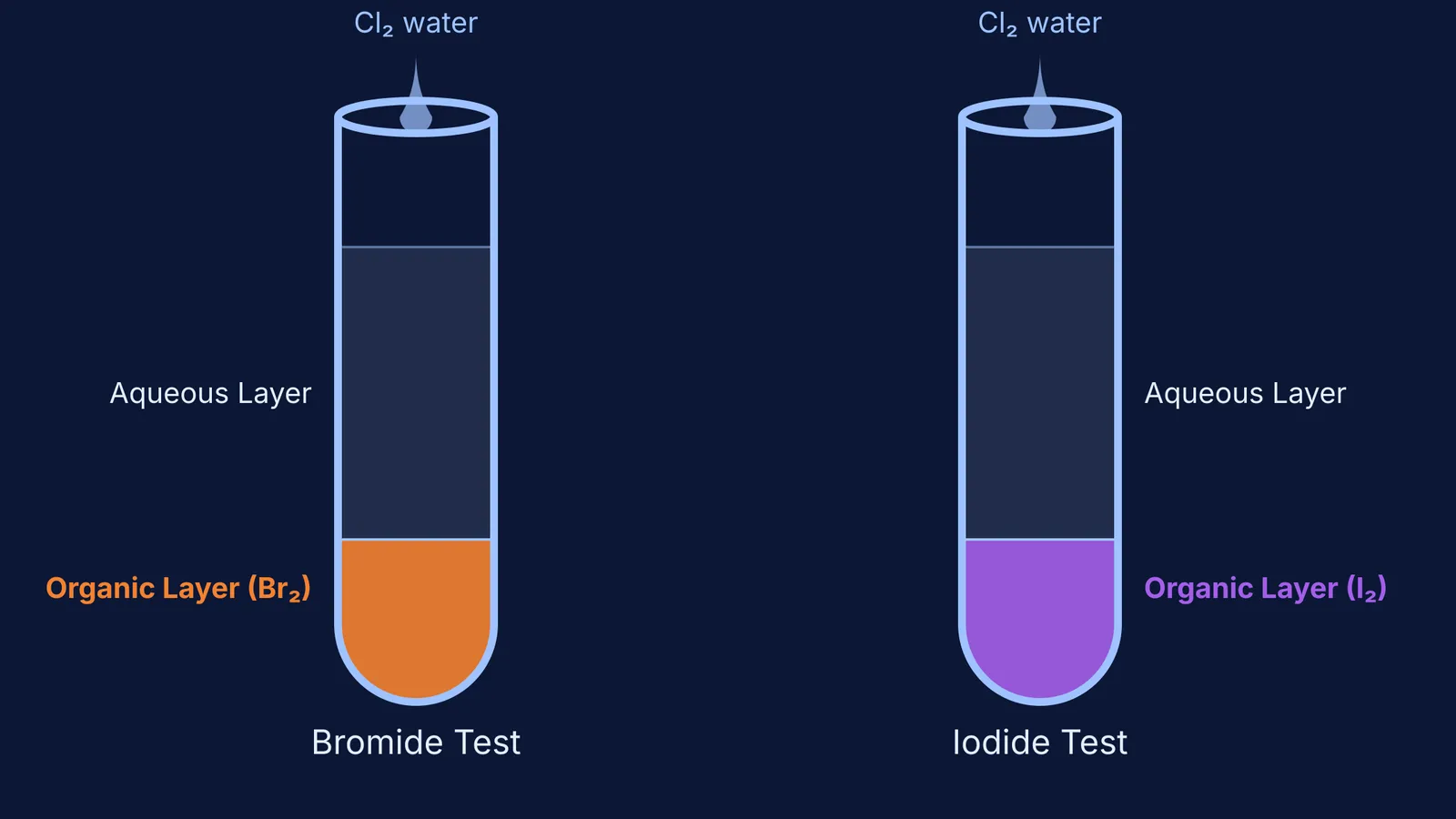
When performing the test, the visual confirmation happens entirely in the lower organic layer. The upper aqueous layer typically remains mostly colourless or faintly tinted, as the halogens migrate into the denser non-polar solvent.
Bromide (Br⁻): The chlorine water oxidises the bromide ions according to the equation 2Br⁻ + Cl₂ → 2Cl⁻ + Br₂. The resulting free bromine dissolves in the organic layer, turning it a distinct orange or reddish-brown.
Iodide (I⁻): The chlorine water oxidises the iodide ions according to the equation 2I⁻ + Cl₂ → 2Cl⁻ + I₂. The liberated free iodine dissolves in the organic layer, turning it a deep violet or purple.
What happens if you add excess chlorine water?
Adding too much chlorine water will change the results, especially for iodide. If you continue to add chlorine water and shake the test tube, the violet colour of the iodine layer will eventually fade and become completely colourless. This happens because the excess chlorine further oxidises the iodine into iodic acid (HIO₃), which is a colourless compound.
The chemical reaction for this secondary oxidation is: I₂ + 5Cl₂ + 6H₂O → 2HIO₃ + 10HCl
In contrast, the orange colour of the bromine layer is much more stable. It persists even if excess chlorine water is added, providing a durable visual indicator for the presence of bromide ions.
How do you perform the layer test?
If you are carrying out this test in the laboratory—often alongside tests for organic functional groups in the chemistry practical—there is a standard procedure to follow. According to the standard NCERT chemistry laboratory manual, you should proceed as follows:
Acidify the sample: Take a small amount of your salt solution (or sodium carbonate extract) in a test tube and add a few drops of dilute hydrochloric acid (HCl). This acidification step is crucial because it decomposes any carbonate or sulphite ions that might interfere with the subsequent reactions.
Add the solvent: Pour in a small volume of an organic solvent like chloroform or carbon tetrachloride. You will see it form a separate layer at the bottom of the tube due to its higher density.
Oxidise: Add freshly prepared chlorine water drop by drop. It is important that the chlorine water is fresh, as it can lose its strength over time.
Shake and observe: Shake the test tube vigorously to ensure the liberated halogens can come into contact with the organic solvent, then let it stand. Read the colour of the lower layer to identify your halide.
If you are reviewing qualitative analysis and its characteristic reactions for an upcoming exam, the Fermi Concept Library maps out these chemical principles, complete with their theoretical foundations and practical applications, to help you structure your revision efficiently.


