

On this page
When you want to tile a rectangular room with square tiles, you face a common maths puzzle: what is the largest tile size you can use so that no tile needs to be cut? This is a classic application of the highest common factor (HCF), which is also known as the greatest common divisor (GCD).
What is the largest square tile to cover a floor without cutting?
To cover an a-by-b rectangle perfectly, the side length of the square tile must divide both the length and the breadth without leaving a remainder. The largest square tile to cover an a-by-b rectangle has a side length equal to the greatest common divisor of a and b (Wikipedia).
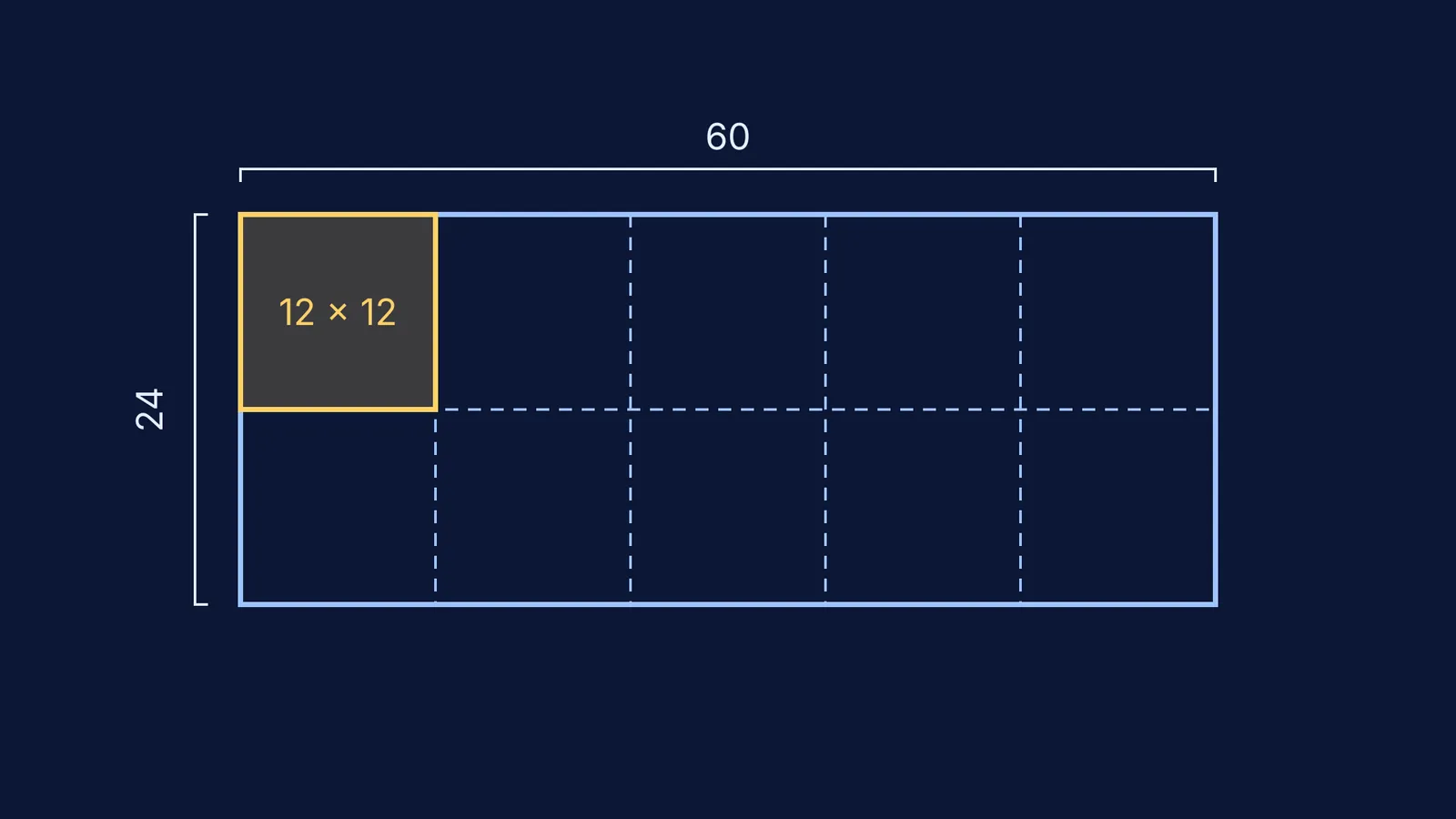
Consider a rectangular floor that is 60 units long and 24 units wide. To find the largest square tile that fits without cutting, we compute the HCF of 60 and 24.
The factors of 24 are 1, 2, 3, 4, 6, 8, 12 and 24. The factors of 60 include 1, 2, 3, 4, 5, 6, 10, 12, 15, 20, 30 and 60. The common factors are 1, 2, 3, 4, 6 and 12. Of these, the greatest is 12, so a 24-by-60 rectangular area can thus be divided into a grid of 12-by-12 squares.
If your child is learning real numbers in Class 10, this is exactly the kind of word problem they will see. It helps to draw a rough sketch so they can visualise why the HCF is the right tool, rather than guessing between HCF and LCM. If they struggle with maths word problems, the Fermi Problem Library has worked problems with a step-by-step solver that explains the reasoning rather than printing an answer.
How to find the total number of tiles needed?
Once you know the side length of the largest square tile, the next step is usually finding how many tiles are required to cover the floor.
First, calculate the total area of the rectangular floor by multiplying its length by its breadth. Then, calculate the area of one square tile. Finally, divide the floor's area by the tile's area: Number of tiles = (Length × Breadth) / (Tile side × Tile side).
In our 60-by-24 example, the tile side is 12. The length fits 60 / 12 = 5 tiles. The breadth fits 24 / 12 = 2 tiles. The total number of tiles is simply 5 × 2 = 10 tiles.
You can also use the area method: the floor area is 1440, and the tile area is 144. Dividing 1440 by 144 gives 10. The row-by-column method is often easier to compute mentally because the numbers stay small. Understanding perimeter and area at this stage ensures students do not confuse the boundary with the space inside.
What about the LCM twin question?
Students often mix up the tiling problem with its twin: finding the smallest square room that can be paved with a given rectangular tile.
If you have rectangular tiles measuring 6 units by 8 units, and you want to arrange them to form the smallest possible perfect square, you need the side of the square to be a multiple of both 6 and 8. Here, you use the least common multiple (LCM). The LCM of 6 and 8 is 24. This means the smallest square floor you can build without cutting the tiles is 24 by 24 units.
To summarise the difference:
Floor to tiles (breaking down): When you are given a large rectangular floor and need to find the size of the square tiles to fill it, use the HCF.
Tiles to floor (building up): When you are given rectangular tiles and want to combine them to form a square floor, use the LCM.
Understanding this difference is key to mastering these problems. If you need a refresher on these concepts, the Fermi Concept Library contains every concept in mathematics with its own lesson and its place in the map.


