

On this page
If you look at the fields across India during the July monsoon, you will see paddy and cotton. Return to the same fields in December, and you will find wheat and mustard. This rhythm of planting and harvesting is split into two main agricultural seasons, known as Kharif and Rabi.
Knowing the difference between them is a standard part of high school geography and biology, but it also explains why you eat fresh watermelon in the summer and see bajra flour more often during the monsoon.
What are Kharif and Rabi crops?
The defining difference between the two groups is when they are planted and how much water they need.
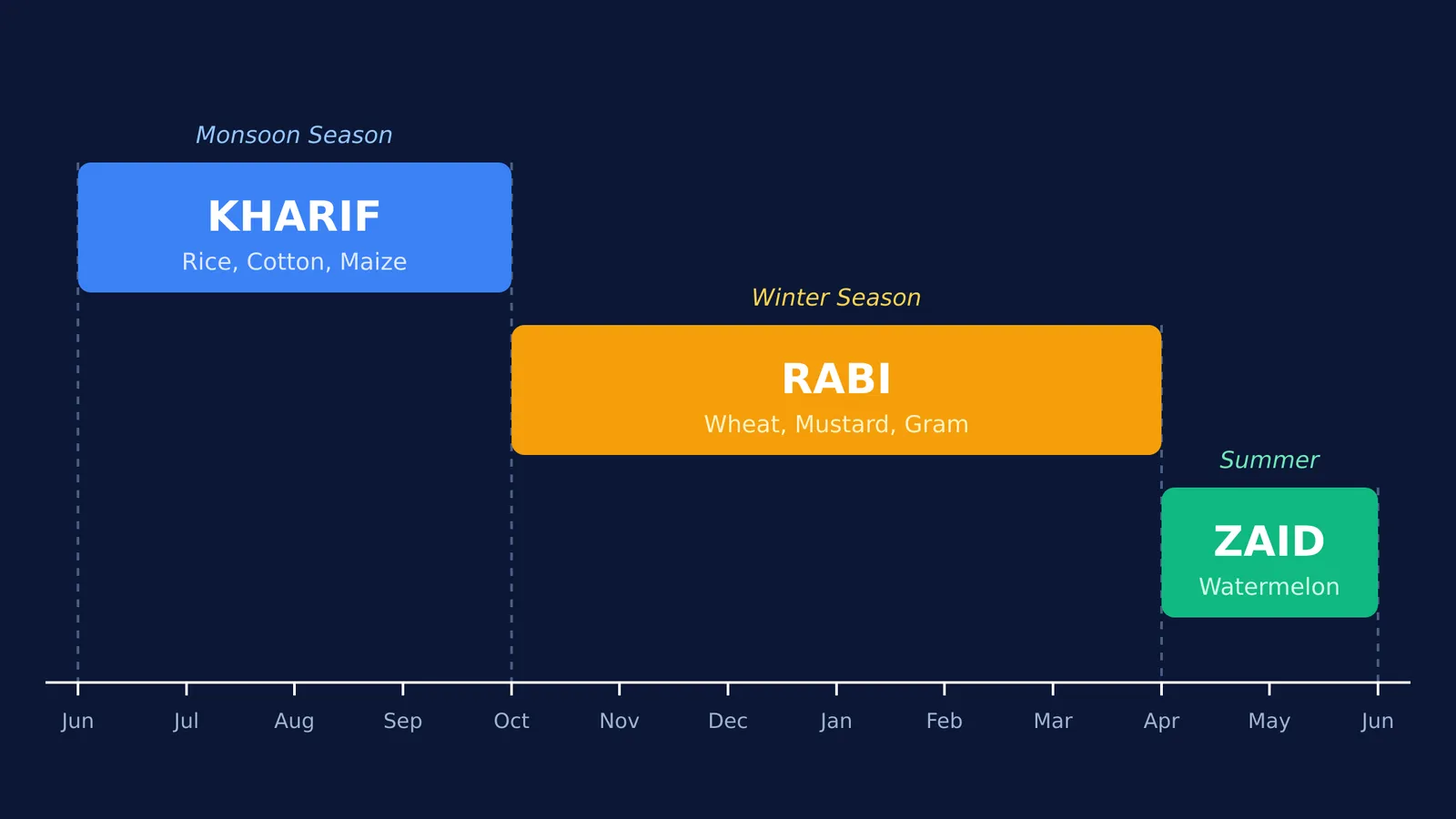
According to the National Council of Educational Research and Training (NCERT) Class 10 Geography textbook, Kharif crops are sown with the onset of the monsoon in different parts of the country, typically in June and July. Because they grow during the heavy rains of the southwest monsoon, they require high humidity and significant water. They are harvested in September and October.
In contrast, Rabi crops are sown in winter, between October and December. They grow through the cooler months and rely on the availability of precipitation during winter months from western temperate cyclones, rather than heavy monsoon flooding. They are harvested in the summer, from April to June.
Between these two major seasons lies a shorter summer period called the Zaid season, used primarily for crops that grow quickly in the heat, such as watermelon, muskmelon, and cucumber.
What are examples of Kharif and Rabi crops?
It is easy to confuse the two lists, so it helps to anchor each season to its most important cereal grain. Rice is the quintessential Kharif crop, while wheat is the definitive Rabi crop.
The official NCERT Geography syllabus lists the following major Kharif crops, which are extensively grown in Assam, West Bengal, and the coastal regions of Odisha and Andhra Pradesh:
Paddy (rice)
Maize
Jowar and bajra
Tur (arhar), moong, and urad
Cotton and jute
Groundnut and soyabean
The textbook lists the following as the primary Rabi crops, grown widely in northern and northwestern parts of India such as Punjab, Haryana, and Uttar Pradesh:
Wheat
Barley
Peas
Gram (chickpea)
Mustard
Why do we have different cropping seasons?
Plants do not just react to temperature and water; they actually measure the length of the day. This biological timing mechanism is called photoperiodism. Because the Earth's axis is tilted, winter days are shorter and summer days are longer.
Many plants require a specific duration of uninterrupted light or darkness to trigger flowering. A crop adapted to the short days and long nights of winter (a short-day plant) will not flower if planted during the long days of the summer monsoon. Conversely, long-day plants need the extended daylight of summer to mature properly. If you are struggling to picture how plants measure light and time, you can map out these mechanisms in the Fermi Concept Library, where every concept in biology has its own lesson.
This is also why environmental factors are so tightly coupled to agriculture. A delay in the monsoon affects the entire Kharif sowing schedule, which can then push back the Rabi planting window. This delicate balance of inputs is similar to what you might study when looking at limiting factors in photosynthesis, where a shortage of just one element bottlenecks the entire plant's growth.
How to answer this in an exam?
When asked to distinguish between the two in an exam, do not just list examples. Build your answer systematically across three points:
Timing: State the exact sowing and harvesting months.
Climate: Mention the water requirements (monsoon rain versus winter precipitation).
Examples: Give at least two cereals and one non-cereal for each (e.g., rice and cotton for Kharif; wheat and mustard for Rabi).
Understanding these cycles is fundamental to botany. Just as you might study how plants respond to gravity and light direction, learning the seasonal cycles shows how plants have evolved to survive the dramatic shifts in India's weather.


