

On this page
A typical Kepler's third law question in a JEE Main or school physics paper is a ratio problem in disguise. You are told about one orbit and asked about another around the same body. If you reach for G and the mass of the Sun, you have taken the long road, and every extra constant is one more place to slip.
What does Kepler's third law actually say?
NASA states it as: "The squares of the orbital periods of the planets are directly proportional to the cubes of the semi-major axes of their orbits" (NASA Science: Orbits and Kepler's Laws). In symbols, T² ∝ a³, so T²/a³ has the same value for everything orbiting one central body.
The semi-major axis is half of the longest diameter of the ellipse, and it sets the size of the orbit (NASA Science). For a circular orbit it is simply the radius. For an ellipse it is the average of the closest and farthest distances from the central body's centre: a = (r_min + r_max)/2.
Why do G and M disappear? For a circular orbit, gravity supplies the centripetal force, which gives T² = (4π²/GM) a³. The bracket is fixed for one central body, so when you divide one orbit by another it cancels:
T₂/T₁ = (a₂/a₁)^(3/2)
a₂/a₁ = (T₂/T₁)^(2/3)
How do you compare the orbital periods of two planets?
NASA's fact sheet defines "distance from Sun" as the semi-major axis (NASA NSSDC fact sheet notes). Earth's semi-major axis is 149.6 million km and its period is 365.2 days; Mars's is 228.0 million km and 687.0 days (NASA Planetary Fact Sheet). Pretend you know only Mars's distance:
Ratio of distances: 228.0 ÷ 149.6 = 1.524.
Raise to the power 3/2: 1.524³ = 3.540, and √3.540 = 1.882.
Multiply: 1.882 × 365.2 days = 687 days.
The prediction matches the measured 687.0 days, with no G, no solar mass and no conversion to metres.
How do you find the semi-major axis of an elliptical orbit?
Examiners often give the nearest and farthest points instead of a. NASA's Moon fact sheet lists perigee 0.3633 million km and apogee 0.4055 million km, and an orbital period of 27.3217 days (NASA Moon Fact Sheet). Their average, 0.3844 million km, is exactly the semi-major axis the same sheet lists.
These distances run centre to centre. If a question gives heights above the surface, add the planet's radius first; Earth's equatorial radius is 6,378 km (NASA Earth Fact Sheet). To see why speed is not constant along such an orbit, read our post on speed at perigee and apogee of an elliptical orbit.
Worked example: from the Moon to a geostationary satellite
ESA says geostationary satellites orbit at an altitude of 35,786 km and take 23 hours 56 minutes 4 seconds per orbit, one sidereal day (ESA: Types of orbits). Can you get that height from the Moon alone, using its 384,400 km semi-major axis and 27.32-day period (NASA Moon Fact Sheet) and Earth's 6,378 km radius (NASA Earth Fact Sheet)?
Period ratio: 23.93 h ÷ (27.32 × 24 h = 655.7 h) = 0.0365.
Distance ratio: 0.0365^(2/3) = 0.110.
Semi-major axis: 0.110 × 384,400 km ≈ 42,300 km from Earth's centre.
Height: 42,300 − 6,378 ≈ 35,900 km.
That lands within 0.4% of ESA's figure. Most of the small gap comes from the Moon's own mass, which is not negligible next to Earth's, a refinement exam problems ignore.
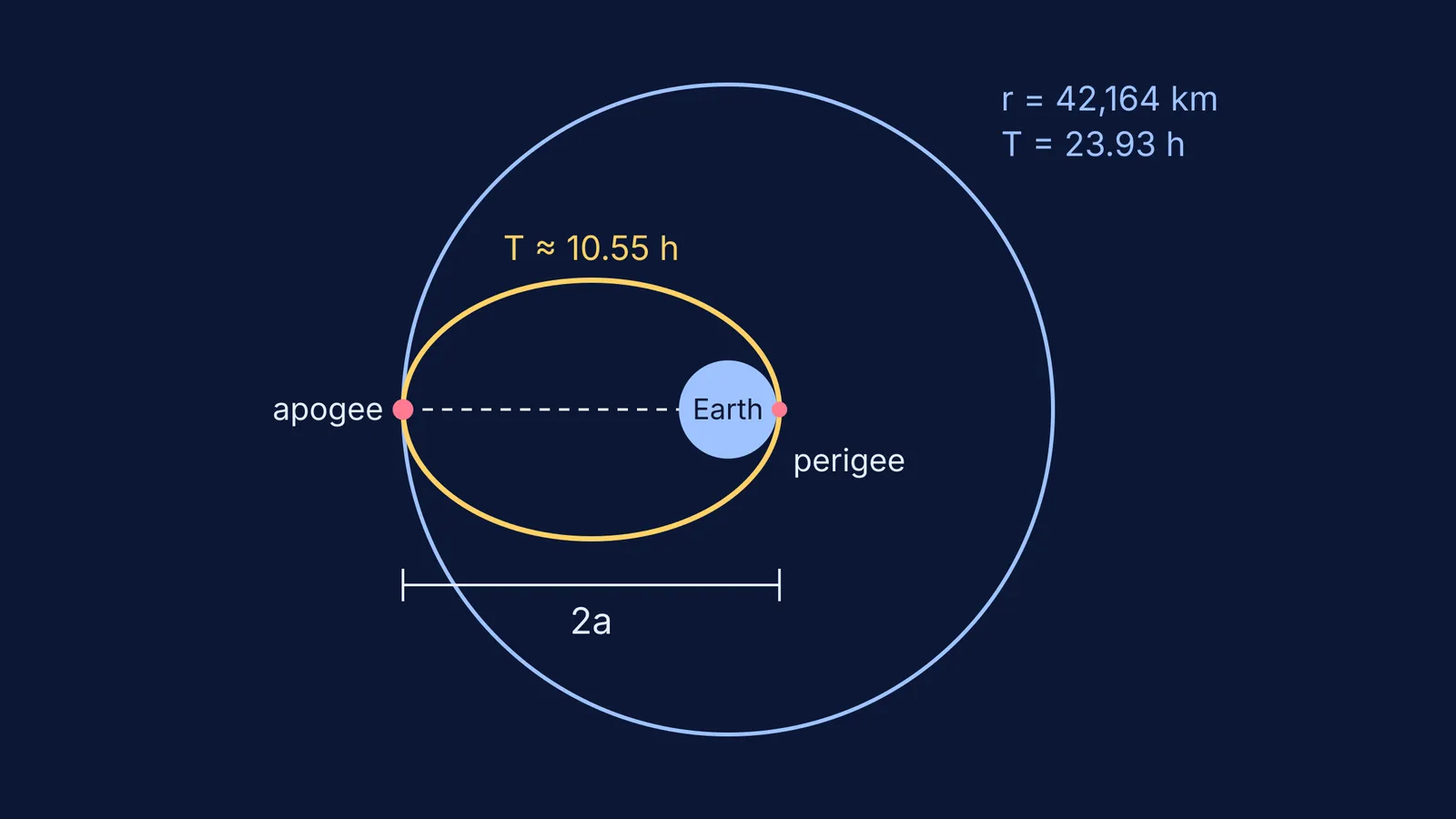
Now the elliptical twist, the orbit drawn in the diagram above. A satellite has its perigee 300 km above Earth and its apogee at geostationary height. Find its period.
r_min = 6,378 + 300 = 6,678 km; r_max = 6,378 + 35,786 = 42,164 km.
a = (6,678 + 42,164) ÷ 2 = 24,421 km.
T = 23.93 h × (24,421 ÷ 42,164)^(3/2) = 23.93 h × 0.441 ≈ 10.55 h.
For the special case of an orbit skimming the ground, see the period of a satellite close to Earth's surface.
Which shortcuts save time in the exam?
Every shortcut below follows from the same proportionality NASA states (NASA Science):
Double a, and T grows by 2^(3/2) = 2√2, about 2.83 times.
A period 8 times longer means a is 8^(2/3) = 4 times bigger.
Any unit works for a (km, AU, Earth radii) as long as both orbits use the same one.
Different central bodies mean no ratio; go back to T² = (4π²/GM) a³.
For an ellipse, use a = (r_min + r_max)/2, never the distance at one instant.
The same divide-and-cancel habit works far beyond orbits; our guide to the ratio method for scaling numericals shows it on other chapters.
If you keep landing on the wrong power, the Fermi Problem Library has worked problems with a step-by-step solver that explains the reasoning rather than printing an answer. If orbits are hard to picture, the Fermi Simulation Lab has interactive simulations for ideas that are easier to see than to read.


