

On this page
Imagine launching an artificial satellite horizontally just above the Earth's surface, assuming a smooth globe without mountains or atmospheric friction. To stay in a stable circular trajectory, the gravitational force acting on the satellite must provide the exact centripetal force required to keep it turning along the curvature of the planet. If the satellite has mass m and speed v, orbiting at a radius r from the centre of the Earth (mass M), Newton's second law gives m v² / r = G M m / r². Cancelling the satellite mass m reveals that the orbital velocity is v = √(G M / r).
How do you derive the orbital period of a near-Earth satellite?
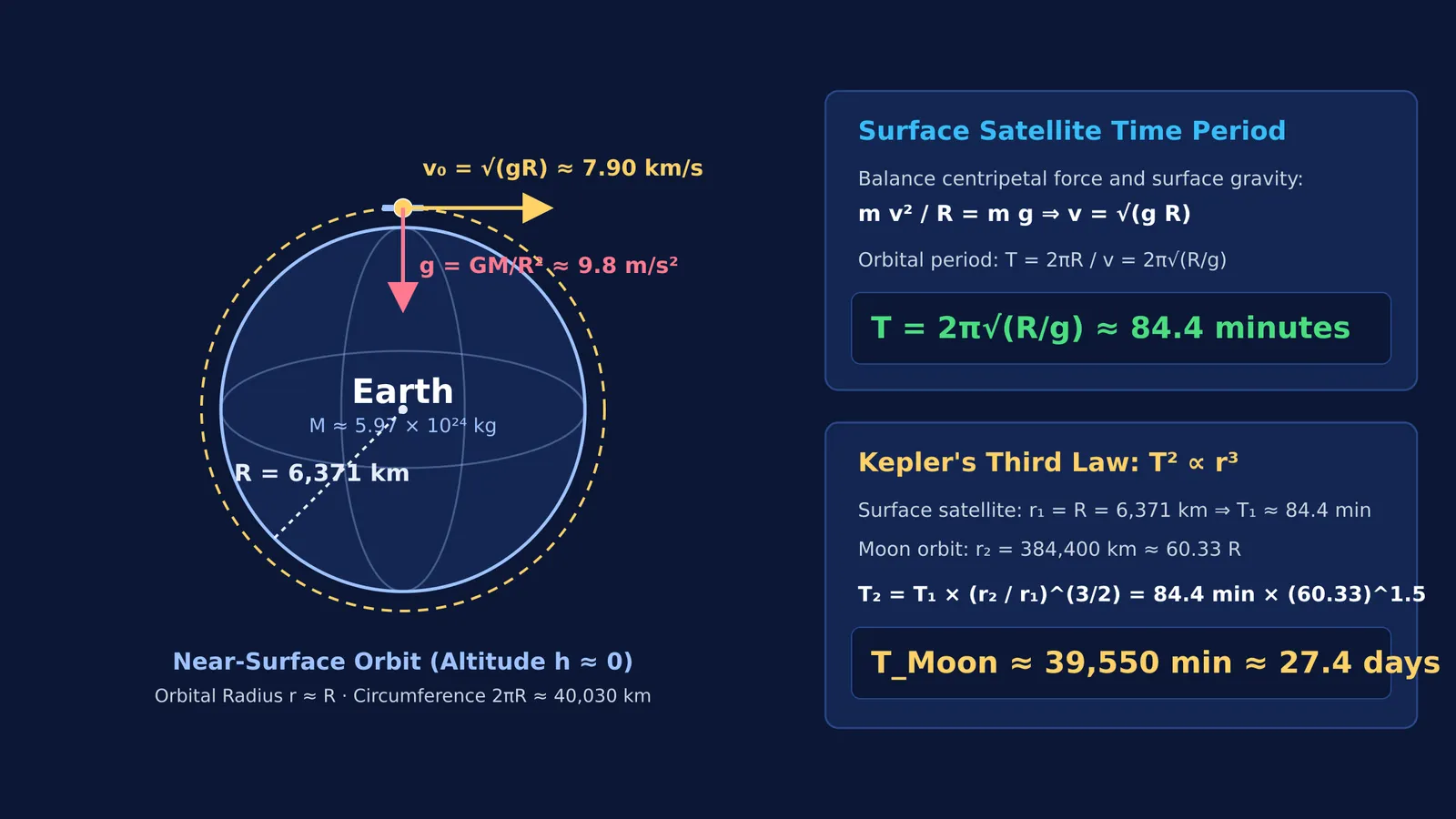
For a satellite orbiting very close to the surface, its orbital altitude h is virtually zero compared to the size of the planet, so we set the orbital radius r equal to Earth's radius R. The required circular orbital speed becomes v₀ = √(G M / R). Since the acceleration due to gravity at Earth's surface is defined as g = G M / R², we can rewrite the product G M as g R². Substituting this into the velocity equation gives v₀ = √(g R). According to the NASA Earth Fact Sheet, Earth has a volumetric mean radius R of 6,371 kilometres and a standard surface gravity g of 9.80 metres per second squared, which yields an orbital speed of approximately 7.90 kilometres per second (nearly 28,440 kilometres per hour).
Because the satellite travels along a circular path of circumference 2π R at this uniform speed v₀, its orbital time period T is the distance divided by the speed: T = 2π R / v₀. Substituting v₀ = √(g R) produces the standard textbook formula:
T = 2π R / √(g R) = 2π √(R / g).
This relationship shows that the orbital period near the surface does not depend on the satellite's mass, shape, or launch mechanism. It is dictated entirely by the planet's radius and its surface gravitational acceleration.
Why does the orbital period equal 84 minutes?
Plugging the physical constants of our planet into the formula demonstrates why 84 minutes is a famous benchmark in physics. Taking Earth's volumetric mean radius R = 6.371 × 10⁶ metres and standard gravitational acceleration g = 9.80665 metres per second squared from the NASA Earth Fact Sheet, the ratio R / g equals approximately 649,661 seconds squared. Taking the square root gives √(R / g) ≈ 806.0 seconds. Multiplying by 2π yields:
T = 2 × 3.14159 × 806.0 ≈ 5,064 seconds.
Dividing 5,064 seconds by 60 seconds per minute gives approximately 84.4 minutes, or roughly 1 hour and 24.4 minutes.
In competitive exams like JEE Main and CBSE physics problems, instructors often use the rounded values R = 6,400 kilometres and g = 9.8 metres per second squared, producing T = 2π √(6.4 × 10⁶ / 9.8) ≈ 5,077 seconds, or 84.6 minutes. Whichever rounded constant you employ, the result lands at approximately 84 to 85 minutes. This value represents the absolute minimum orbital period for any object in a free, unpowered circular orbit around the Earth. Real-world low-orbit spacecraft, such as the International Space Station orbiting at an average altitude of approximately 400 kilometres, experience a slightly larger orbital radius and therefore take about 92.9 minutes per revolution.
Students preparing for competitive examinations frequently encounter this exact derivation in gravitation and satellite problems. The Fermi Problem Library has worked problems with a step-by-step solver that explains the reasoning rather than printing an answer, helping you see how force balance and kinematics connect across orbital mechanics.
How does Kepler's third law connect a surface satellite to the Moon?
One of the most satisfying ways to verify the 84-minute surface period is to compare it with the Moon using Kepler's third law of planetary motion. As detailed in the historical analysis of Kepler's laws of planetary motion, the square of any satellite's orbital period is directly proportional to the cube of its orbit's semi-major axis: T² ∝ r³. Because both our hypothetical surface satellite and the Moon orbit the same central body, their periods and orbital radii satisfy the exact ratio:
(T_Moon / T_surface)² = (r_Moon / R)³.
Taking the square root of both sides gives:
T_Moon = T_surface × (r_Moon / R)^(3/2).
According to the NASA Moon Fact Sheet, the Moon has a mean orbital radius r_Moon of 384,400 kilometres. Comparing this to Earth's mean radius of 6,371 kilometres from the NASA Earth Fact Sheet, the orbital radius ratio is r_Moon / R = 384,400 / 6,371 ≈ 60.33 times. Raising 60.33 to the power of 1.5 yields:
(60.33)^(1.5) = 60.33 × √(60.33) ≈ 60.33 × 7.767 ≈ 468.6.
Now we can compute the Moon's orbital period directly from our 84.4-minute surface orbit:
T_Moon = 84.4 minutes × 468.6 ≈ 39,550 minutes.
Dividing by 1,440 minutes in a standard 24-hour day gives:
T_Moon ≈ 27.47 days.
The official sidereal period of the Moon recorded in the NASA Moon Fact Sheet is 27.32 days (approximately 655.7 hours). Our calculation from Kepler's third law matches the Moon's observed orbit within an error margin of less than 0.6 percent, with the slight difference arising from lunar orbital eccentricity and solar gravitational perturbations. You can explore how conservation of angular momentum governs these elliptical orbits in our guide to Kepler's second law and areal velocity.
What does T = 2π√(R/g) reveal about planetary density?
A deeper insight emerges when we express Earth's mass M in terms of its average density ρ. Assuming a spherical Earth of radius R, the mass is given by volume times density: M = (4/3) π R³ ρ. Substituting this mass into Kepler's orbital period formula T = 2π √(R³ / (G M)) causes the radius R³ to cancel out entirely:
T = 2π √[ R³ / (G × (4/3) π R³ ρ) ] = √(3π / (G ρ)).
As noted in the analysis of orbital periods, this remarkable formula reveals that the orbital period of a surface satellite does not depend on the size of the planet at all—it depends solely on the planet's mean density ρ.
Whether a rocky planet has the radius of the Moon, Earth, or Jupiter, any satellite skimming its surface will have a period governed entirely by its material composition. With Earth's mean density of 5,513 kilograms per cubic metre documented in the NASA Earth Fact Sheet, the density formula yields √(3π / (6.6743 × 10⁻¹¹ × 5513)) ≈ 5,064 seconds, or 84.4 minutes. If Earth were made entirely of water with a density of 1,000 kilograms per cubic metre, a surface orbit would take approximately 3.3 hours (roughly 198 minutes).
This density-period equivalence also explains the famous harmonic connection: a particle oscillating in a straight tunnel drilled through the centre of Earth experiences a restoring force proportional to distance, creating simple harmonic motion through a tunnel across Earth with the exact same period of √(3π / (G ρ)) ≈ 84.4 minutes, as derived in orbital periods.
How to solve satellite period problems: a four-step checklist
When tackling orbital mechanics questions in competitive exams, memorising isolated formulas can lead to calculation errors under time pressure. The Fermi Concept Library maps every concept in physics, chemistry, biology, mathematics and computing, each with its own lesson and its place in the map, so you can always trace equations back to first principles. Use this four-step checklist whenever a problem asks for an orbital period or speed:
Identify the orbital radius: Confirm whether the question provides an altitude h above the surface (requiring r = R + h) or specifies an orbit close to the surface (allowing the approximation r ≈ R).
Balance forces or apply Kepler's ratio: If the central body's mass and radius are given, set centripetal force equal to gravity to find v = √(G M / r) and T = 2π √(r³ / (G M)). If comparing two satellites orbiting the same planet, jump immediately to Kepler's third law ratio (T₁ / T₂)² = (r₁ / r₂)³.
Use surface gravity shortcuts: For near-surface problems where G and M are not specified, replace G M / R with g R, giving v₀ = √(g R) and T = 2π √(R / g).
Check density dependencies: If a question alters a planet's radius while keeping its average density constant, remember that T_surface remains completely unchanged because T = √(3π / (G ρ)).


