

On this page
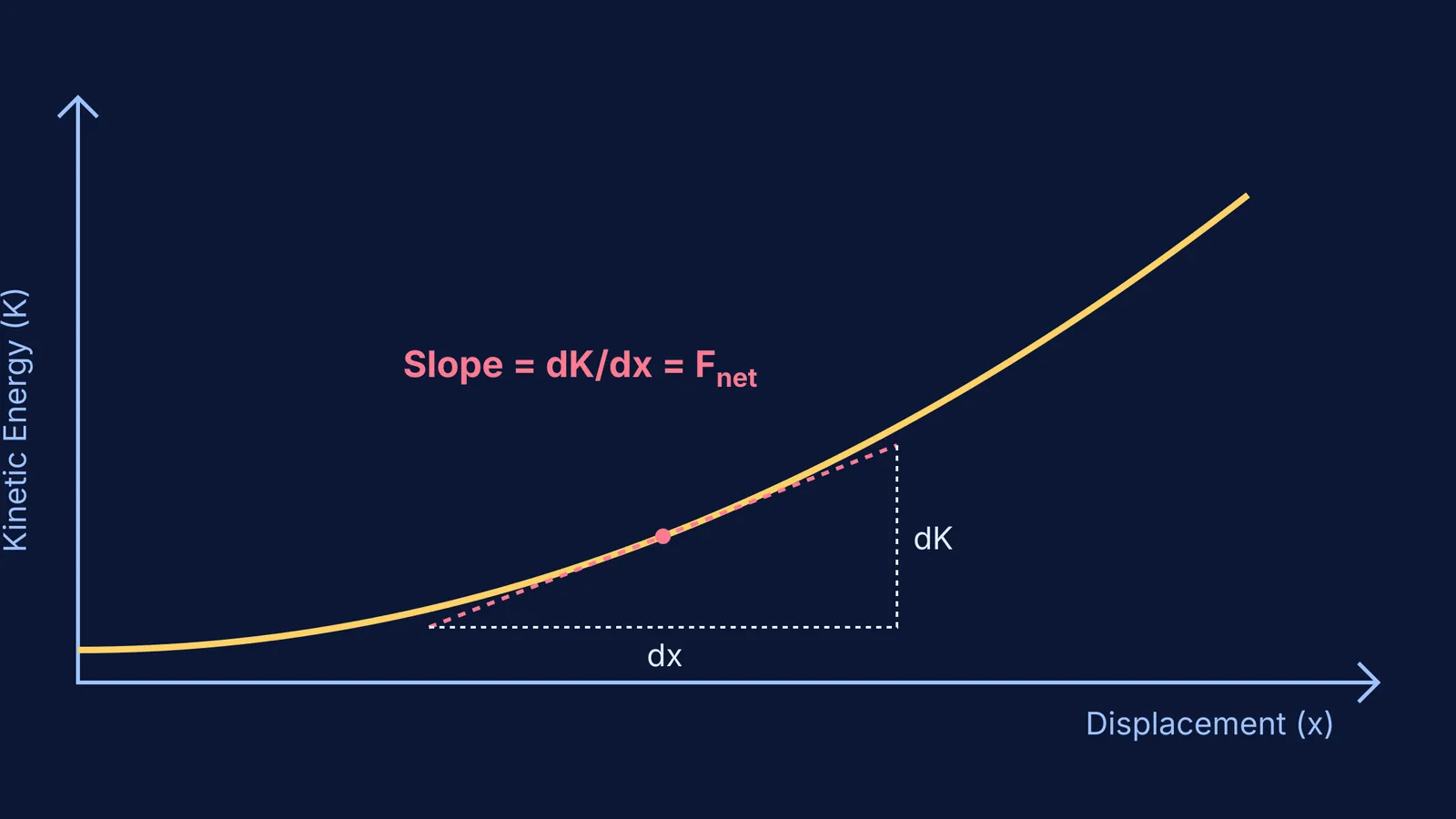
Often in JEE Main and NEET physics, a question provides a graph of an object's kinetic energy (K) plotted against its displacement (x) and asks you to find the force or acceleration at a certain point. While you could try to extract velocities and use kinematic equations, the fastest way is to read the slope directly.
Because of the work-energy theorem, the slope of a K-x graph is exactly equal to the net force acting on the object.
What is the calculus behind the rule?
The work-energy theorem states that the net work done on a system equals its change in kinetic energy (ΔK), according to *University Physics Volume 1* (OpenStax). For a force that varies with position, the work done is the integral of the net force (F_net) over the displacement:
W = ∫ F_net dx = ΔK
By taking the derivative of both sides with respect to position (x), we reverse the integral. This gives us the rate of change of kinetic energy:
dK/dx = F_net
In calculus terms, dK/dx is the slope of the tangent line on a K-x graph. Therefore, the slope at any given displacement tells you the instantaneous net force at that point.
How do you read a kinetic energy vs displacement graph?
When you look at a K-x graph, the shape of the curve tells you immediately what kind of force is acting on the object:
Positive constant slope (a straight line slanting up): The net force is positive and constant. The object is accelerating steadily.
Zero slope (a horizontal line): The net force is zero. The kinetic energy is not changing, which means the object is moving at a constant speed.
Negative slope (a straight line slanting down): The net force is negative. The force opposes the motion, slowing the object down.
A curve (changing slope): The net force is variable. For example, a spring force F = -kx changes with displacement, which produces a parabolic K-x curve.
How do you find acceleration from the slope?
Once you know the net force from the slope, finding the object's acceleration is a single step. Newton's second law tells us that F_net = ma. Therefore, the acceleration (a) is simply the slope divided by the object's mass:
a = (dK/dx) / m
For example, if the tangent to a K-x graph has a slope of 20 J/m and the object has a mass of 4 kg, the net force is 20 N and the acceleration is 5 m/s².
How do you solve a changing force problem step by step?
When the force is not constant, the graph forms a curve. Let us walk through a typical problem where you must find the acceleration at a specific point.
Suppose a 2 kg block's kinetic energy is given by a curve. You draw a tangent at x = 3 m and find it passes through two points: (1 m, 10 J) and (5 m, 50 J). The question asks for the acceleration at x = 3 m.
First, you need to find the net force, which is the slope of the tangent line at that exact displacement.
The slope along the tangent line is the change in kinetic energy divided by the change in displacement (ΔK/Δx):
Slope = (50 J - 10 J) / (5 m - 1 m) = 40 J / 4 m = 10 J/m.
Because the slope of the K-x graph equals the net force, F_net = 10 N.
Finally, divide the net force by the object's mass to find acceleration:
a = F_net / m = 10 N / 2 kg = 5 m/s².
This method is much faster than attempting to find a function for the velocity and differentiating it. By reading the tangent directly, you bypass the kinematic equations entirely and jump straight to the force.
What should you do when you get stuck on graphical problems?
Graphs in mechanics often combine concepts from kinematics, Newton's laws, and work-energy. If you are not sure whether to look at the area under the curve or the slope, it helps to check the dimensions: dividing the y-axis unit (Joules) by the x-axis unit (metres) gives Joules per metre, which is equivalent to Newtons (force).
If you want to master how these physical quantities connect, the Fermi Concept Library maps out the relationships between work, energy, and force. When you are ready to test your understanding on actual exam questions, the Fermi Problem Library provides a step-by-step solver that explains the reasoning behind reading graphs, rather than just printing an answer.


