

On this page
The formula C5H10O2 is a classic organic chemistry puzzle. Because its hydrogen count is exactly double its carbon count (minus the oxygens), it has a "degree of unsaturation" of 1. This means it has exactly one double bond or one ring in its structure. In exam questions, this almost always points to compounds with a carbonyl group (C=O)—specifically carboxylic acids and esters.
So, how many isomers of C5H10O2 are there? If you stick to carboxylic acids and esters, there are 13 structural isomers. Let's break down how to find the four acids and nine esters, and how a systematic approach stops you from missing any during a test.
What are the 4 carboxylic acid isomers?
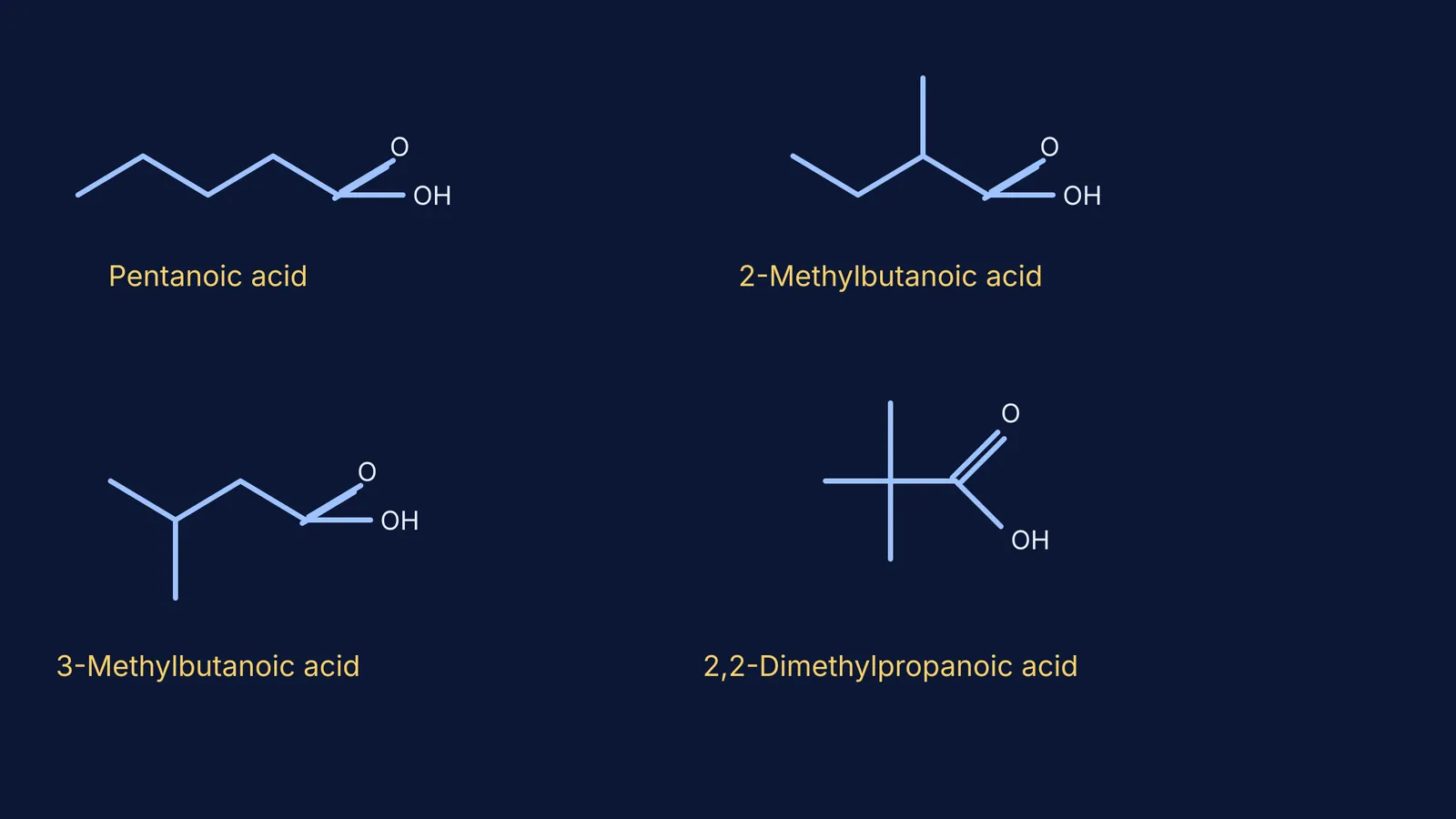
Carboxylic acids end with a –COOH group. This uses up one carbon, leaving four carbons to form an alkyl chain. Finding the acid isomers is just a matter of drawing all the possible arrangements of a four-carbon chain (a butyl group):
Pentanoic acid (Valeric acid): A straight chain of all five carbons.
2-Methylbutanoic acid: A four-carbon chain with a methyl branch on the second carbon.
3-Methylbutanoic acid (Isovaleric acid): A four-carbon chain with a methyl branch on the third carbon.
2,2-Dimethylpropanoic acid (Pivalic acid): A three-carbon main chain with two methyl groups on the second carbon.
If you want to check whether you have named these correctly or drawn their skeletal structures right, the Fermi Problem Library has worked problems with a step-by-step solver that explains the reasoning rather than printing an answer.
How many ester isomers does C5H10O2 form?
Esters have the general formula R–COO–R'. To find all nine isomers, you have to split the five available carbons between the acid part (R, which includes the carbonyl carbon) and the alcohol part (R').
Here is the step-by-step breakdown of the 9 esters:
1. Formates (1 carbon in the acid part, 4 in the alcohol part) If the acid part is a formate (methanoate, H–COO–), the remaining four carbons form a butyl group. Since a butyl group has four distinct structural isomers, there are four formate esters:
Butyl methanoate
sec-Butyl methanoate
Isobutyl methanoate
tert-Butyl methanoate
2. Acetates (2 carbons in the acid part, 3 in the alcohol part) If the acid part is an acetate (ethanoate, CH3–COO–), the remaining three carbons form a propyl group. A propyl group has two distinct structural isomers (propyl and isopropyl), giving two acetate esters:
Propyl ethanoate
Isopropyl ethanoate
3. Propionates (3 carbons in the acid part, 2 in the alcohol part) If the acid part is a propionate (propanoate, CH3CH2–COO–), the alcohol part must be an ethyl group (two carbons). The ethyl group has only one shape, giving one propionate ester:
Ethyl propanoate
4. Butyrates (4 carbons in the acid part, 1 in the alcohol part) If the acid part is a butyrate (butanoate), it has four carbons. A four-carbon acid has two branched forms (as we saw earlier with the acids), and the alcohol part is just a methyl group (one carbon). This gives two butyrate esters:
Methyl butanoate
Methyl 2-methylpropanoate
Do stereoisomers increase the count?
The number 13 refers strictly to the structural isomers. However, if an exam question asks for the total number of isomers including stereoisomers, you have to look for chiral centres. A chiral carbon is attached to four different groups.
In this set, two molecules have chiral centres:
2-Methylbutanoic acid has a chiral centre at the second carbon.
sec-Butyl methanoate (1-methylpropyl methanoate) has a chiral centre on the alcohol's carbon chain.
Because each of these can exist as two enantiomers (mirror images), counting stereoisomers brings the total number of carboxylic acid and ester isomers for C5H10O2 to 15.
A checklist for drawing isomers
When you face an isomer question in an exam, do not draw structures at random. Use this systematic method to ensure you find every single one:
Count the DBE: Calculate the Double Bond Equivalent to confirm what functional groups are possible. For C5H10O2, DBE = 1.
Isolate the functional group: Write down the –COOH or –COO– group first, so you know exactly how many carbons are left to work with.
Count the leftovers: See how many carbons are left to form alkyl groups.
Use standard alkyl branches: Memorise that propyl has 2 isomers and butyl has 4. This immediately tells you how many esters you will get for each split.
If you struggle with the nomenclature of branched chains, understanding IUPAC Numbering for Enynes: Resolving Double and Triple Bond Ties or the IUPAC Rules for Naming Symmetric and Mixed Acid Anhydrides will strengthen your grasp of the basic rules. By treating isomer problems as a logic puzzle rather than a memory test, you will start getting them right every time.


