

On this page
How many structural isomers exist for C4H8Cl2?
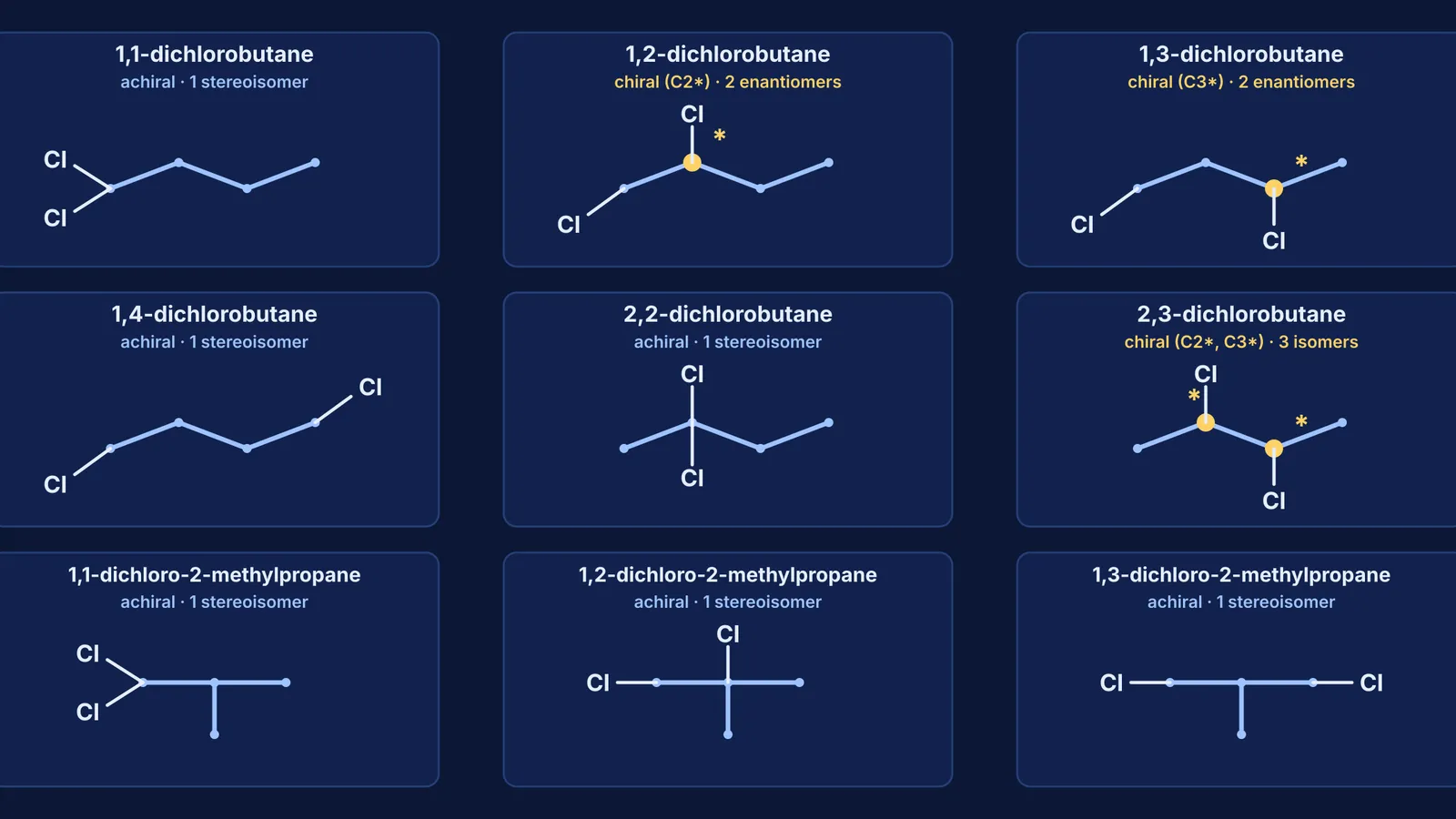
For the molecular formula C4H8Cl2, exactly 9 structural isomers exist. As detailed in Wikipedia's isomer reference, structural or constitutional isomers share identical molecular formulas but differ in atom connectivity. When you replace two hydrogen atoms of butane with two chlorine atoms, the resulting dichlorides fall into two distinct carbon frameworks: 6 straight-chain dichlorobutanes and 3 branched dichloro-2-methylpropanes.
A common pitfall in competitive examinations like JEE Main and NEET-UG is confusing structural isomers with total stereoisomers. While there are 9 constitutional connectivity patterns, chiral carbons within several isomers increase the total count of distinct molecules to 13. The Fermi Problem Library offers worked problems with a step-by-step solver that explains the reasoning rather than printing an answer, helping students avoid skipping branched frameworks or conflating constitutional forms with enantiomers.
Why does the butane skeleton produce six isomers?
To count constitutional isomers systematically, begin by calculating the degree of unsaturation. For C4H8Cl2, the degree of unsaturation is 4 + 1 − (8 + 2)/2 = 0, proving every isomer is an open-chain, fully saturated alkane skeleton.
The four-carbon linear backbone yields 6 positional isomers:
1,1-dichlorobutane: both chlorines attach to carbon 1 (CH3-CH2-CH2-CHCl2), forming a geminal dichloride.
1,2-dichlorobutane: chlorines occupy adjacent carbons 1 and 2 (CH3-CH2-CH(Cl)-CH2Cl), forming a vicinal dichloride.
1,3-dichlorobutane: chlorines attach at carbons 1 and 3 (CH3-CH(Cl)-CH2-CH2Cl).
1,4-dichlorobutane: chlorines attach to terminal carbons 1 and 4 (ClCH2-CH2-CH2-CH2Cl). In industrial chemistry, 1,4-dichlorobutane is a known precursor for adiponitrile in nylon 6,6 production.
2,2-dichlorobutane: both chlorines attach to carbon 2 (CH3-CH2-CCl2-CH3), giving a second geminal isomer.
2,3-dichlorobutane: chlorines bind to internal carbons 2 and 3 (CH3-CH(Cl)-CH(Cl)-CH3).
A laboratory study by Perry C. Reeves in the *Journal of Chemical Education* isolated the constitutional isomers formed during the chlorination of 1-chlorobutane, confirming substitution across all four positions. For broader chain variations, see our guide to counting monochlorination products.
How do you find the three branched isomers?
Next, branch the skeleton into isobutane (2-methylpropane), where three equivalent methyl groups attach to a central carbon. Because carbon 2 holds only one hydrogen atom, it can accept at most one chlorine substituent. Therefore, 2,2-dichloro-2-methylpropane cannot exist.
Distributing two chlorines across this branched skeleton yields 3 constitutional isomers:
1,1-dichloro-2-methylpropane: both chlorines bind to one terminal methyl carbon ((CH3)2CH-CHCl2).
1,2-dichloro-2-methylpropane: one chlorine attaches to a methyl group and the second to the central carbon ((CH3)2C(Cl)-CH2Cl).
1,3-dichloro-2-methylpropane: chlorines attach to two different terminal methyl groups (ClCH2-CH(CH3)-CH2Cl).
Together with the 6 straight-chain dichlorobutanes, these 3 branched structures bring the constitutional isomer count of C4H8Cl2 to exactly 9.
Which isomers of C4H8Cl2 are chiral?
According to Wikipedia's chirality guide), a carbon is a chiral centre when bonded to four distinct groups, rendering the molecule non-superimposable on its mirror image. Among the 9 structural isomers of C4H8Cl2, exactly three contain chiral centres:
1,2-dichlorobutane: carbon 2 bonds to -H, -Cl, -CH2Cl, and -CH2CH3. Having four different groups, carbon 2 is chiral.
1,3-dichlorobutane: carbon 3 bonds to -H, -Cl, -CH3, and -CH2CH2Cl. All four ligands differ, making carbon 3 chiral.
2,3-dichlorobutane: both carbon 2 and carbon 3 bond to -H, -Cl, -CH3, and -CH(Cl)CH3. Thus, 2,3-dichlorobutane possesses two stereocentres.
None of the three branched isomers are chiral. In 1,1-dichloro-2-methylpropane and 1,2-dichloro-2-methylpropane, carbon 2 holds two identical methyl groups. In 1,3-dichloro-2-methylpropane, carbon 2 holds two identical chloromethyl groups. When visualizing three-dimensional molecular configurations or checking for mirror planes, Fermi's AI tutor can write on a board, draw the figure, and check understanding as it goes.
How do stereoisomers raise the total count to 13?
When questions ask for total isomers including stereoisomers, chiral structures expand into their optical forms. As detailed in Wikipedia's enantiomer overview, molecules with one chiral centre exist as a pair of non-superimposable mirror images called enantiomers. Thus, 1,2-dichlorobutane and 1,3-dichlorobutane each contribute 2 enantiomers: (R) and (S).
The stereochemistry of 2,3-dichlorobutane depends on symmetry. As described in Wikipedia's meso compound overview, molecules with two identical stereocentres produce both chiral enantiomers and an achiral meso form. In a 1941 paper in the *Journal of the American Chemical Society*, Lucas and Gould demonstrated that 2,3-dichlorobutane yields an optically active (2R,3R) and (2S,3S) pair alongside an optically inactive (2R,3S) meso isomer containing an internal plane of symmetry. This yields 3 stereoisomers for 2,3-dichlorobutane.
Summing all configurations gives:
6 achiral structural isomers (1,1-; 1,4-; 2,2-dichlorobutane; and the 3 branched isomers)
4 enantiomers from the single-centre isomers (2 from 1,2-dichlorobutane and 2 from 1,3-dichlorobutane)
3 stereoisomers from 2,3-dichlorobutane (2 enantiomers plus 1 meso compound)
This results in 6 + 4 + 3 = 13 total stereoisomers. Exactly 6 are chiral (optically active) and 7 are achiral. Because enantiomeric pairs share identical boiling points, fractional distillation yields 10 distinct fractions. For more on stereocentres, read our guides on counting stereoisomers from chiral centres and stereoisomerism step by step. To see how functional groups fit into broader mechanisms, the Fermi Concept Library catalogs every concept in chemistry with its place in the map.


