

On this page
If you hand a young child a box of crayons and ask them to draw the Sun, they will reach for the yellow one. But if you ask an astronaut on the International Space Station what colour the Sun is, they will tell you it is a brilliant, blinding white.
The difference is the layer of air between us and space. Here is why our atmosphere paints our star yellow, and what happens to the missing colours.
What colour is the Sun in space?
In the vacuum of space, there is no air to filter or bend light. The Sun emits electromagnetic radiation across all visible wavelengths, from red to violet. When all these colours of light are combined, the human eye perceives them as pure white.
Astronomers classify the Sun as a "yellow dwarf" (a G2V star), but this is a scientific label based on its temperature, not a description of how it looks to the eye (NASA). In fact, the Sun's energy output actually peaks in the blue-green part of the spectrum. At the top of the atmosphere, this intense white sunlight delivers a total solar irradiance of about 1,361 W/m² (Wikipedia).
Why does sunlight look yellow on Earth?
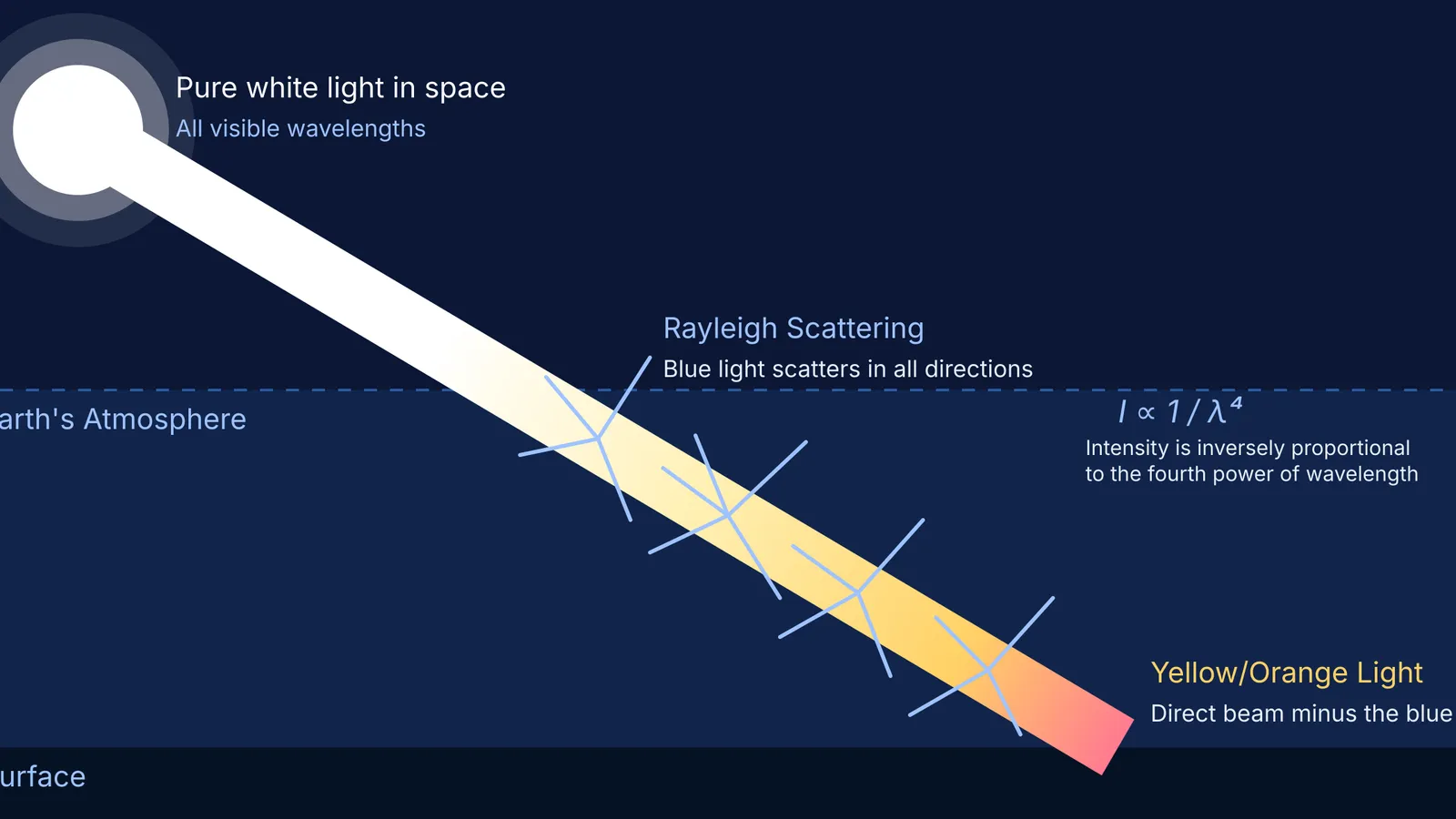
The colour shift happens when sunlight hits Earth's atmosphere, which is packed with nitrogen and oxygen molecules. These molecules are much smaller than the wavelength of visible light, leading to a phenomenon called Rayleigh scattering.
According to the physics of Rayleigh scattering, the intensity of scattered light (I) is inversely proportional to the fourth power of the wavelength (λ), written as I ∝ 1/λ⁴ (Wikipedia). This means shorter wavelengths, like blue and violet, are scattered much more strongly than longer ones. Understanding this wavelength dependence is a core part of optics, much like understanding what happens to speed, wavelength and frequency when light enters glass.
At the top of the atmosphere, sunlight is about 30% more intense than at the surface (Wikipedia). Because blue light (around 450 nm) has a much shorter wavelength than red light (around 650 nm), it is scattered more than four times as efficiently. As a large percentage of the blue light is scattered in all directions to create our blue sky, the direct beam of sunlight that reaches your eyes is depleted of blue. When you subtract blue from white light, the remaining mix of wavelengths appears yellow or warm.
Why do sunsets turn red?
This scattering effect depends on how much air the light has to travel through. At noon, the Sun is high and the light takes the shortest path through the atmosphere. But at sunrise or sunset, the Sun is low on the horizon, and its light must pass through a much thicker layer of air.
By the time the beam reaches you, almost all of the blue and green light has been scattered away, leaving only the longest wavelengths. This is why the Sun and the surrounding sky glow in vivid shades of orange and red. The atmosphere does more than just scatter light at this angle; it also bends it, which is the same reason behind atmospheric refraction and why stars twinkle.
Try this: the milk-water sunset
You can recreate this atmospheric scattering at home to see the colour shift yourself.
Fill a clear glass with water and shine a bright white LED torch through it. The water looks clear, and the light on the wall behind it is white.
Add just one or two drops of milk and stir. The milk particles act like the molecules in our atmosphere.
Look at the glass from the side: the water will have a faint bluish glow, because the milk particles are scattering the blue light.
Look at the light hitting the wall (the direct beam): it will have shifted to a warm yellow or pale orange.
By adding more milk, you simulate a thicker atmosphere—just like a sunset—and the direct beam on the wall will turn deeper red. If you want to explore the mathematical side of optics and wave behaviour, you can set up interactive experiments in the Fermi Simulation Lab. Seeing a physics concept in motion is one of the most effective ways to make the theory stick.


