

On this page
If you look at the first page of a CBSE mathematics exam paper, you will likely see a familiar instruction: *"Take π = 22/7 wherever required if not stated."* Because students use this fraction so often to find the area and circumference of circles, it is easy to assume they are exactly the same number.
They are not.
The number π is an irrational number, which means it cannot be written as a simple fraction of two integers. Its decimal digits (3.14159265…) continue forever without settling into a repeating pattern. The fraction 22/7, on the other hand, is a rational number. If you divide 22 by 7, the result is a repeating decimal: 3.142857142857…
Where does the 22/7 fraction come from?
The fraction 22/7 has been used as a stand-in for π since the 3rd century BCE, when the Greek mathematician Archimedes calculated the bounds of the number using a method of exhaustion.
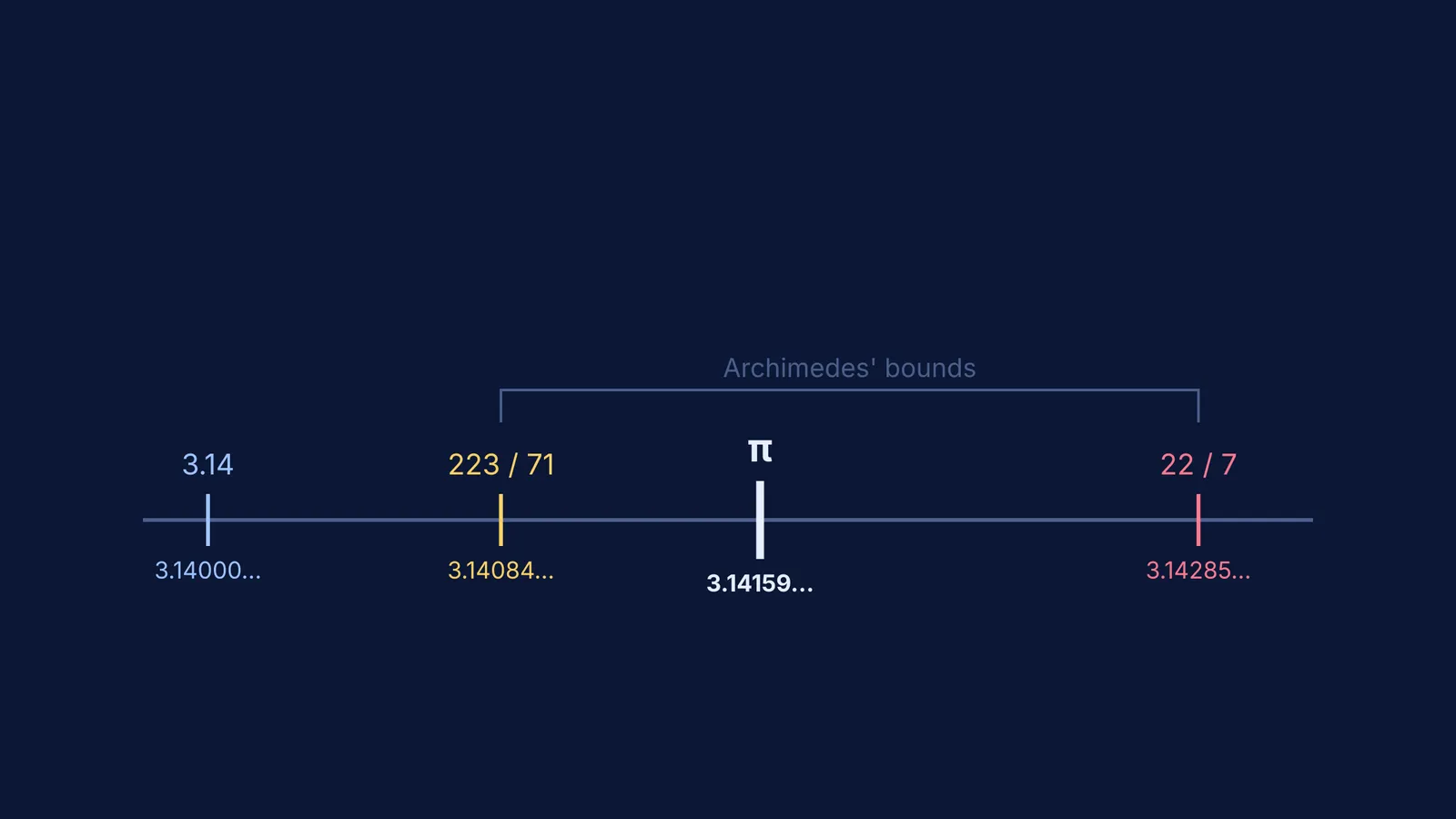
Archimedes knew that the circumference of a circle is shorter than the perimeter of a polygon drawn around it, but longer than the perimeter of a polygon drawn inside it. According to MathWorld, by calculating the perimeters of 96-sided polygons, he proved that π must lie between 223/71 (about 3.1408) and 22/7 (about 3.1429). He presented 22/7 as a strict upper bound, not an exact value.
If you want to trace the history of how mathematicians refined these bounds across centuries, you can read more in our posts about Liu Hui and how doubling a polygon's sides closes in on pi and Aryabhata's Aryabhatiya: place value, pi and a spinning Earth.
Is 22/7 or 3.14 more accurate?
Both 3.14 and 22/7 are approximations, but they differ slightly in their accuracy:
The true value of π begins 3.14159…
The decimal 3.14 is off by about 0.00159.
The fraction 22/7 (3.14285…) is off by about 0.00126.
This means that 22/7 is actually closer to the true value of π than 3.14 is. As detailed on MathWorld, the error in using 22/7 is roughly +0.04%, which is more than accurate enough for school geometry problems.
If you are stuck on a geometry problem or unsure how to simplify your calculations, the Fermi Problem Library has worked problems with a step-by-step solver that explains the reasoning rather than printing an answer.
How many decimals of pi do you really need?
While supercomputers have calculated π to trillions of digits, real-world physics does not require them. According to Marc Rayman, the director and chief engineer for NASA's Dawn mission, NASA's Jet Propulsion Laboratory uses just 15 decimal places for its highest-accuracy interplanetary navigation.
To understand why, consider Voyager 1, the most distant human-made object. If you used 15 digits of π to calculate the circumference of a circle with a radius equal to Voyager's distance from Earth, your answer would be wrong by just 1.5 centimetres. For a circle the size of the Earth, the error would be the size of a molecule. You do not need infinite decimals to build spacecraft.
How should you choose between 22/7 and 3.14?
When a question does not force your hand, choosing the right approximation saves time (especially in exams where calculators are banned). If you want to explore the properties of circles in more depth, the Fermi Concept Library contains every concept in mathematics mapped out with its own lesson.
Here is a quick framework for deciding which value to use:
Use 22/7 when the radius or diameter is a multiple of 7 (such as 7, 14, 21, or 3.5). The 7 in the denominator will cancel out immediately, leaving you with simple integer multiplication.
Use 3.14 when the radius or diameter is a multiple of 10 or 100 (such as 10, 20, 100). Moving the decimal point is faster than multiplying by 22 and dividing by 7.
Leave it as π when the question asks for an exact answer, or if you are in the middle steps of a long algebra problem. Only plug in the numbers at the very end.


