

On this page
How do you evaluate the integral of tan cubed x sec squared x?
To find the indefinite integral ∫ tan³ x sec² x dx, the fastest method is integration by substitution. According to Section 7.3.1 of the NCERT Class 12 Mathematics textbook, the substitution method succeeds whenever an integrand contains a function alongside its exact derivative.
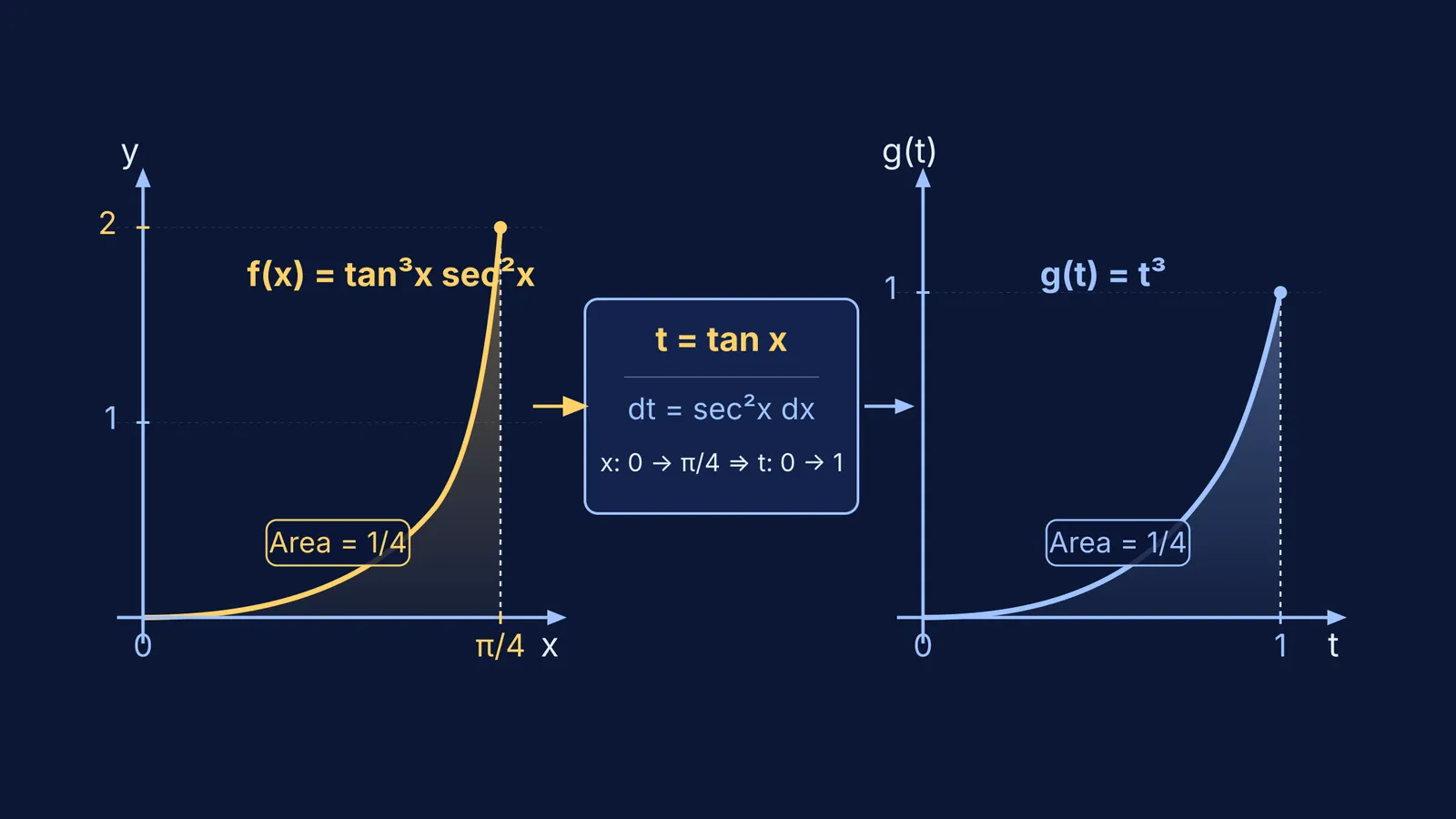
Because the derivative of the tangent function is sec² x, the factor sec² x dx acts directly as the differential of tan x. Setting up the substitution requires four steps:
Identify the base function: let t = tan x.
Differentiate both sides: dt = sec² x dx.
Rewrite the integral in terms of t: ∫ tan³ x sec² x dx = ∫ t³ dt.
Integrate using the standard power rule: ∫ t³ dt = (1/4) t⁴ + C.
Substituting t = tan x back into the antiderivative gives the final solution:
(1/4) tan⁴ x + C
This approach requires no trigonometric identities. The factor sec² x dx is absorbed into dt, leaving only an elementary cubic polynomial to integrate.
What happens if you substitute u = sec x instead?
Many students preparing for competitive entrance tests like JEE Main hesitate when they see an odd exponent on tangent. Standard integration guidelines often teach students to reserve a factor of sec x tan x whenever tangent has an odd power.
As documented in OpenStax Calculus Volume 2 Section 3.2, setting u = sec x is also a valid pathway whenever the power of tangent is odd and secant appears to a power of at least 1. To follow this route, factor out one secant and one tangent:
tan³ x sec² x dx = tan² x · sec x · (sec x tan x) dx
To express the integrand in terms of sec x, convert the remaining even power of tangent using the Pythagorean identity tan² x = sec² x − 1:
tan³ x sec² x dx = (sec² x − 1) · sec x · (sec x tan x) dx
Now carry out the substitution:
Let u = sec x.
Differentiate: du = sec x tan x dx.
Substitute u and du into the integral: ∫ (u² − 1) · u du = ∫ (u³ − u) du.
Integrate term by term: (1/4) u⁴ − (1/2) u² + C₁.
Replacing u with sec x produces the alternative antiderivative:
(1/4) sec⁴ x − (1/2) sec² x + C₁
Why do the two antiderivatives look completely different?
In competitive multiple-choice exams, finding that your working produces an expression different from the answer key is a common source of panic. However, indefinite integrals define a family of curves that share identical slopes everywhere. As a result, two valid antiderivatives of the same continuous function differ only by an arbitrary constant. For a broader explanation of this phenomenon, see why two answers to an integral look different.
To prove that (1/4) sec⁴ x − (1/2) sec² x is mathematically equivalent to (1/4) tan⁴ x, substitute the trigonometric identity sec² x = 1 + tan² x into the secant antiderivative:
(1/4) sec⁴ x − (1/2) sec² x = (1/4)(1 + tan² x)² − (1/2)(1 + tan² x)
Expand the squared binomial:
(1/4)(1 + 2 tan² x + tan⁴ x) − (1/2) − (1/2) tan² x
Distribute the fractions across the expressions:
(1/4) + (1/2) tan² x + (1/4) tan⁴ x − (1/2) − (1/2) tan² x
The middle terms (1/2) tan² x cancel each other out:
(1/4) tan⁴ x + (1/4 − 1/2) = (1/4) tan⁴ x − 1/4
Adding the constant of integration C₁ yields:
(1/4) sec⁴ x − (1/2) sec² x + C₁ = (1/4) tan⁴ x + (C₁ − 1/4)
Setting C = C₁ − 1/4 shows that both expressions represent the exact same curve shifted along the vertical axis. If you ever want to check an antiderivative during practice, you can differentiate the result back to the integrand, as outlined in how to check integration and differentiation answers fast.
When should you substitute tan x versus sec x?
Trigonometric integrals involving products of powers of tangent and secant follow a structured decision tree. According to Paul's Online Math Notes, you can choose the optimal substitution for any integral of the form ∫ tanᵐ x secⁿ x dx using these rules:
Even power of secant (n is even and positive): Strip off sec² x dx to serve as dt, convert any remaining secant factors to tangents using sec² x = 1 + tan² x, and substitute t = tan x.
Odd power of tangent (m is odd and positive): Strip off sec x tan x dx to serve as du, convert remaining tangent factors to secants using tan² x = sec² x − 1, and substitute u = sec x.
Overlap case (m is odd and n is even): Both substitutions work. Choosing t = tan x requires far less algebraic manipulation because reserving sec² x dx leaves no remaining secant factors to convert.
Even power of tangent with odd power of secant: Neither direct substitution works. Convert even powers of tangent into secants and apply integration by parts, as demonstrated in the integral of sec³x.
When practicing multi-step calculus problems, the Fermi Problem Library provides worked problems with a step-by-step solver that explains the reasoning rather than printing an answer. For a broader conceptual view of how substitution connects differential and integral calculus, explore the Fermi Concept Library. If you find yourself getting stuck between conflicting trigonometric identities, Fermi's AI tutor notices where a student is stuck and decides whether to explain, ask, or show, ensuring you build confidence before exam day.


