

On this page
A calculus answer can be wrong even when you know the method. In a 2017 study, Voon Li Li, Nor Hazizah Julaihi and Tang Howe Eng examined errors in the integral calculus work of 70 diploma students, and traced some to confusion between differentiation and integration and others to poor mathematical skills and carelessness (Asian Journal of University Education, 2017).
Calculus has built-in tests that are faster than redoing the question. Here are three, each with a worked example.
How do you check an integration answer?
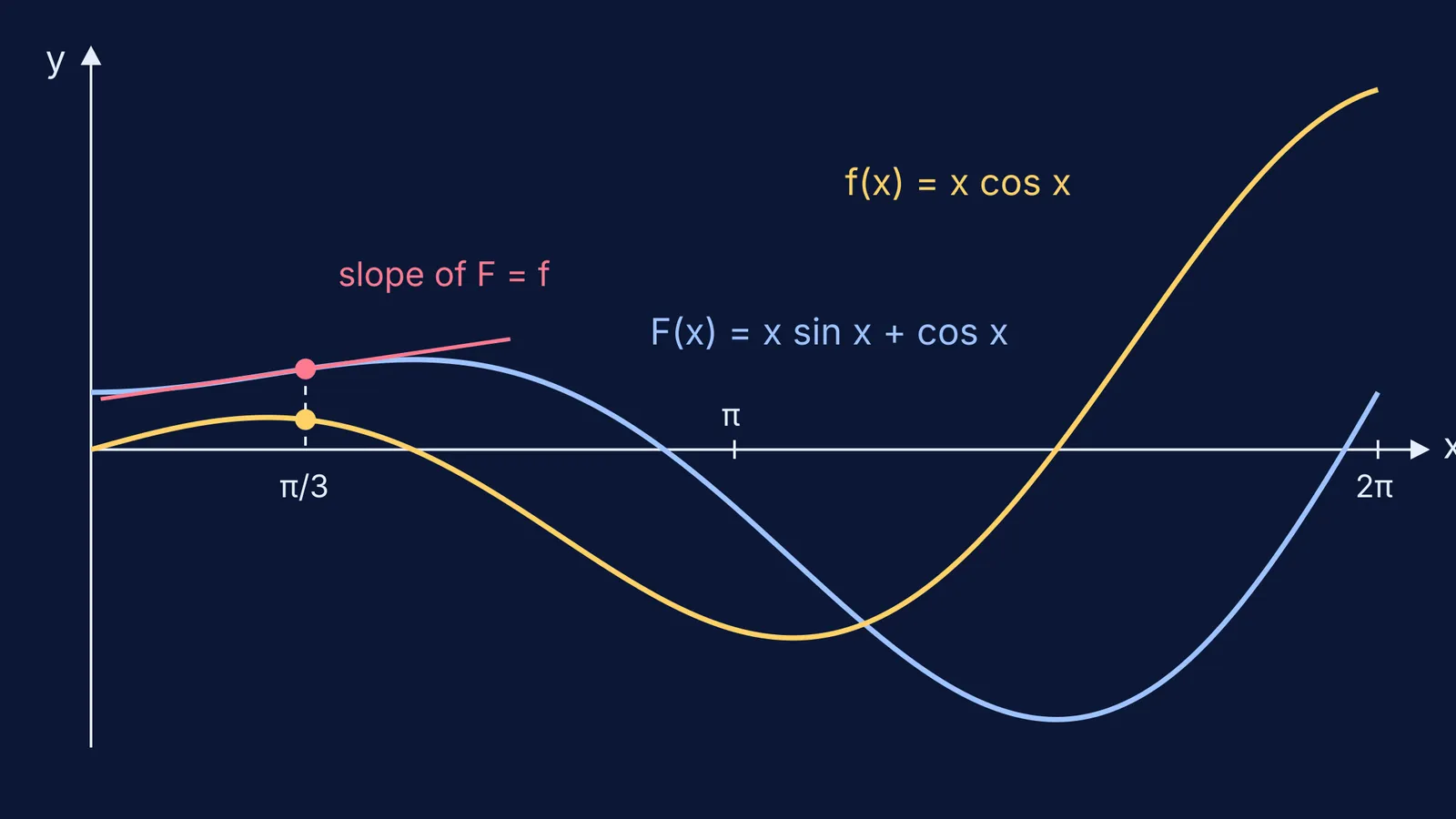
Differentiate it back. F is an antiderivative of f if F′(x) = f(x) for all x in the domain of f (OpenStax Calculus Volume 1, section 4.10). The same section says that whenever you claim ∫f(x)dx = F(x) + C, you should check it by verifying that F′(x) = f(x).
Worked example. Using integration by parts, you write ∫x cos x dx = x sin x − cos x + C. Now differentiate your answer:
d/dx (x sin x) = sin x + x cos x
d/dx (−cos x) = +sin x
Total: x cos x + 2 sin x
That is not x cos x. The extra 2 sin x points at the sign in front of cos x: the correct answer, x sin x + cos x + C, differentiates to exactly x cos x. If parts trips you up, see our guide to choosing the first function in integration by parts.
If the derivative is messy, put x = 1 into both F′(x) and f(x) instead of simplifying.
How do you check a derivative without redoing it?
Test a point. The derivative is the limit of a difference quotient, f′(a) = lim (h → 0) [f(a + h) − f(a)]/h, and the slopes of secant lines get closer to the slope of the tangent as h shrinks (OpenStax Calculus Volume 1, section 3.1). So a secant slope with a small h estimates your derivative.
Worked example. You differentiate y = x²/(1 + x) with the quotient rule and get (3x² + 2x)/(1 + x)². At x = 1 that gives 5/4 = 1.25. Now estimate the slope near x = 1 with h = 0.01 on each side:
y(1.01) = 1.0201/2.01 ≈ 0.50751
y(0.99) = 0.9801/1.99 ≈ 0.49251
slope ≈ (0.50751 − 0.49251)/0.02 = 0.750
0.75 is nowhere near 1.25. The slip is a sign in the numerator: the quotient rule gives [2x(1 + x) − x²]/(1 + x)² = (x² + 2x)/(1 + x)², which is 3/4 at x = 1.
This needs a calculator, so use it in practice. In a paper without one, pick a point where the function is clearly rising or falling and check the sign of your derivative there, or check a point where you know the tangent is flat.
How do you check a definite integral?
The limits. In a definite integral, changing the variable in the integrand changes the limits of integration as well (OpenStax Calculus Volume 1, section 5.5). Write them beside your substitution line. See also choosing the right t in integration by substitution.
The size and sign. If f(x) ≥ 0 on [a, b], then the integral from a to b is ≥ 0; and if m ≤ f(x) ≤ M on [a, b], the integral lies between m(b − a) and M(b − a) (OpenStax Calculus Volume 1, section 5.2).
Worked example. Integrate x/(1 + x²) from 0 to 1. Put u = 1 + x², so du = 2x dx and the limits become u = 1 to u = 2. The answer is ½ ln 2 ≈ 0.35. Suppose you dropped the ½ and wrote ln 2 ≈ 0.69. On [0, 1], x/(1 + x²) rises from 0 to ½, so the answer must lie between 0 and ½. 0.69 fails; 0.35 fits.
A quick checking routine for calculus exams
Indefinite integral: differentiate back, or compare F′ and f at x = 1.
Derivative: check the sign where the function clearly rises or falls; in practice, estimate the slope with h = 0.01.
Definite integral: confirm the limits changed with any substitution, then check the sign and the bounds.
Limit question: in practice, put in a value close to the point (x = 0.01 for a limit at 0) and compare.
If a check fails and the fix isn't obvious, mark the question and return later.
Run these on every practice question so they are automatic by exam day; our piece on Kahneman's fast and slow thinking and careless exam errors explains why a short, deliberate pause helps.
What if the same check keeps failing?
Then the problem is probably the method, not the arithmetic. The Fermi Problem Library has worked problems with a step-by-step solver that explains the reasoning rather than printing an answer, so you can find the step where yours went wrong. If the gap is the idea itself, the Fermi Concept Library has a lesson for every concept in mathematics.
Next time you finish an integral, spend one more line differentiating it back.


