

On this page
Integrating rational powers often leaves students stuck on the first line. The problem ∫ 1 / (√x + ∛x) dx looks deceptively simple, but standard substitution rules fail when you face two different root indices. This is a classic test of algebraic manipulation before any calculus can begin.
For Indian students, calculus holds the highest weightage in the CBSE Class 12 mathematics theory paper, accounting for 35 out of 80 marks (cbseacademic.nic.in). If you want to secure these marks for engineering entrances like JEE, mastering the trick of the Lowest Common Multiple (LCM) is essential to avoid dropping easy points.
Why do rational exponents make integration hard?
One of the most frequent mistakes students make when dealing with rational exponents is treating the differential dx as merely punctuation at the end of the integral. When you apply a substitution like x = t⁶, it is incredibly easy to simply swap out the denominator terms and forget to transform the dx into 6t⁵ dt.
Without that factor of 6t⁵, the integral incorrectly turns into ∫ 1 / (t³ + t²) dt. That mistake forces you into a completely different and far more tedious partial fraction decomposition, usually leading to a dead end during an exam under time pressure. Remember, every time you define a new variable t, you must immediately compute its derivative and replace dx.
How do you integrate 1 over square root x plus cube root x?
When you encounter multiple roots of the exact same variable, the goal is to find a single substitution that clears all fractions from the exponents simultaneously.
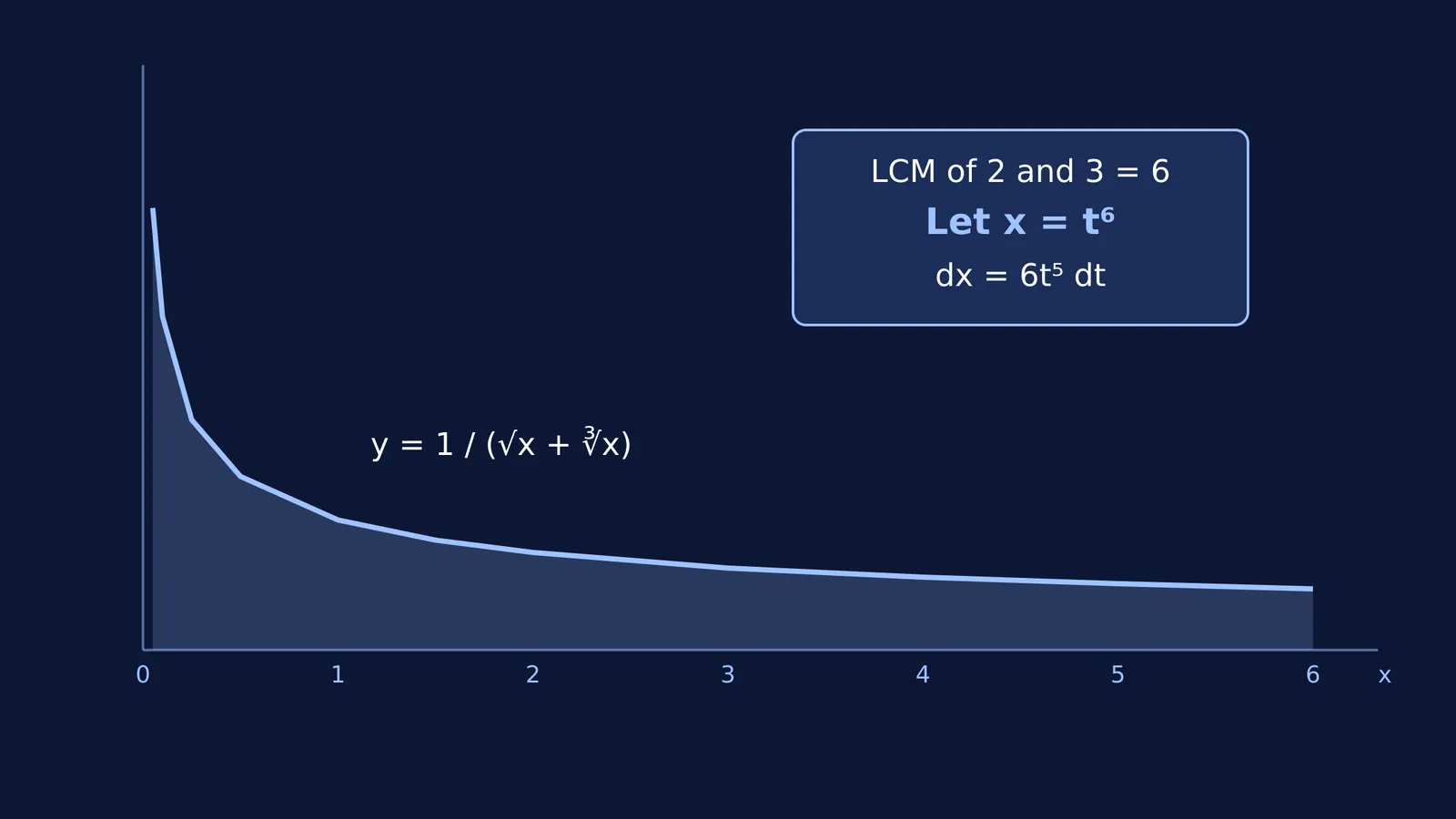
Find the LCM of the root indices: The expression has a square root (index 2) and a cube root (index 3). The lowest common multiple of 2 and 3 is 6.
Set up the substitution: Let x = t⁶.
Differentiate immediately: This gives dx = 6t⁵ dt.
Rewrite the roots: √x = (t⁶)^(1/2) = t³. And ∛x = (t⁶)^(1/3) = t².
Now, substitute everything into the original integral: ∫ 1 / (t³ + t²) × (6t⁵) dt
Factor out t² from the denominator: = ∫ (6t⁵) / [t²(t + 1)] dt
Cancel the t²: = ∫ 6t³ / (t + 1) dt
How do you tackle the polynomial division?
The hardest part is often what comes next. You now have an improper rational function where the numerator's degree (3) is higher than the denominator's (1). You cannot integrate an improper fraction directly using natural logarithms.
Polynomial division is a skill often learned in lower classes and then forgotten by the time calculus arrives. Algebraic long division will always work, but it consumes valuable minutes. This is why the "add and subtract a constant" trick is so powerful. By adding 1 and subtracting 1, you can force a cancellation: t³ = (t³ + 1) - 1
Since the sum of cubes (t³ + 1³) can be factored as (t + 1)(t² - t + 1), the fraction becomes: t³ / (t + 1) = [ (t + 1)(t² - t + 1) - 1 ] / (t + 1) = t² - t + 1 - 1 / (t + 1)
Multiply this entire expression by the 6 we pulled out earlier, and integrate term by term: 6 ∫ [ t² - t + 1 - 1 / (t + 1) ] dt = 6 [ (t³/3) - (t²/2) + t - ln|t + 1| ] + C = 2t³ - 3t² + 6t - 6 ln|t + 1| + C
Finally, substitute back t = x^(1/6): = 2(x^(1/6))³ - 3(x^(1/6))² + 6(x^(1/6)) - 6 ln|x^(1/6) + 1| + C = 2√x - 3∛x + 6x^(1/6) - 6 ln|x^(1/6) + 1| + C
This framework works for any combination of roots. For example, if you faced ∫ 1 / (x^(1/4) + x^(1/3)) dx, the LCM of 4 and 3 is 12, so you would substitute x = t¹².
How does Fermi help you spot the right substitution?
Knowing when to apply the LCM rule and when to rely on integration by parts takes practice. Rational integrals test your pattern recognition more than your memorisation of formulas. If you need to review the rules of integration, the Fermi Concept Library has every concept in physics, chemistry, biology, mathematics and computing, each with its own lesson and its place in the map.
For practice, the Fermi Problem Library has worked problems with a step-by-step solver that explains the reasoning rather than printing an answer. Instead of staring at a blank page, you can ask Fermi's AI tutor to help you build a plan for the session. The tutor works out what you already know and teaches through it—writing the algebra out clearly and checking your understanding of the substitution rules as it goes.
For more practice on choosing the right substitution variable, see our guide on integration by substitution: how to choose the right t. If you want to see how to handle boundaries once you have made your substitution, read about u-substitution with bounds: change the end points, skip going back.


