

On this page
The trick behind this integral takes one line: 1 + sin 2x is a perfect square. The easy mistake comes next, when you take the square root. Here is the method, a worked example and a quick check.
Why is 1 + sin 2x equal to (sin x + cos x)²?
Two Class 11 identities do all the work. NCERT's trigonometry chapter derives sin 2x = 2 sin x cos x as its identity 15, then rewrites it over cos²x + sin²x, which equals 1 (NCERT Class 11 Mathematics, Chapter 3, page 61).
Replace the 1 with sin²x + cos²x and the sin 2x with 2 sin x cos x:
1 + sin 2x = sin²x + cos²x + 2 sin x cos x = (sin x + cos x)²
The same move gives 1 − sin 2x = (sin x − cos x)².
What is the integral of root of 1 plus sin 2x?
The square root of a square is a modulus, not the original expression:
√(1 + sin 2x) = |sin x + cos x|
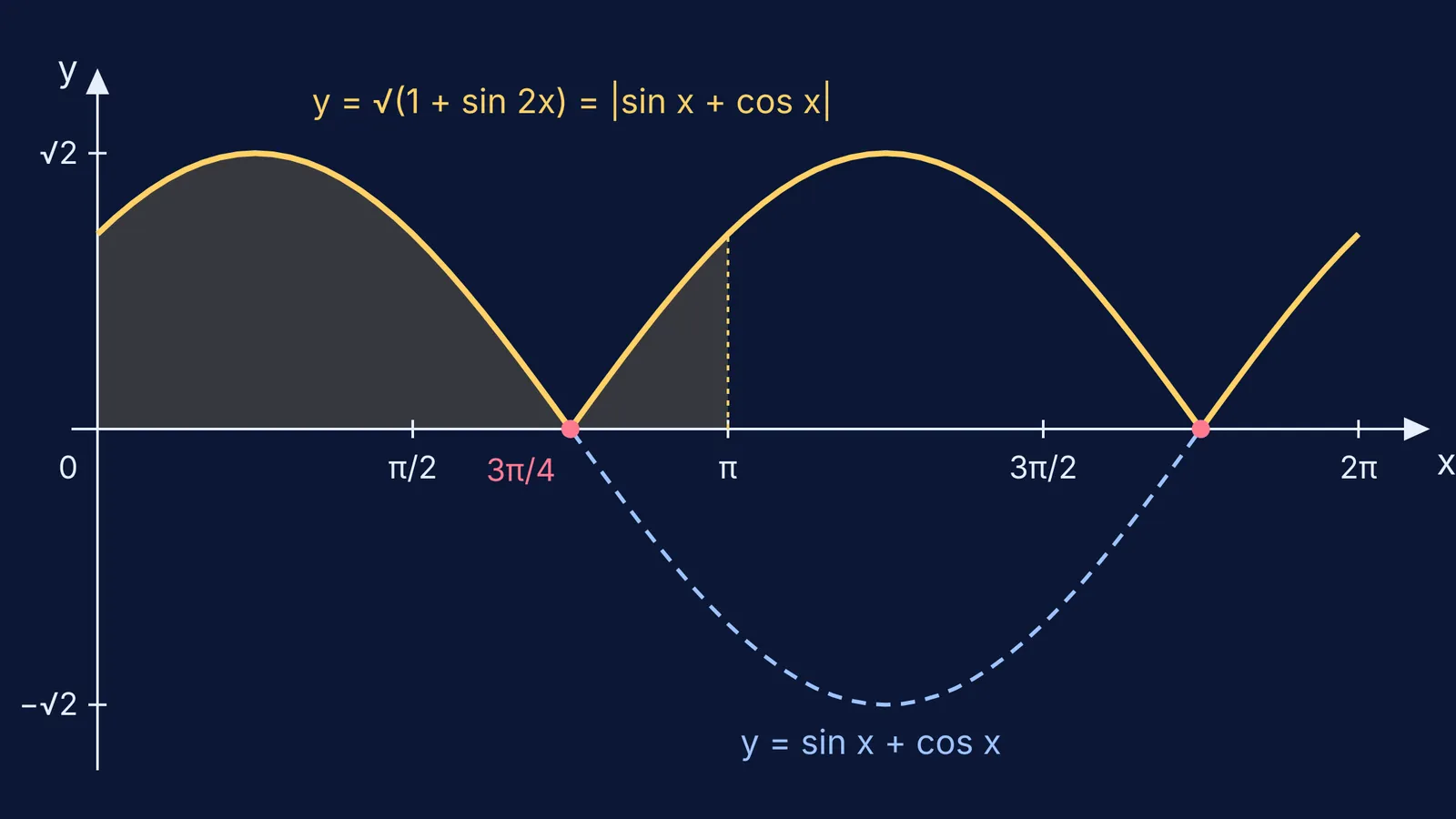
This is the step that is easiest to skip. Between 3π/4 and 7π/4, sin x + cos x is negative, but a square root never is.
To see exactly where the sign changes, use sin(x + y) = sin x cos y + cos x sin y (identity 7 in the same NCERT Class 11 chapter, page 59) with y = π/4. Since sin π/4 = cos π/4 = 1/√2, you get sin x + cos x = √2 sin(x + π/4). So sin x + cos x ≥ 0 from −π/4 to 3π/4, and on every copy of that interval shifted by a multiple of 2π. In between, it is negative.
So the indefinite integral comes in two pieces:
Where sin x + cos x ≥ 0: the integral of √(1 + sin 2x) is sin x − cos x + C
Where sin x + cos x < 0: the integral of √(1 + sin 2x) is cos x − sin x + C
Check by differentiating: the derivative of sin x − cos x is cos x + sin x.
How do you handle the modulus in a definite integral?
Split the interval at every point where the expression inside the modulus is zero. This uses the property that the integral from a to b equals the integral from a to c plus the integral from c to b. NCERT calls this P2 and proves it on page 274 of the Class 12 integrals chapter. The same chapter's Example 41 splits |x sin πx| at x = 1 in exactly this way (page 284), and Exercise 7.10 gives you three modulus integrals to practise on (page 280).
Worked example: evaluate the integral of √(1 + sin 2x) from 0 to π.
Rewrite: the integrand is |sin x + cos x|.
Find the sign change: sin x + cos x = 0 when tan x = −1, which in [0, π] means x = 3π/4.
Split: on [0, 3π/4] the expression is non-negative. On [3π/4, π] it is negative, so the modulus flips its sign.
First piece: [sin x − cos x] from 0 to 3π/4 = (√2) − (−1) = √2 + 1.
Second piece: [cos x − sin x] from 3π/4 to π = (−1) − (−√2) = √2 − 1.
Add: (√2 + 1) + (√2 − 1) = 2√2, about 2.83.
Now try it without the modulus, using sin x − cos x across the whole interval: (0 + 1) − (0 − 1) = 2. That answer is wrong: it subtracts the piece after 3π/4 instead of adding it.
What answers should you expect on common intervals?
From 0 to π/2: no sign change, so the answer is 2.
From 0 to π: one sign change at 3π/4, so the answer is 2√2.
From 0 to 2π: sign changes at 3π/4 and 7π/4, so the answer is 4√2. Ignoring the modulus gives 0.
That 0 is the giveaway. √(1 + sin 2x) is never negative and touches zero only at single points, so its integral from a smaller limit to a larger one must be positive.
A 30-second checklist for any √(1 ± sin 2x) question
Write 1 ± sin 2x as (sin x ± cos x)².
Replace the root with |sin x ± cos x|.
Find the zeros inside your limits: tan x = −1 for the plus sign, tan x = 1 for the minus sign.
Split the interval, flip the sign on each negative piece, and integrate.
Check that the answer is positive.
To practise the same move on other problems, the Fermi Problem Library has worked problems with a step-by-step solver that explains the reasoning rather than printing an answer. If the identities themselves feel shaky, the Fermi Concept Library gives each mathematics concept its own lesson, so you can go back to double-angle formulas before trying again.
Next time you see a square root over a trig expression, write the modulus down first.


